Last updated: August 16, 2026
Quick Answer: On August 13, 2026, Tether announced that KPMG US had completed a full financial statement audit of its reserves for the year ended December 31, 2025, issuing an unqualified opinion under AICPA standards and US GAAP. This marks the first time in Tether’s history that a Big Four accounting firm has audited the full balance sheet behind USDT, the world’s largest stablecoin. The audited financials confirmed that Tether’s reserve assets exceeded its liabilities by approximately $6.814 billion, with roughly $141 billion held in U.S. Treasury instruments. [1][2][3]
Key Takeaways
- Tether undergoes first full audit of stablecoin reserves by KPMG US, covering the complete financial statements for the year ended December 31, 2025.
- KPMG issued an unqualified (clean) audit opinion under AICPA standards and US GAAP, the highest standard of assurance available from an independent auditor. [1][2]
- Audited reserves exceeded outstanding USDT liabilities by approximately $6.814 billion as of December 31, 2025. [2][3]
- Tether held roughly $141 billion in U.S. Treasury instruments at year-end 2025, making it one of the largest single holders of U.S. government debt globally. [3][6]
- KPMG physically inspected and counted gold bars backing Tether’s gold-backed token (XAUT) as part of the audit process. [5]
- This audit goes far beyond Tether’s previous quarterly attestations, which only provided point-in-time snapshots rather than a full examination of transactions, systems, and counterparties. [1][2]
- The engagement was first publicly disclosed in March 2026; the completed audit opinion was formally announced on August 13, 2026. [2][6]
- Analysts view the audit as a positive transparency milestone but note that ongoing, preferably annual, audits will be needed to sustain investor confidence. [2][6]
- Regulatory fragmentation, particularly in the EU, may limit the immediate global impact of the audit despite the clean opinion. [3][6]
- The audit is expected to pressure other stablecoin issuers to raise their own transparency standards. [2][14]
What Is Tether and How Does It Work as a Stablecoin
Tether (USDT) is a fiat-collateralized stablecoin designed to maintain a 1:1 value with the U.S. dollar. It is issued by Tether International, S.A. de C.V. and operates across multiple blockchain networks, including Ethereum, Tron, and Solana.
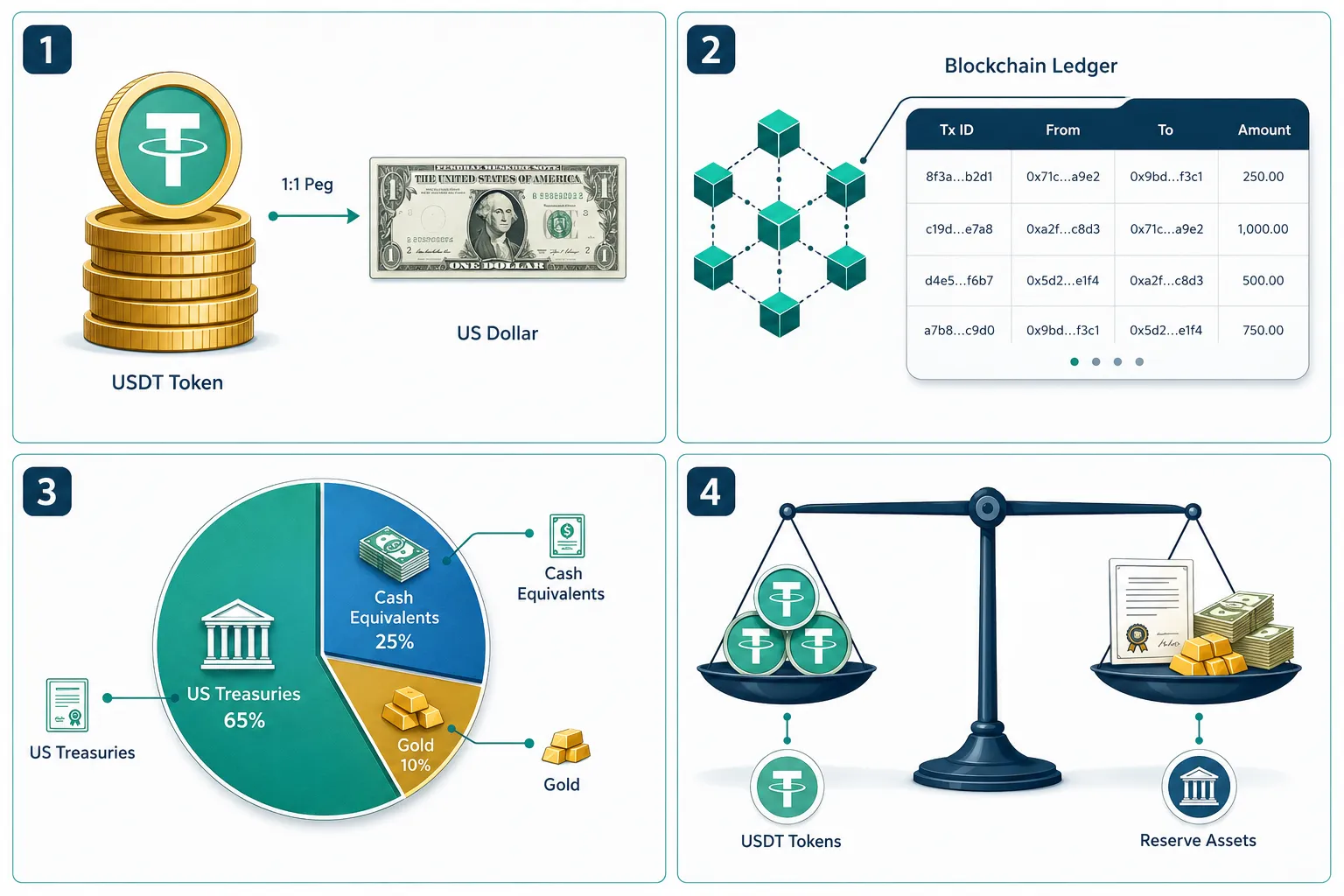
The basic mechanics work like this: when a user deposits one U.S. dollar (or equivalent assets), Tether mints one USDT token. When a user redeems, the token is burned and the underlying asset is returned. The peg holds as long as the issuer keeps sufficient reserve assets to cover every token in circulation.
- Market size: As of mid-2026, USDT has a market capitalization in the roughly $180-186 billion range, making it the dominant stablecoin by a wide margin. [2]
- Use cases: USDT is widely used for crypto trading pairs, cross-border payments, and as a dollar substitute in markets with limited banking access.
- Reserve composition: Tether backs USDT primarily with U.S. Treasury bills, cash, and cash equivalents, plus smaller positions in other assets including gold (held via the XAUT product). [3]
How Does Tether Maintain Its 1 Dollar Peg
Tether maintains its dollar peg through a reserve-backed model: for every USDT in circulation, Tether holds at least one dollar’s worth of assets in reserve. If the total reserve value drops below total liabilities, the peg could break.
The audited 2025 financials confirm that Tether’s reserve assets exceeded its liabilities by approximately $6.814 billion, providing a meaningful buffer above the minimum required to sustain the peg. [2][3] A prior Q1 2026 attestation reported an even larger excess of approximately $8.23 billion at that time, suggesting the cushion fluctuates but has remained multi-billion-dollar in scale. [10]
The heavy concentration in U.S. Treasury instruments, approximately $141 billion at year-end 2025, is central to this stability. Treasuries are highly liquid and carry minimal credit risk, which means Tether can meet large redemption demands without being forced to sell illiquid assets at a loss. [3][6]
What Are the Differences Between Tether’s Old Attestations and This Full Audit
A quarterly attestation and a full financial statement audit are fundamentally different in scope, depth, and legal weight. The KPMG audit goes far beyond what Tether’s previous attestation reports covered.
| Feature | Quarterly Attestation | Full KPMG Audit |
|---|---|---|
| Scope | Point-in-time snapshot of reserves | Full balance sheet, income statement, cash flows, equity changes |
| Verification method | Primarily documentary review | Examination of transactions, systems, ownership records, valuations, counterparties |
| Physical verification | Not typically included | KPMG physically counted gold bars for XAUT reserves |
| Standard applied | Agreed-upon procedures | AICPA audit standards, US GAAP |
| Opinion type | Factual report, no opinion | Unqualified (clean) audit opinion |
| Auditor | BDO (for prior attestations) | KPMG US, a Big Four firm |
Sources: [1][2][5][13]
The practical difference matters for investors. An attestation tells you what the numbers looked like on one day, based on documents the issuer provided. An audit examines the underlying evidence, tests internal controls, and independently verifies that the financial statements as a whole are free from material misstatement.
What Did KPMG Find in the Tether Audit Results
KPMG issued an unqualified audit opinion, meaning the firm found no material misstatements in Tether’s financial statements for the year ended December 31, 2025. This is the cleanest possible outcome of a financial audit. [1][2]
The key findings from the audited financials include:
- Reserve surplus: Assets exceeded liabilities (outstanding USDT tokens) by approximately $6.814 billion. [2][3]
- Treasury holdings: Approximately $141 billion held in U.S. Treasury instruments, placing Tether among the largest single holders of U.S. government debt globally. [3][6]
- Gold verification: KPMG physically inspected and counted individual gold bars backing the XAUT token, confirming physical reserves matched reported figures. [5]
- Full financial statement coverage: The audit covered the complete balance sheet, income statement, cash-flow statement, and changes in equity, not just a reserve snapshot. [2]
The engagement was first disclosed publicly in March 2026, with the completed unqualified opinion formally announced on August 13, 2026. [2][6]
Is Tether Actually Backed by Real Dollars
Yes, based on the KPMG audit, Tether’s reserve assets are real and exceed its outstanding liabilities. The audited financials for year-end 2025 show that the reserves are primarily held in U.S. Treasury instruments, which are among the most liquid and creditworthy assets in the world. [3][6]

That said, “backed by real dollars” requires some precision. Tether does not hold one physical dollar bill for every USDT. Instead, it holds dollar-equivalent assets, mainly short-term U.S. Treasuries, that can be quickly converted to cash. KPMG’s unqualified opinion confirms that the reported values of these assets are materially accurate. [1][2]
Important nuance: The audit confirms the financial position as of December 31, 2025. It does not guarantee that reserves will remain above liabilities at every future point in time. Ongoing audits, ideally annual, would be needed to sustain this level of assurance. [2][6]
Why Is Tether’s Audit Important for Crypto Investors
For years, skepticism about whether Tether was fully backed was one of the most persistent concerns in crypto markets. The completion of Tether undergoes first full audit of stablecoin reserves by KPMG US directly addresses that concern with the highest standard of independent verification available. [1][2]
For investors, the practical implications include:
- Reduced counterparty risk: A verified $6.814 billion surplus means Tether has a real financial buffer above its obligations, reducing the risk of a sudden peg failure. [2][3]
- Improved institutional confidence: Big Four audits are the standard that institutional investors and regulators expect. This audit makes USDT more credible as a settlement and collateral asset.
- Regulatory alignment: As stablecoin legislation advances in the U.S. and globally, having a clean Big Four audit positions Tether more favorably with regulators. [2][6]
- Market signal: The audit is expected to pressure other stablecoin issuers to improve their own transparency, which benefits the broader market. [2]
What Happened With Tether’s Previous Reserve Concerns
Tether has faced persistent questions about its reserves since at least 2017. The core concern was simple: nobody could independently verify that every USDT in circulation was backed by a real dollar. Earlier audits were either incomplete or abandoned before completion.
Prior to the KPMG engagement, Tether relied on quarterly attestation reports, most recently conducted by BDO. These reports provided limited assurance because they only examined a snapshot of reserves on a specific date, using documents provided by Tether rather than independent verification of the underlying assets. [1][2]
Tether had discussed obtaining a full Big Four audit for years. The formal engagement with KPMG was first publicly announced in March 2026, and the completed audit was released on August 13, 2026, representing the culmination of a long-promised process. [2][6][14]
How Does Tether Compare to Other Stablecoins Like USDC
Tether (USDT) and USD Coin (USDC), issued by Circle, are the two largest stablecoins by market capitalization. Both are fiat-collateralized and designed to hold a 1:1 peg with the U.S. dollar, but they have historically differed in their approach to transparency.
Circle has published monthly reserve attestations from Grant Thornton and, more recently, Deloitte, and has generally been regarded as more transparent than Tether prior to the KPMG audit. With Tether now completing a full Big Four audit, the transparency gap between the two has narrowed considerably. [2][6]
Key differences that remain:
- Scale: USDT’s market cap is significantly larger than USDC’s, making Tether’s reserve quality more systemically important to crypto markets.
- Regulatory posture: USDC is structured to comply with U.S. regulatory requirements and is more accessible in regulated markets. Tether’s European access may remain constrained by local rules on reserve location and custody. [3][6]
- Audit frequency: Circle has maintained more consistent third-party reporting. Tether’s commitment to ongoing annual audits is expected but not yet confirmed as a formal policy. [2][6]
What Does a Full Reserve Audit Mean for Stablecoin Credibility
A full reserve audit, as opposed to a periodic attestation, establishes that an independent Big Four firm has examined the complete financial statements and found them free from material misstatement. For stablecoin credibility, this is the gold standard of third-party verification. [1][2]
The significance of Tether undergoes first full audit of stablecoin reserves by KPMG US extends beyond Tether itself. It sets a new benchmark for what the industry should expect from major stablecoin issuers and may accelerate regulatory requirements for full audits across the sector. [2][12][14]
Commentators from CoinDesk and Bloomberg note that while the audit improves confidence, it is not the final word on Tether’s risk profile. Concentration in U.S. Treasuries and the need for consistent ongoing audits remain areas that regulators and institutional investors will continue to monitor. [2][6]
Can I Trust Tether After the KPMG Audit, and What Are the Remaining Risks
The KPMG audit provides the strongest independent verification of Tether’s reserves in the company’s history, and the clean opinion is a meaningful improvement in trust. However, several risks remain even after a successful audit.
Reasons for increased confidence:
- Unqualified audit opinion from a Big Four firm under AICPA standards [1][2]
- Verified $6.814 billion surplus above liabilities [2][3]
- Physical verification of gold reserves [5]
- $141 billion in liquid U.S. Treasury holdings [3][6]
Risks that persist:
- The audit covers a single year (2025). Without annual audits going forward, the assurance degrades over time. [2][6]
- Heavy concentration in U.S. Treasuries creates exposure to interest rate changes and potential liquidity stress in extreme market conditions. [6][10]
- Regulatory risk remains, particularly in the EU, where local rules on reserve location and custody may restrict USDT access regardless of audit quality. [3][6]
- The audit does not eliminate broader crypto-market risks, only clarifies Tether’s current financial position. [2][6]
Decision rule: If you use USDT primarily for short-term trading or transfers, the audit meaningfully reduces reserve risk. If you plan to hold large USDT positions long-term, monitor whether Tether commits to annual audits and how the regulatory environment evolves.
How Often Will Tether Be Audited Going Forward
Tether has not yet made a confirmed public commitment to a specific annual audit schedule as of August 2026. However, multiple analysts and commentators expect Tether to pursue recurring Big Four audits, likely on an annual basis, both to maintain investor confidence and to align with evolving regulatory frameworks. [2][6][15]
These expectations are predictions based on industry norms and regulatory direction, not confirmed policy. Investors should watch for formal announcements from Tether regarding audit frequency and whether KPMG will be retained for subsequent years.
What Other Stablecoins Have Full Audits Like This
As of mid-2026, full financial statement audits by Big Four firms remain relatively rare in the stablecoin sector. Circle (USDC) has maintained regular third-party reserve reporting with major accounting firms, though the format and depth have varied over time. [2][6]
Most other stablecoins, including algorithmic and crypto-collateralized variants, rely on on-chain transparency mechanisms or periodic attestations rather than full GAAP audits. Tether’s KPMG audit is expected to raise the bar and may prompt competitors and regulators to push for equivalent standards across the industry. [2][14]
FAQ
What exactly did KPMG audit for Tether? KPMG US audited the full financial statements of Tether International, S.A. de C.V. for the year ended December 31, 2025, including the balance sheet, income statement, cash-flow statement, and changes in equity. The audit examined transactions, systems, ownership records, valuations, and counterparties, and included physical inspection of gold bars backing the XAUT token. [1][2][5]
When was the Tether KPMG audit announced? The engagement with KPMG was first publicly disclosed in March 2026. The completed audit with an unqualified opinion was formally announced on August 13, 2026. [2][6]
What does an unqualified audit opinion mean? An unqualified opinion is the cleanest possible outcome of a financial audit. It means the auditor found no material misstatements and concluded that the financial statements present a fair view of the company’s financial position in accordance with the applicable accounting standards (in this case, US GAAP). [1][2]
How much surplus does Tether hold above its liabilities? As of December 31, 2025, Tether’s audited reserve assets exceeded its outstanding USDT liabilities by approximately $6.814 billion. [2][3]
How much does Tether hold in U.S. Treasuries? Tether held approximately $141 billion in U.S. Treasury instruments at year-end 2025, making it one of the largest single holders of U.S. government debt globally. [3][6]
Is the KPMG audit the same as a government guarantee? No. The audit is an independent verification by a private accounting firm. It confirms the accuracy of Tether’s reported financial position but does not constitute a government guarantee or insurance on USDT holdings.
Did the audit cover Tether’s gold-backed token XAUT? Yes. KPMG physically inspected and counted individual gold bars as part of its verification procedures for the XAUT product. [5]
How does this audit differ from Tether’s previous attestations? Previous attestations were point-in-time snapshots based primarily on documents provided by Tether. The KPMG audit examined the full financial statements, tested internal controls, verified underlying evidence, and issued a formal opinion under AICPA standards. [1][2]
Does the audit mean USDT is completely risk-free? No. The audit reduces reserve risk by confirming that assets exceed liabilities with a multi-billion-dollar buffer. It does not eliminate risks from interest rate changes, regulatory action, or broader crypto-market volatility. [2][6]
Will Tether be audited every year going forward? No confirmed annual audit commitment has been made as of August 2026, though analysts widely expect Tether to pursue recurring Big Four audits to maintain credibility and meet regulatory expectations. [2][6]
How does this affect other stablecoins? The audit sets a new transparency benchmark and is expected to pressure other stablecoin issuers, including Circle and others, to match or exceed this standard of independent verification. [2][14]
How long did the Tether KPMG audit take? The engagement was publicly announced in March 2026 and completed with a formal opinion on August 13, 2026, suggesting a process of approximately five months. The audit covered the full fiscal year ended December 31, 2025. [2][6]
Conclusion
The completion of Tether undergoes first full audit of stablecoin reserves by KPMG US is the most significant transparency event in Tether’s history. A clean, unqualified opinion from a Big Four firm, covering the full financial statements and confirming a $6.814 billion reserve surplus backed by approximately $141 billion in U.S. Treasuries, directly addresses the reserve concerns that have followed USDT for nearly a decade. [1][2][3]
Actionable next steps for different audiences:
- Crypto investors holding USDT: The audit meaningfully reduces reserve risk. Continue monitoring whether Tether commits to annual audits and watch for any changes in reserve composition or regulatory status in your jurisdiction.
- Institutional participants: The KPMG opinion brings USDT closer to the transparency standard required for institutional use. Evaluate whether ongoing audit frequency meets your internal compliance requirements before expanding USDT exposure.
- Competing stablecoin issuers: This audit raises the industry bar. Issuers relying solely on attestations should assess whether a full financial statement audit is needed to remain competitive and credible.
- Regulators and policymakers: The audit demonstrates that full independent verification of stablecoin reserves is achievable. This provides a practical model for reserve transparency requirements in upcoming stablecoin legislation.
The audit is a strong step forward, but a single clean opinion does not permanently resolve all questions about Tether’s long-term risk profile. Consistency over multiple audit cycles will be the real measure of whether this milestone translates into lasting trust.
References
[1] Stablecoin Issuer Tether Says Kpmg Us Has Audited Its 2025 Statements 2026 08 14 – https://www.reuters.com/world/americas/stablecoin-issuer-tether-says-kpmg-us-has-audited-its-2025-statements-2026-08-14/
[2] Tether Says It Completed Long Promised Big Four Audit Of Finances Behind Usd180 Billion Usdt Stablecoin – https://www.coindesk.com/business/2026/08/13/tether-says-it-completed-long-promised-big-four-audit-of-finances-behind-usd180-billion-usdt-stablecoin
[3] Kpmg U S Gives Tether A Clean Audit Opinion Finds B Reserve Surplus And B In Us Treasuries For Fy – https://bingx.com/en/flash-news/post/kpmg-u-s-gives-tether-a-clean-audit-opinion-finds-b-reserve-surplus-and-b-in-us-treasuries-for-fy
[4] Tether Kpmg First Full Audit Clean Opinion – https://stablecoininsider.org/tether-kpmg-first-full-audit-clean-opinion/
[5] x – https://x.com/Crypto_Briefing/article/2087958646953067001
[6] Crypto Firm Tether Says Kpmg Completes Long Promised Audit – https://www.bloomberg.com/news/articles/2026-08-13/crypto-firm-tether-says-kpmg-completes-long-promised-audit
[7] Tether Completes First Full Independent 195039624 – https://finance.yahoo.com/markets/crypto/articles/tether-completes-first-full-independent-195039624.html
[9] Stablecoin Issuer Tether Completes First 182700214 – https://finance.yahoo.com/markets/crypto/articles/stablecoin-issuer-tether-completes-first-182700214.html
[10] 279c9 Tether Kpmg First Clean Audit Reserve Cushion Shrinks – https://cryptorank.io/news/feed/279c9-tether-kpmg-first-clean-audit-reserve-cushion-shrinks