Last updated: August 15, 2026
Quick Answer: US authorities warn of a surge in fake job crypto scams this August, with documented losses already reaching $11.8 million from schemes that lure victims through unsolicited job offers before pressuring them to deposit cryptocurrency. The FBI, FTC, and U.S. Secret Service are all actively tracking these scams, and federal enforcement actions have seized more than $25 million in related cryptocurrency fraud cases. Anyone who receives an unexpected job offer involving crypto payments should treat it as a scam until proven otherwise.
Key Takeaways
- US authorities warn of a surge in fake job crypto scams this August, with at least $11.8 million in documented losses tied to fake job-offer schemes [1][10]
- The FBI’s Internet Crime Complaint Center (IC3) logged nearly $363 million in reported losses from employment and task-job scams in 2025 [5]
- Scams typically start with unsolicited texts or messages on WhatsApp or Telegram offering simple remote tasks, then escalate to demands for crypto deposits [4][14]
- No legitimate employer will ever ask you to deposit your own money to perform job tasks, this is always a scam [2][7]
- The FTC states explicitly that any demand to pay in cryptocurrency to get or keep a job is “always a scam” [7]
- The U.S. Attorney’s Office for the District of Columbia filed civil forfeiture complaints seeking more than $25 million in seized cryptocurrency from related fraud investigations [9]
- Fake crypto job scams are a global trend, with Singapore authorities reporting the same $11.8 million loss figure from a parallel variant of the scheme [10]
- Victims should stop sending funds immediately, preserve all communications, and file a report with IC3 at ic3.gov [2]
What Is a Fake Job Crypto Scam and How Does It Work
A fake job crypto scam is a fraud scheme in which criminals pose as employers or recruiters, offer victims simple remote work, and then manipulate them into depositing cryptocurrency under the guise of “unlocking” tasks or earnings. The job and the promised income are entirely fictitious, any crypto sent goes directly to the scammer.
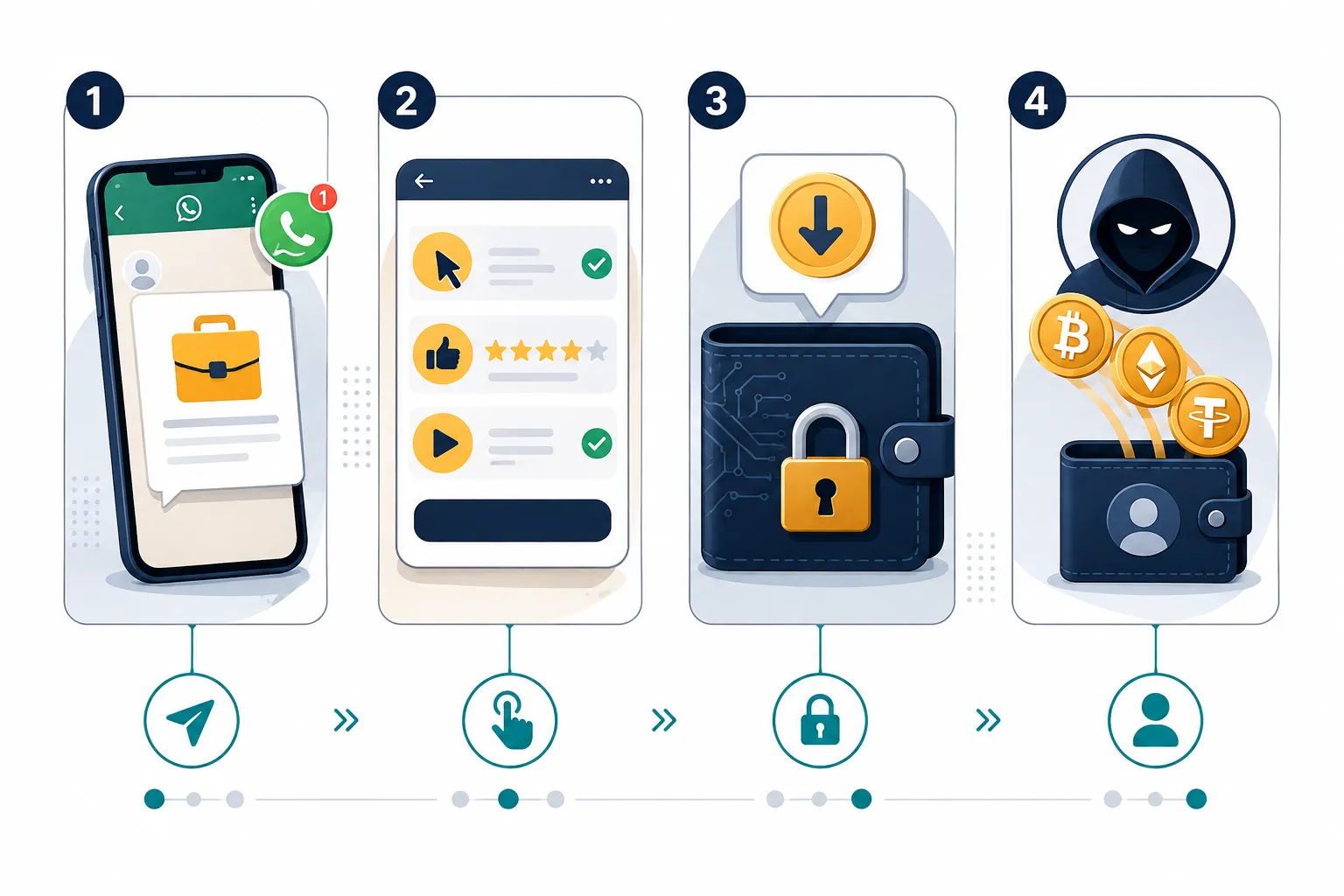
The scam typically unfolds in four stages:
- Initial contact: The victim receives an unsolicited text, WhatsApp message, or Telegram contact offering easy part-time work such as clicking buttons, rating restaurants, or “optimizing” app listings [4][14].
- Task phase: The victim completes a few simple tasks and sees fake earnings accumulate in a dashboard designed to build trust.
- Deposit demand: The scammer introduces a rule requiring the victim to deposit their own cryptocurrency to “activate” a new task batch or access higher-paying assignments [1][4].
- Escalation and disappearance: Deposit demands grow larger. Eventually the scammer cuts off contact and the victim cannot withdraw any funds [2].
The earnings shown on the platform are fabricated. The “company” has no real business operations. Victims often lose not just their initial deposit but multiple follow-up payments made under increasing pressure.
Which US Agencies Warned About Crypto Job Scams and What Did They Say
The FBI, FTC, U.S. Secret Service, and the U.S. Attorney’s Office for the District of Columbia have all issued warnings or taken enforcement action related to fake job crypto scams in 2026.
- FBI / IC3: The FBI’s dedicated guidance on cryptocurrency job scams states that no legitimate job requires workers to deposit their own money to perform tasks. The FBI advises victims to stop sending funds immediately and file a report with IC3 [2]. A July 2026 joint advisory from FBI-linked sources and LinkedIn flagged nearly $363 million in IC3-reported losses from employment and task-job scams in 2025 alone [5].
- FTC: The Federal Trade Commission has issued consumer alerts warning that any demand to pay in cryptocurrency to get a job is “always a scam.” The FTC also warns that scammers sometimes send fake checks and instruct victims to convert the funds to crypto [7].
- U.S. Secret Service / DOJ: On July 22, 2026, the U.S. Attorney’s Office for the District of Columbia announced five civil forfeiture complaints seeking more than $25 million in cryptocurrency seized from separate fraud investigations led by the U.S. Secret Service Washington Field Office [9].
- FBI Field Offices: A July 13, 2026 warning from a regional FBI field office explicitly categorized “cryptocurrency job scams” alongside investment, romance, and tech-support fraud as a standard category in federal crypto-fraud messaging [15, cited via source material].
- CISA: The Cybersecurity and Infrastructure Security Agency has issued broader guidance reminding the public that no legitimate government agency or employer will ever request payment via cryptocurrency [11, cited via source material].
“No legitimate job requires you to deposit your own money to perform tasks.”, FBI Cryptocurrency Job Scams Guidance [2]
How Many People Have Been Targeted and What Are the Losses
Documented losses from fake job crypto scams reached at least $11.8 million in the cases highlighted by US authorities this August, and the broader employment-scam category logged nearly $363 million in IC3 reports for 2025 [1][5].
The $11.8 million figure reflects losses specifically tied to fake job-offer crypto schemes reported in mid-August 2026 [1][10]. Singapore’s authorities reported the same loss figure from a parallel variant of the scam in which victims were directed to install compromised software after being approached by supposed crypto-firm recruiters [10]. This parallel pattern confirms that fake crypto job scams are part of a coordinated global fraud trend, not an isolated domestic problem.
The broader IC3 data for 2025, nearly $363 million in employment and task-job scam losses, shows just how large the attack surface has become [5]. Actual losses are likely higher because many victims do not report fraud out of embarrassment or uncertainty about where to file.
How Scammers Recruit People for Fake Crypto Jobs
Scammers recruit victims primarily through unsolicited messages on SMS, WhatsApp, Telegram, and social media platforms, often impersonating legitimate recruiters or companies.
Common recruitment tactics include:
- Random text messages claiming the recipient was referred by a mutual contact or found through a professional database
- LinkedIn and job-board postings listing vague remote roles with unusually high pay for simple tasks [5]
- Social media ads and DMs promoting “flexible work-from-home” opportunities with no experience required
- Romance or friendship angles where scammers build rapport over days or weeks before introducing the job offer [5]
Once contact is made, scammers move the conversation to encrypted messaging apps quickly, which limits the victim’s ability to verify the employer and reduces the scammer’s exposure [4]. They often use professional-looking websites, fake employee profiles, and fabricated company registration documents to appear credible.
How to Spot a Fake Crypto Job Posting Before Applying
A fake crypto job posting can almost always be identified by at least one of the following red flags. Legitimate employers do not require upfront payments, do not recruit through unsolicited messages, and do not ask workers to move funds.
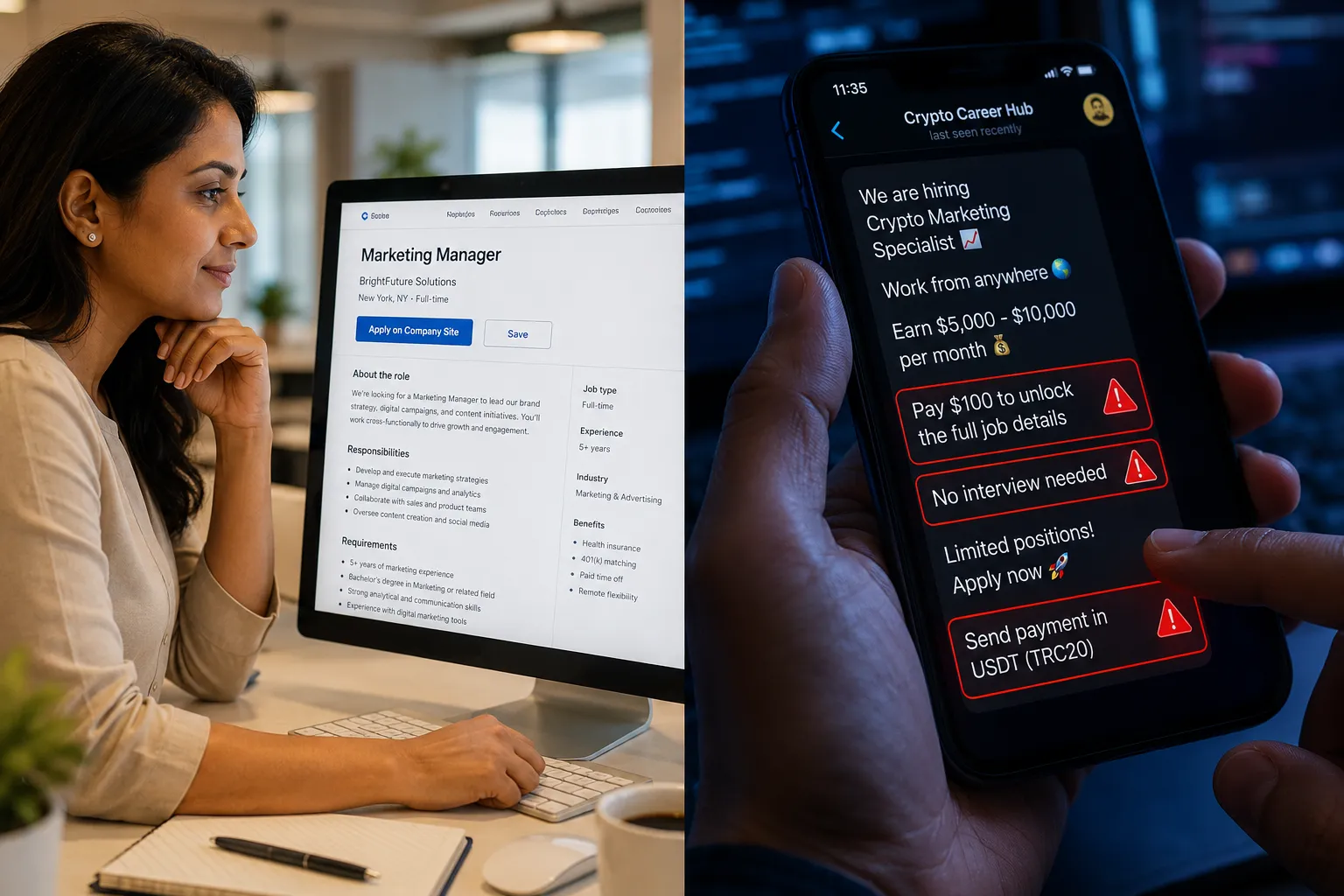
Red flags to watch for:
- The offer arrived unsolicited via text, WhatsApp, or Telegram from an unknown number
- The job involves simple, repetitive tasks (clicking, rating, liking) with disproportionately high pay
- The job title or description uses vague terms like “task optimization” or “product boosting”
- You are asked to deposit cryptocurrency to “activate” your account or access more tasks
- There is no formal interview, no reference check, and no verifiable company address
- The recruiter insists on moving communication to an encrypted app away from the original platform [4]
- The company’s website was registered recently or has minimal online presence
- Payment is promised only in cryptocurrency, with no option for bank transfer or payroll
Decision rule: If any job offer requires you to send money, in any form, for any reason, before you can earn money, stop all contact immediately [2][7].
What Should You Do If You Fell for a Crypto Job Scam
If you have already sent cryptocurrency to a fake job scam, act immediately: stop all further payments, preserve every piece of evidence, and report the fraud to federal authorities.
Step-by-step response:
- Stop sending funds. Do not send additional deposits, even if the scammer threatens to cancel your “earnings” or demands one final payment to release funds [2].
- Preserve evidence. Screenshot all conversations, save transaction IDs, note wallet addresses, and record any website URLs or phone numbers used.
- Report to IC3. File a detailed complaint at ic3.gov, the FBI’s Internet Crime Complaint Center. Include all evidence gathered [2].
- Report to the FTC. File a separate report at reportfraud.ftc.gov [7].
- Contact your bank or exchange. If you converted funds through a U.S.-based crypto exchange, notify their fraud team. Some exchanges can flag or freeze destination wallets.
- Report to local law enforcement. File a local police report, which creates an official record that may be needed for insurance or legal purposes.
Can You Recover Money Lost to a Crypto Job Scam
Recovery of funds lost to a crypto job scam is possible in some cases but is not guaranteed, and most victims do not recover the full amount lost.
Federal seizures, such as the $25 million in cryptocurrency recovered by the U.S. Secret Service and the DOJ in July 2026, show that authorities can and do recover funds from large-scale operations [9]. However, individual victims are rarely made whole from these seizures unless a formal victim-compensation process is established as part of the prosecution.
What increases the chance of partial recovery:
- Reporting quickly, before funds are moved through additional wallets or exchanges
- Filing with IC3 and providing complete transaction records
- The scam operation being large enough to attract federal investigation
What reduces the chance of recovery:
- Funds sent to overseas wallets or converted to privacy-focused cryptocurrencies
- Delays in reporting
- Engaging with “recovery services” that promise to retrieve lost crypto for an upfront fee, these are almost always secondary scams [5]
What Platforms Are Fake Crypto Job Scams Posted On Most
Fake crypto job scams appear most frequently on messaging apps (WhatsApp, Telegram), social media platforms, and general job boards, with LinkedIn increasingly flagged as a vector for recruiter impersonation [5].
Platforms most commonly used:
- WhatsApp and Telegram: The primary channels for initial unsolicited contact and ongoing communication [1][4]
- LinkedIn: Scammers create convincing fake recruiter profiles and post fraudulent job listings [5]
- General job boards: Scam listings appear on broad employment platforms, particularly for remote or part-time roles
- SMS: Mass-text campaigns reach large numbers of potential victims with minimal cost to the scammer
- Instagram and Facebook: Used for targeted ads and direct messages, often tied to fake company pages
No single platform is immune. The common thread is the unsolicited nature of the contact and the request to move communication away from the original platform.
Is It Safe to Apply for Remote Crypto Jobs Right Now
Yes, legitimate remote jobs in the cryptocurrency and blockchain industry exist and are safe to apply for, but the current surge in fake job scams requires extra verification steps before engaging with any offer.
Legitimate crypto jobs typically:
- Are listed on the company’s official website with a verifiable domain and history
- Require a formal application, resume submission, and at least one interview
- Pay via standard payroll or invoicing, never by requiring the worker to deposit funds
- Can be verified through independent sources such as LinkedIn company pages, Glassdoor, or Crunchbase
Scam jobs typically:
- Arrive unsolicited with no prior application
- Require crypto deposits to start work
- Offer unusually high pay for no-skill tasks
- Cannot be verified through any independent source
Apply through official company channels only. If a recruiter contacts you first, verify their identity independently before proceeding.
How to Report a Fake Crypto Job Posting to Authorities
Report fake crypto job postings to the FBI’s IC3, the FTC, and the platform where the scam appeared. Multiple reports from different victims increase the likelihood of federal investigation.
Where and how to report:
- IC3.gov: The FBI’s Internet Crime Complaint Center accepts detailed fraud reports online. Include all communications, wallet addresses, and transaction records [2].
- ReportFraud.ftc.gov: The FTC’s reporting portal for consumer fraud, including employment scams [7].
- The platform itself: Report the fake job listing or recruiter profile directly to LinkedIn, WhatsApp, Telegram, or whichever platform was used.
- Your state attorney general: Many state AG offices maintain consumer fraud units that track regional scam patterns.
- Local FBI field office: If losses are significant, contact your nearest FBI field office directly in addition to filing with IC3.
Conclusion
US authorities warn of a surge in fake job crypto scams this August, and the evidence, $11.8 million in documented losses, nearly $363 million in broader IC3-reported employment scam losses for 2025, and active federal seizures exceeding $25 million, makes clear that this is a serious and growing threat [1][5][9].
The scam’s formula is consistent: an unsolicited message, simple tasks, fake earnings, and then escalating demands for crypto deposits. Recognizing that formula is the most reliable protection.
Actionable next steps:
- Treat any unsolicited job offer involving cryptocurrency as a scam by default until independently verified
- Never deposit your own money to perform job tasks, regardless of how convincing the platform looks
- Verify all recruiters and companies through official websites and independent sources before engaging
- If targeted, stop all payments immediately and file reports with IC3 (ic3.gov) and the FTC (reportfraud.ftc.gov)
- Share this information with friends and family, particularly those actively job-hunting, awareness is the first line of defense
FAQ
What is the main warning US authorities issued about crypto job scams in August 2026? US authorities, including the FBI and FTC, warned that fake job-offer crypto scams have surged, with at least $11.8 million in documented losses. Scammers use unsolicited messages to lure victims into depositing cryptocurrency under the pretense of completing remote work tasks [1][2].
How do I know if a crypto job offer is a scam? If the offer arrived unsolicited, involves simple tasks like clicking or rating, requires you to deposit cryptocurrency to access work, or cannot be verified through an official company website, it is almost certainly a scam [2][7].
Which agencies are warning about fake crypto job scams? The FBI, FTC, U.S. Secret Service, U.S. Attorney’s Office for the District of Columbia, and CISA have all issued warnings or taken enforcement action related to these scams [2][7][9].
Can I get my money back if I was scammed? Recovery is possible but not guaranteed. Report immediately to IC3.gov and provide full transaction records. Federal seizures have recovered funds in large cases, but individual recovery is rare without a formal victim-compensation process [2][9].
What should I do first if I realize I’m being scammed? Stop sending money immediately. Do not make any additional deposits. Then preserve all evidence, screenshots, wallet addresses, transaction IDs, and file a report with IC3.gov [2].
Are all remote crypto jobs scams? No. Legitimate remote jobs in the crypto and blockchain industry exist. The key difference is that legitimate employers never ask workers to deposit their own funds to perform tasks or access work assignments [2][7].
What platforms do these scams use most? WhatsApp, Telegram, LinkedIn, and general job boards are the most commonly used platforms. Scammers often start contact on one platform and then move the conversation to an encrypted messaging app [4][5].
Is there a secondary scam I should watch out for after being defrauded? Yes. “Crypto recovery services” that promise to retrieve lost funds for an upfront fee are almost always secondary scams. Report losses only through official government channels [5].
How much has been seized by US authorities from crypto scam operations? The U.S. Attorney’s Office for the District of Columbia announced civil forfeiture complaints seeking more than $25 million in cryptocurrency from related fraud investigations in July 2026 [9].
Why do scammers specifically use cryptocurrency? Cryptocurrency transactions are difficult to reverse, can be moved across borders instantly, and offer a degree of anonymity that makes tracing and recovering funds harder for law enforcement [2][4].
References
[1] Crypto Scams Fake Job Offers 11 8 Million Losses – https://thesiliconreview.com/2026/08/crypto-scams-fake-job-offers-11-8-million-losses
[2] Cryptocurrency Job Scams – https://www.fbi.gov/how-we-can-help-you/victim-services/national-crimes-and-victim-resources/cryptocurrency-job-scams
[4] Scammers Recruiters Steal Your Crypto Salary Fbi – https://www.bitdefender.com/en-gb/blog/hotforsecurity/scammers-recruiters-steal-your-crypto-salary-fbi
[5] Fbi Linkedin Job Scam Alert Ai Romance Crypto Cons Fake Recovery Callers 2026 07 28 – https://www.avasc.org/briefings/fbi-linkedin-job-scam-alert-ai-romance-crypto-cons-fake-recovery-callers-2026-07-28
[7] New Crypto Payment Scam Alert – https://consumer.ftc.gov/new-crypto-payment-scam-alert
[9] Investigations Cryptocurrency Scams Result Seizure More 25 Million – https://www.justice.gov/usao-dc/pr/investigations-cryptocurrency-scams-result-seizure-more-25-million
[10] Authorities Warn Against Cryptocurrency Related Scams Involving Fake Job Offers After Us118 Million In Losses – https://ground.news/article/authorities-warn-against-cryptocurrency-related-scams-involving-fake-job-offers-after-us118-million-in-losses_52b0fe