Last updated: July 17, 2026
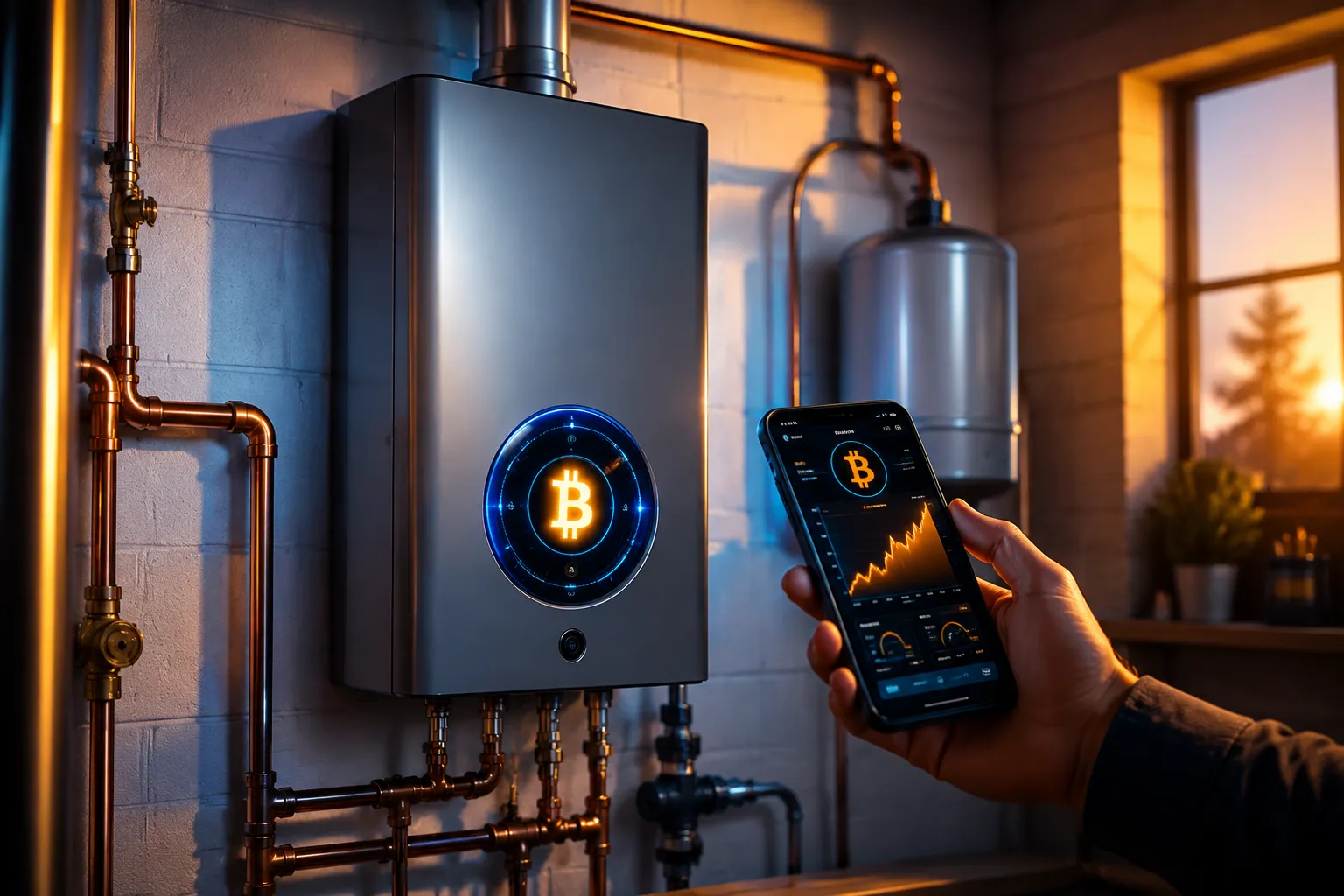
Quick Answer: Cryptocurrency-mining water heaters are dual-purpose home appliances that heat household water using heat generated by onboard Bitcoin mining hardware. The leading product in this space, the Superheat H1C, claims to capture over 99% of computational heat for water heating while generating Bitcoin passively. At a launch price of $2,999 with deliveries expected in Q4 2026, these devices represent a genuinely new category of smart home appliance, though economic returns depend heavily on Bitcoin price, electricity costs, and household hot water usage.
Key Takeaways
- Cryptocurrency-mining water heaters combine ASIC mining chips with standard water heating to produce hot water and Bitcoin simultaneously
- The Superheat H1C, winner of a CES 2026 award, is the first purpose-built Bitcoin mining water heater available for pre-order [1]
- Superheat claims the H1C can generate roughly $1,000 per year in Bitcoin at current network conditions, potentially offsetting up to 80% of electricity and water costs [2]
- The H1C operates at 38.4 dB(A) during water heating, comparable to a quiet library, making it suitable for residential use [1]
- Pre-orders require a $199 deposit with a launch price of $2,999; deliveries begin Q4 2026 [1]
- These devices mine Bitcoin exclusively, not altcoins, because Bitcoin’s SHA-256 algorithm is the only one where ASIC heat output aligns practically with residential water heating demand
- Renters face significant barriers due to installation requirements and landlord approval
- Bitcoin mining income is taxable in most jurisdictions and must be reported as ordinary income
- The concept is legitimate, not a scam, but projected returns carry real uncertainty tied to Bitcoin difficulty and price volatility
What Is a Cryptocurrency Mining Water Heater and How Does It Work
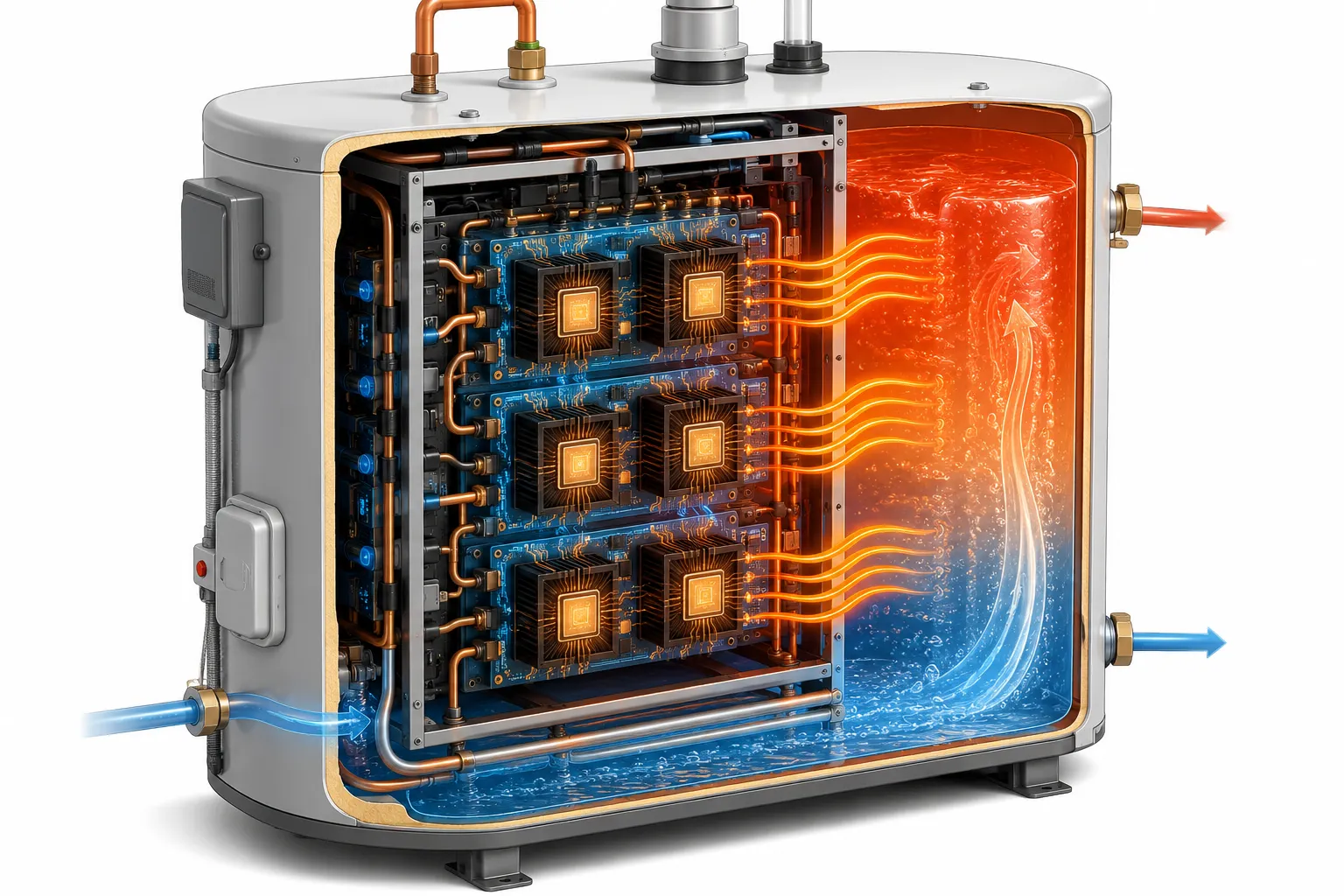
A cryptocurrency-mining water heater replaces the electric resistance heating element found in a standard tank water heater with ASIC (Application-Specific Integrated Circuit) mining chips. These chips perform Bitcoin proof-of-work computations, generating heat as a byproduct. Instead of dissipating that heat through fans and exhaust (as a traditional mining rig does), the water heater captures it directly to warm the water in the tank.
The Superheat H1C claims to capture over 99% of computational heat for household hot water, meaning almost no energy is wasted [1]. The mining chips run continuously, and the heat they produce keeps the tank at the target temperature. When the tank is already hot, excess heat can be managed through thermal controls built into the unit.
How the heat loop works:
- ASIC chips solve Bitcoin hash functions, consuming electricity
- Chips generate heat as a natural byproduct of computation
- Heat transfers directly into the surrounding water tank
- Hot water is available on demand, just like a conventional water heater
- Mining rewards accumulate in a connected Bitcoin wallet
Can You Actually Make Money From a Mining Water Heater at Home
Yes, but the amount is modest and variable. Superheat estimates the H1C can generate approximately $1,000 per year in Bitcoin under current network conditions [2]. For a single-family home, that translates to roughly $80 per month in Bitcoin earnings, which, combined with savings on the water heating portion of the electricity bill, could meaningfully reduce utility costs.
For larger deployments, the numbers scale significantly. Superheat estimates a 700-unit apartment community could earn close to $1 million annually, potentially offsetting up to 80% of electricity and water costs [2].
What affects your actual earnings:
- Current Bitcoin price and network difficulty (both fluctuate constantly)
- Local electricity rate (lower rates improve net returns)
- Daily hot water usage (more usage means more mining time)
- Bitcoin halving cycles, which reduce block rewards over time
Decision rule: If your electricity rate is above $0.15 per kWh, the economics tighten considerably. Households in low-rate states or those with solar installations are better candidates.
How Much Does a Crypto Mining Water Heater Cost to Buy and Install
The Superheat H1C launches at $2,999, with pre-orders secured by a $199 deposit and deliveries expected in Q4 2026 [1]. That price is higher than a standard electric tank water heater (typically $400 to $900 installed) but lower than buying a comparable ASIC miner separately and then purchasing a water heater.
The broader market for mining heaters ranges from approximately $170 for basic units up to over $900 for higher-hashrate models, with hashrates between 12 TH/s and 95 TH/s and noise levels from 35 dB to 45 dB [4]. These lower-cost units are generally space heaters or radiator-style devices, not full water heater replacements.
Estimated total cost for the H1C:
- Unit price: $2,999 (launch)
- Standard 240V electrical hookup (if not already present): $150 to $400
- Professional plumbing installation: $100 to $300
- Estimated total: $3,250 to $3,700
Mining Water Heater vs Regular Water Heater Electricity Costs
A standard 50-gallon electric resistance water heater uses roughly 4,500 watts and costs an average household $400 to $600 per year in electricity (estimate based on U.S. average rates and typical usage patterns). A mining water heater uses a similar or slightly higher wattage, but the electricity cost is partially offset by Bitcoin earnings.
The key difference: with a standard water heater, every dollar of electricity is a pure cost. With a mining water heater, a portion of that cost is returned as Bitcoin. Superheat’s 80% offset claim [2] is the optimistic scenario, likely assuming favorable Bitcoin prices and high daily hot water demand. A conservative estimate might put real-world savings at 30% to 50% for most single-family homes.
Best Cryptocurrency Mining Water Heater Brands in 2026
The market is still early, but several companies are building in this space.
| Brand | Product Type | Notable Feature |
|---|---|---|
| Superheat | Full tank water heater (H1C) | CES 2026 award winner, 38.4 dB operation [1] |
| DS Thermal LLC | Hydronic heating systems, heated driveways | Broader home heating integration [3] |
| Various (D-Central comparison) | Space heaters and radiator units | $170 to $900+, 12-95 TH/s range [4] |
Superheat is currently the only company offering a direct water-heater replacement unit. DS Thermal focuses on hydronic systems better suited to whole-home or commercial heating [3].
Is a Mining Water Heater Worth It for a Single-Family Home
For most homeowners, a mining water heater is worth evaluating if they meet specific criteria. It is not a universally good investment.
Choose a mining water heater if:
- You own your home and can make appliance decisions freely
- Your current water heater needs replacement anyway (reduces the effective upgrade cost)
- Your electricity rate is below $0.12 per kWh
- You have a 240V circuit available in your utility area
- You are comfortable holding Bitcoin or converting it regularly
Skip it (for now) if:
- Your water heater is less than five years old
- You rent your home
- You are in a high-electricity-cost state
- You need guaranteed returns rather than variable crypto income
Do Mining Water Heaters Need Special Electrical Setup
Most mining water heaters, including the H1C, require a standard 240V circuit, which is the same connection used by conventional electric water heaters. If your home already has an electric water heater, the electrical infrastructure is likely already in place.
If you currently use a gas water heater and are switching, you will need a licensed electrician to run a 240V dedicated circuit, which typically costs $150 to $400 depending on panel distance and local labor rates.
No special permits are required for the electrical connection beyond what a standard water heater replacement would require in most U.S. jurisdictions, but always verify with your local building department.
What Cryptocurrency Can You Mine With a Water Heater
Current mining water heaters mine Bitcoin exclusively. This is not an arbitrary choice. Bitcoin uses the SHA-256 proof-of-work algorithm, which is handled by ASIC chips that generate predictable, consistent heat output. That consistency is what makes them practical for water heating.
Altcoins that use GPU-based or memory-intensive algorithms (like Ethereum Classic or Monero) generate heat less predictably and are not currently suited to this application. As the technology matures, other SHA-256 coins (such as Bitcoin Cash or Bitcoin SV) could theoretically be mined on the same hardware, but Bitcoin remains the primary target due to its network value and liquidity.
Mining Water Heater Scam or Legitimate Investment
Cryptocurrency-mining water heaters are a legitimate product category, not a scam. The Superheat H1C received recognition at CES 2026, one of the most scrutinized consumer technology events in the world [1]. The underlying technology, using ASIC heat for water heating, is physically sound and has been demonstrated in smaller-scale mining heater products already on the market [4].
Red flags to watch for in this space (general guidance):
- Companies promising fixed guaranteed Bitcoin returns regardless of network conditions
- No verifiable hardware specifications or hashrate disclosures
- Pre-orders with no refund policy or company address
- Claims of mining altcoins with no explanation of the algorithm used
Superheat’s claims are conditional on Bitcoin price and network difficulty, which is an honest framing. The $199 pre-order deposit and $2,999 launch price are in line with comparable hardware costs.
Mining Water Heater Making Noise or Running Hot Issues
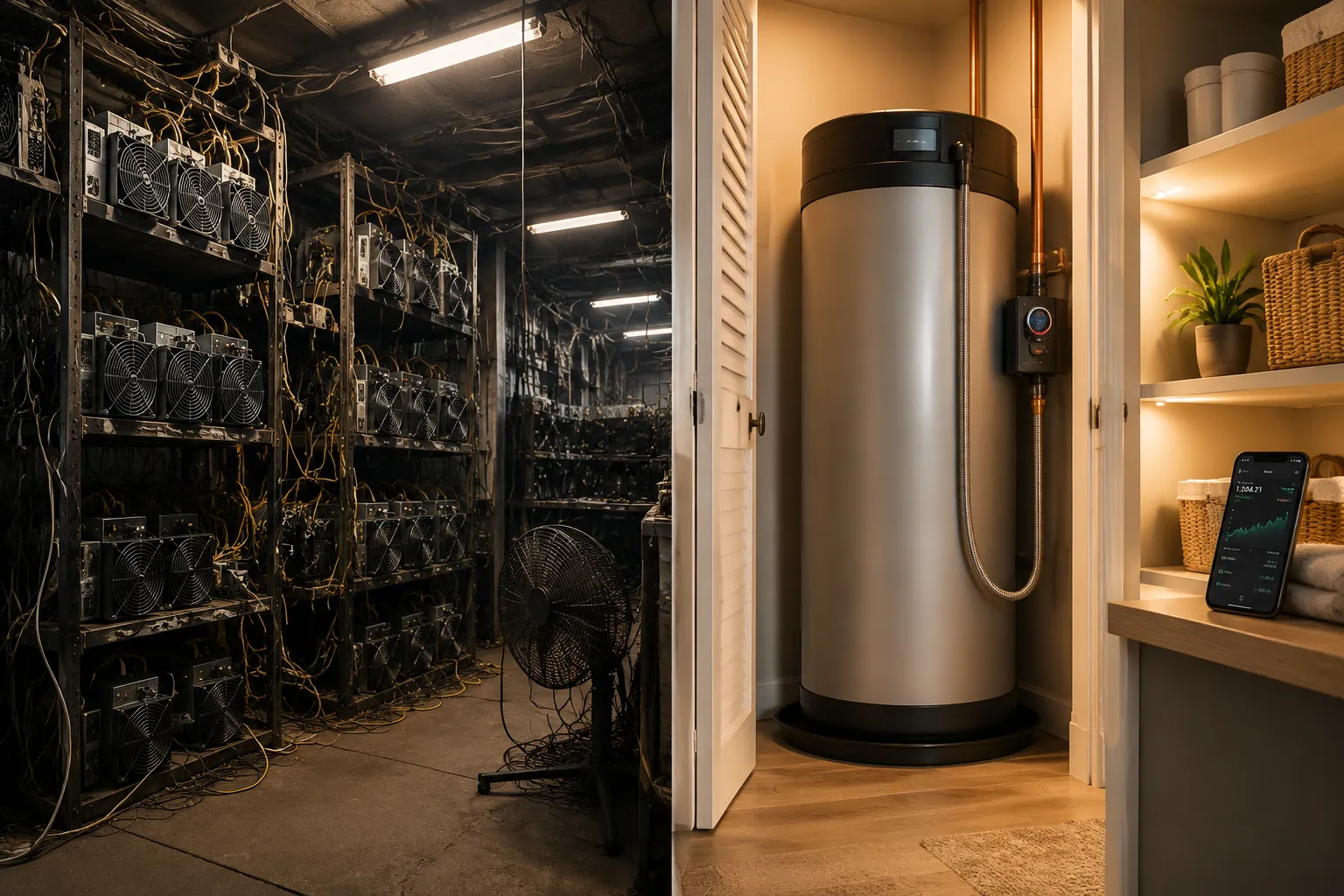
The Superheat H1C operates at 38.4 dB(A) during water heating, which is roughly equivalent to a quiet library or a soft conversation at a distance [1]. This is significantly quieter than a traditional ASIC mining rig, which typically runs at 65 to 85 dB.
Common operational concerns:
- Noise above 45 dB: Could indicate a fan issue or loose component; contact manufacturer support
- Water temperature inconsistency: May mean the mining load is lower than expected due to network throttling; check app settings
- Unit running warm to the touch externally: Normal for any water heater; the external casing should not exceed safe touch temperatures per UL standards
- App not syncing mining rewards: Check Wi-Fi connection and wallet address configuration
How Long Does a Mining Water Heater Last Before Wearing Out
ASIC chips in mining hardware typically have an operational lifespan of three to five years under continuous load before hashrate degrades meaningfully. The water heater tank itself, if built to standard residential specifications, should last eight to twelve years.
This creates a practical consideration: the mining component may need replacement or upgrade before the tank does. Superheat has not yet published a chip replacement or upgrade program, which is worth clarifying before purchase. Ask the manufacturer whether the mining module is field-replaceable.
Can You Use a Mining Water Heater If You Rent Your Home
In most cases, renters cannot install a mining water heater without explicit landlord approval. Water heater replacement is typically classified as a structural or systems modification, requiring landlord consent in nearly all residential lease agreements.
Even with approval, the Bitcoin earnings would likely belong to whoever controls the device, creating a potential dispute if the landlord considers the appliance part of the property. Renters interested in this technology should get written agreements covering ownership of mining rewards, responsibility for electricity costs, and what happens to the device at lease end.
Mining Water Heater Tax Implications and Reporting Income
Bitcoin mined by a home mining water heater is taxable income in the United States. The IRS treats mined cryptocurrency as ordinary income at the fair market value on the day it is received. This means every Bitcoin payout must be recorded with its dollar value at receipt and reported on Schedule 1 of Form 1040.
When the Bitcoin is later sold, any gain or loss relative to that recorded cost basis is subject to capital gains tax. Homeowners should use mining tracking software or exchange records to maintain accurate cost basis documentation.
Key tax points:
- Mining income is reported as ordinary income (not capital gains) at receipt
- Hardware costs may be depreciable as a business expense if the activity qualifies as a trade or business
- Consult a tax professional familiar with cryptocurrency before filing, especially in the first year
Conclusion
Cryptocurrency-mining water heaters represent a genuinely practical application of an idea that has long existed in theory: using unavoidable computational heat for something useful. The Superheat H1C, backed by a CES 2026 award and now open for pre-orders, is the clearest signal yet that this category is moving from concept to consumer product [1].
Actionable next steps for homeowners considering this technology:
- Check your electricity rate. If you pay above $0.15 per kWh, run the numbers carefully before committing.
- Assess your water heater’s age. If replacement is due within two years, the timing makes a mining water heater more financially logical.
- Verify your electrical setup. Confirm a 240V circuit is available or get an electrician’s quote for installation.
- Consult a tax professional. Set up a simple system for tracking mining income before the first payout arrives.
- Compare the full market. Review the broader mining heater landscape, including DS Thermal and other providers, before committing to a single product [3][4].
The economics are not guaranteed, and Bitcoin’s volatility means projected returns are estimates, not promises. But for homeowners whose water heater is due for replacement and who are comfortable with cryptocurrency, this is one of the more rational entry points into home mining available in 2026.
FAQ
What is a cryptocurrency-mining water heater? It is a residential water heater that uses ASIC Bitcoin mining chips as its heat source. The chips mine Bitcoin continuously, and the heat they generate warms the water in the tank, serving both functions simultaneously.
How much Bitcoin can a mining water heater produce? Superheat estimates the H1C can generate approximately $1,000 per year in Bitcoin under current network conditions, though this varies with Bitcoin price and network difficulty [2].
Is the Superheat H1C available to buy now? Pre-orders opened on July 16, 2026, with a $199 deposit and a launch price of $2,999. Deliveries are expected to begin in Q4 2026 [1].
Does a mining water heater increase my electricity bill? It uses roughly the same electricity as a standard electric water heater. The difference is that a portion of that electricity cost is offset by Bitcoin earnings.
Can a mining water heater replace my existing water heater? Yes, if your home uses an electric water heater with a 240V connection. Gas water heater homes require an electrical upgrade first.
Is Bitcoin mining income from a water heater taxable? Yes. The IRS treats mined Bitcoin as ordinary income at fair market value on the day received. Accurate record-keeping is essential.
How loud is a mining water heater? The Superheat H1C operates at 38.4 dB(A), comparable to a quiet library, making it suitable for utility rooms in residential homes [1].
What happens if Bitcoin’s value drops significantly? The water heating function continues regardless. Mining earnings decrease, but the appliance still performs its primary job. The investment case weakens, but the device remains functional.
Can renters install a mining water heater? Generally no, without explicit written landlord approval. Renters should also clarify in writing who owns the Bitcoin earnings before installation.
Are there mining water heaters for altcoins like Ethereum? Not currently. Available products mine Bitcoin using SHA-256 ASIC chips. GPU-based altcoin mining does not produce the consistent, controllable heat output needed for water heating applications.
How long will the mining hardware inside last? ASIC chips typically degrade over three to five years of continuous operation. The water tank itself may last eight to twelve years, so ask the manufacturer about chip replacement options.
Is this technology regulated? Water heater installation is subject to standard local plumbing and electrical codes. Bitcoin mining income is subject to IRS reporting requirements. No specific federal regulation targets mining water heaters as of mid-2026.
References
[1] CES Award Winning Superheat H1C Opens Pre-Orders For World’s First Bitcoin Mining Water Heater – https://chainwire.org/2026/07/16/ces-award-winning-superheat-h1c-opens-pre-orders-for-worlds-first-bitcoin-mining-water-heater/?utm_source=openai
[2] Bitcoin Mining Water Heater Firm Says Its $2,000 Product Can Rake Back $1,000 A Year In BTC And Claims It Can Offset Up To 80 Percent Of Electricity And Water Costs – https://www.tomshardware.com/tech-industry/cryptomining/bitcoin-mining-water-heater-firm-says-its-usd2-000-product-can-rake-back-usd1-000-a-year-in-btc-and-claims-it-can-offset-up-to-80-percent-of-electricity-and-water-costs?utm_source=openai
[3] DS Thermal LLC – https://dsthermal.com/?utm_source=openai
[4] Mining Heater Comparison – https://d-central.tech/mining-heater-comparison/?utm_source=openai