
Last updated: August 13, 2026
Quick Answer: The SEC Meeting August 14 is a formal open meeting at which the Commission will vote on whether to publish proposed rules, informally called “Regulation Crypto,” that would create a tailored offering regime allowing certain crypto projects to raise capital without full securities registration. An affirmative vote does not create binding rules immediately; it opens a public comment period, with final adoption realistically projected into 2027. [1][2]
Key Takeaways
- The SEC open meeting on August 14, 2026 begins at 10:00 a.m. ET at SEC headquarters in Washington, D.C., with a live webcast available on the SEC’s website. [2]
- The sole agenda item is whether to issue a release proposing new rules for a “tailored offering regime” for certain investment contracts involving crypto assets. [2]
- The proposal is informally known as “Regulation Crypto” or “Reg Crypto” and is designed to operate within the existing securities law framework, not replace it. [3]
- Two illustrative exemption tiers have been previewed: a startup exemption (up to four years, approximately $5 million total) and a larger exemption (up to $75 million in any 12-month period). These figures are subject to change during rulemaking. [6]
- A vote on August 14 only authorizes publication of a proposed rule and opens a public comment period; it does not create an immediately usable legal exemption. [1][6]
- Final rules are realistically projected into 2027, meaning crypto projects cannot rely on Reg Crypto for near-term fundraising. [1][8]
- Even under the proposed framework, significant disclosure obligations and compliance conditions are expected, so Reg Crypto reduces friction but does not eliminate compliance complexity. [6][1]
- DeFi protocols and projects without a centralized team may face different treatment under the proposed rules. [1]
- FINRA member firms will continue to face extensive due diligence requirements for any unregistered crypto offerings, regardless of Reg Crypto’s final form. [10]
- Accredited investors are expected to remain a key participant class in crypto raises under the new framework, though the rules may also open limited pathways to non-accredited investors. [6]
What Are the New SEC Crypto Capital Raising Rules from August 14
The SEC Meeting August 14 centers on a single agenda item: a Commission vote on whether to publish a proposed rulemaking that would establish a new, tailored offering regime for certain crypto asset investment contracts. [2] If the vote is affirmative, the SEC will release a formal proposal for public comment, marking the first structured regulatory pathway specifically designed for token-based capital raises.
The proposal, known informally as Regulation Crypto, is not a replacement for existing securities law. Instead, it would sit alongside frameworks like Regulation D and Regulation A+, offering crypto-specific conditions, caps, and disclosure requirements. [3][8]
What Reg Crypto is expected to include:
- A definition of which crypto asset investment contracts qualify for the tailored regime
- Quantitative fundraising caps tied to offering size and time period
- Mandatory disclosure requirements covering business operations, risk factors, token mechanics, and use of proceeds
- A potential “exit route” from SEC jurisdiction once a network is sufficiently decentralized and no longer managed by a central team [1]
- Time-limited exemptions rather than permanent carve-outs
The August 14 meeting is one of two significant decisions the SEC was expected to take that day for crypto markets, underscoring the perceived importance of this rulemaking step for the digital asset industry. [7]
What Changed in Crypto Fundraising Regulations After August 14
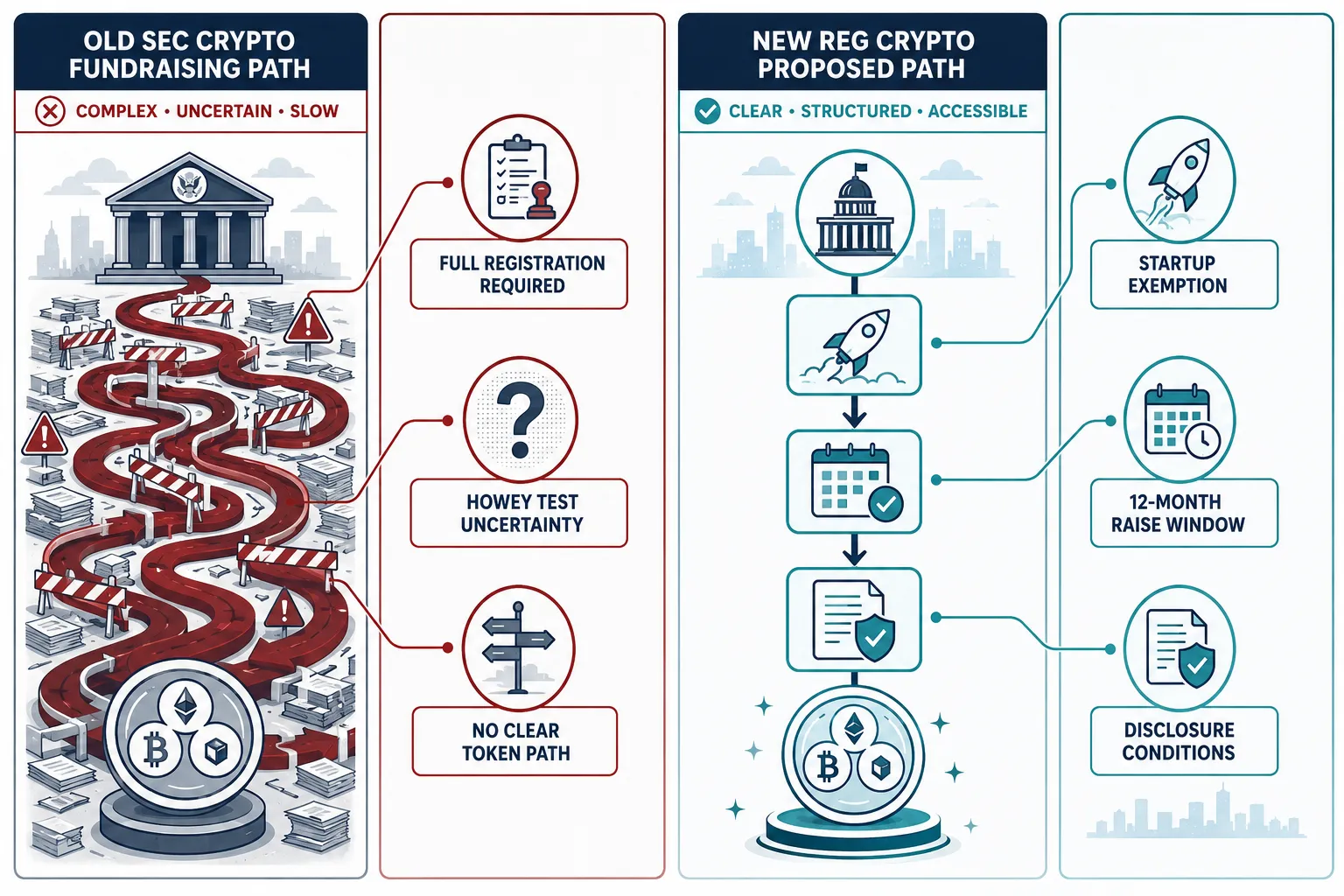
Before August 14, 2026, crypto projects seeking to raise capital faced a binary choice: register as a securities offering (a lengthy and expensive process) or attempt to qualify under existing exemptions like Regulation D (which limits participation to accredited investors) or Regulation A+ (which permits up to $75 million in a 12-month public offering but was not designed for token mechanics). [6][12]
The August 14 vote, if affirmative, initiates a formal rulemaking process that would add a third, crypto-specific path. The core change is that the SEC is proposing rules tailored to the realities of token issuance, including network decentralization milestones, smart contract disclosures, and token supply mechanics, rather than forcing crypto offerings into frameworks built for traditional equity or debt.
Key differences between old and new approaches:
| Feature | Existing Frameworks (Reg D / Reg A+) | Proposed Reg Crypto |
|---|---|---|
| Designed for tokens | No | Yes |
| Investor eligibility | Accredited only (Reg D) or broad (Reg A+) | Expected to include tiered access |
| Decentralization exit | Not available | Proposed for qualifying networks |
| Token-specific disclosures | Not specified | Expected to be required |
| Fundraising cap | $75M (Reg A+) | Up to $75M (12-month tier, illustrative) |
| Startup tier | Not available | Up to $5M over four years (illustrative) |

Sources: [6][12]
How the New SEC Rules Affect ICOs and Token Sales
The new SEC crypto capital raising rules proposed at the August 14 meeting would directly affect how token sales and initial coin offerings (ICOs) are structured and disclosed. Under the current environment, most token sales either avoid U.S. investors entirely or rely on Regulation D exemptions that restrict participation to accredited investors.
Reg Crypto is expected to provide a formal, lawful path for token issuers to raise from a broader investor base, provided they meet specific disclosure and operational conditions. [3][8] However, legal analysts caution that the fine print in the final rule text could create unexpected compliance traps for issuers who assume the new regime is simpler than it actually is. [6]
What token issuers should watch for:
- Disclosure requirements covering smart contract audits, total token supply, vesting schedules, and team backgrounds
- Restrictions on how proceeds can be used
- Ongoing reporting obligations during the offering period
- Conditions that must be met before claiming the decentralization exit route [1]
The bottom line: Reg Crypto may reduce the cost and complexity of compliant token sales, but it will not make them paperwork-free.
Which Crypto Projects Are Impacted by the New SEC Rules
The proposed rules from the SEC Meeting August 14 are most directly relevant to U.S.-based crypto projects that issue tokens functioning as investment contracts. This covers a wide range of projects, from early-stage blockchain startups to more established networks still under centralized management.
Projects most likely affected:
- Early-stage token issuers seeking to raise seed or Series A-equivalent capital through token sales
- Mid-stage projects planning larger fundraising rounds in the $10 million to $75 million range
- Any project that has previously relied on Regulation D and wants to expand to non-accredited investors
- Networks that are working toward decentralization and want a defined legal path to exit SEC oversight [1]
Projects less directly affected (for now):
- Fully decentralized protocols with no identifiable issuer
- Projects that raise exclusively outside the United States
- Stablecoin issuers and projects structured as commodities rather than securities
DeFi protocols occupy a gray zone. The August 14 proposal focuses on “certain investment contracts,” and whether automated, governance-token-based fundraising qualifies will likely depend on the rule’s final definitions. [1]
How Startups Raise Crypto Capital Under the New Rules
Under the proposed Reg Crypto framework, a startup-tier exemption would allow qualifying projects to raise approximately $5 million over a period of up to four years without full securities registration. [6] These figures are illustrative and subject to change during the public comment and final rulemaking process.
Expected steps for a startup-tier raise under Reg Crypto:
- Confirm the token offering qualifies as a “crypto asset investment contract” under the rule’s definitions
- Prepare required disclosures: business description, token mechanics, risk factors, team backgrounds, use of proceeds, and smart contract details
- File the offering with the SEC under the new regime (exact filing mechanics to be specified in the final rule)
- Conduct the offering within the prescribed cap and time limits
- Provide ongoing disclosures to investors during the offering period
- Monitor decentralization milestones if pursuing an eventual exit from SEC jurisdiction [1][6]
Common mistake to avoid: Assuming that the startup exemption is a low-documentation safe harbor. SEC statements on crypto asset offerings consistently emphasize “robust disclosures,” and FINRA’s 2026 annual oversight report confirms that broker-dealers facilitating such offerings must conduct extensive due diligence covering all the elements above. [10][14]
Are There Exemptions to the New SEC Crypto Capital Raising Requirements
Two illustrative exemption tiers have been previewed in coverage of the August 14 proposal. The first is a startup exemption, potentially capping total raises at approximately $5 million over four years. The second is a larger exemption, potentially allowing up to $75 million in any 12-month period, which aligns with the existing Regulation A+ threshold. [6][12]
Both tiers are expected to carry conditions rather than function as blanket carve-outs. Likely conditions include:
- Quantitative caps on total raise amount and offering period
- Mandatory disclosures filed with or reported to the SEC
- Restrictions on advertising and investor solicitation
- Eligibility criteria for the issuer and the token itself
An additional proposed feature is a decentralization exit: once a network meets defined criteria for being “no longer actively managed by a central team,” it may be able to exit the investment contract classification entirely. [1] The specific criteria for this exit have not yet been finalized.
Edge case: Projects that start under the startup tier and grow quickly may need to transition to the larger exemption tier or to full registration before their original exemption expires. Planning for that transition from day one is advisable.
What Does the SEC Require for Crypto Token Offerings Now
As of August 2026, and pending the outcome of the August 14 vote, crypto token offerings that qualify as securities must still comply with existing SEC requirements. The SEC has reaffirmed that issuers of crypto asset securities must provide narrative descriptions of material business aspects and robust disclosures. [14]
Current requirements for token offerings treated as securities include:
- Registration or a valid exemption (Regulation D, Regulation A+, or Regulation S for offshore offerings)
- Disclosure of material risks, business operations, and use of proceeds
- Anti-fraud provisions apply regardless of registration status
- Broker-dealer intermediaries must conduct full due diligence per FINRA guidelines [10]
Reg Crypto, once finalized, would add a new exemption category with crypto-specific disclosure templates rather than replacing these baseline obligations.
How Much Does It Cost to Comply with New SEC Crypto Rules
Precise compliance cost estimates for Reg Crypto are not yet available because the rule text has not been finalized. However, drawing on costs for comparable existing frameworks provides a reasonable baseline.
Estimated cost ranges (based on comparable frameworks, subject to change):
- Legal counsel for offering document preparation: $25,000 to $150,000 depending on complexity
- Smart contract audit (typically required for credible disclosure): $10,000 to $50,000
- SEC filing and administrative fees: variable, typically modest for smaller offerings
- Ongoing compliance and reporting: $5,000 to $30,000 per year
These are estimates based on current market rates for Regulation D and Regulation A+ offerings adapted for crypto. Final Reg Crypto compliance costs will depend on the rule’s specific disclosure and filing requirements.
Choose the startup tier if: the project is pre-revenue, raising under $5 million, and willing to accept a four-year cap in exchange for lower initial compliance overhead.
Choose the larger tier if: the project has a working product, a defined investor base, and is targeting institutional or semi-institutional capital in the $10 million to $75 million range.
What Mistakes Are Crypto Companies Making with the New SEC Rules
The most common mistake is treating the August 14 vote as the finish line rather than the starting gun. A vote to publish a proposed rule opens a public comment period; it does not create an immediately usable legal exemption. [1][6] Projects that begin structuring raises around Reg Crypto before the final rule is adopted risk building on a framework that may change materially.
Other mistakes to avoid:
- Underestimating disclosure obligations. Reg Crypto is expected to require detailed, ongoing disclosures, not a one-time filing. [14]
- Ignoring broker-dealer requirements. If a project uses a registered intermediary, FINRA’s due diligence standards apply independently of whatever exemption the issuer claims. [10]
- Assuming the decentralization exit is automatic. The criteria for exiting SEC jurisdiction are not yet defined and will require affirmative demonstration. [1]
- Conflating Reg Crypto with commodity status. The proposed framework operates within securities law; it does not reclassify tokens as commodities.
Is DeFi Fundraising Affected by the August 14 SEC Decision
DeFi protocols are partially affected, but the degree depends on how the final rule defines “crypto asset investment contracts” and whether automated governance token distributions qualify as offerings. [1] Protocols with no identifiable central issuer are less likely to fall within the rule’s scope, but those that conduct structured token sales to fund development remain in scope.
The proposed decentralization exit route is particularly relevant for DeFi projects that start with a central team and plan to transition to community governance. If the final rule includes clear, measurable decentralization criteria, it could provide a defined legal pathway that DeFi projects currently lack.
How Do Accredited Investors Participate in Crypto Raises Under New Rules
Accredited investors are expected to remain eligible participants under both proposed Reg Crypto tiers, and they may face fewer restrictions than non-accredited investors. [6] Under existing Regulation D, accredited investors can already participate in private crypto offerings; Reg Crypto is expected to supplement rather than replace that pathway.
The larger tier exemption, potentially up to $75 million, is likely to attract institutional and accredited investor participation given its size. The startup tier may include limited access for non-accredited investors, similar to Regulation Crowdfunding, but with crypto-specific conditions.
For accredited investors: the key change is that Reg Crypto may require issuers to provide more standardized, comparable disclosures than Regulation D currently mandates, making it easier to evaluate token offerings on a consistent basis.
Which Countries Have Similar Crypto Fundraising Regulations
Several jurisdictions have developed structured crypto offering frameworks that the SEC’s proposed Reg Crypto appears to draw on conceptually.
- European Union: The Markets in Crypto-Assets (MiCA) regulation, which took effect in 2024, provides a tiered framework for crypto asset issuers including white paper requirements and ongoing disclosure obligations.
- Singapore: The Monetary Authority of Singapore (MAS) has operated a licensing and exemption framework for digital token offerings under its Payment Services Act since 2020.
- Switzerland: FINMA has issued guidance categorizing tokens and applying securities law selectively based on token function.
- United Kingdom: The FCA has been developing a crypto asset regulatory regime with registration and disclosure requirements.
The U.S. has been notably slower to establish a crypto-specific offering framework compared to the EU and Singapore, which is part of why the August 14 SEC Meeting on new rules for crypto capital raising has drawn significant international attention. [3][8]
What Happens If a Crypto Project Doesn’t Follow the New SEC Rules
Until Reg Crypto is finalized, existing enforcement standards apply. Token offerings that qualify as securities and lack a valid exemption or registration remain subject to SEC enforcement action, which can include cease-and-desist orders, disgorgement of proceeds, civil penalties, and in egregious cases, criminal referral.
Once Reg Crypto is finalized, projects that fail to comply with its conditions while claiming its exemption would face the same enforcement exposure as any other unregistered securities offering. The SEC has consistently pursued enforcement in the crypto space, and Reg Crypto is not expected to reduce enforcement activity against non-compliant issuers. [1][3]
The practical risk: A project that raises capital under a Reg Crypto exemption but fails to meet its disclosure or cap conditions could be required to rescind the offering and return investor funds, in addition to facing penalties.
Conclusion
The SEC Meeting August 14 represents a meaningful step toward regulatory clarity for crypto capital raising, but it is the beginning of a process, not the end. An affirmative vote to publish Regulation Crypto opens a public comment period and signals the Commission’s direction; it does not create an immediately usable legal framework. Final rules are realistically projected into 2027. [1][6][8]
Actionable next steps for crypto projects and investors:
- Monitor the August 14 vote outcome via the SEC’s live webcast and official newsroom. [2]
- Engage in the public comment process once the proposed rule is published. This is the most direct way to shape the final rule’s disclosure requirements, exemption caps, and decentralization exit criteria.
- Audit current fundraising structures against existing Regulation D and Regulation A+ requirements. Do not wait for Reg Crypto to address compliance gaps.
- Consult legal counsel before structuring any token offering around the proposed framework. The fine print in the final rule will matter significantly. [6]
- Review FINRA’s 2026 annual oversight report if using broker-dealer intermediaries, as its due diligence standards apply independently of whatever exemption an issuer claims. [10]
- Track decentralization criteria as the rule develops, particularly if the project plans to use the proposed exit route from SEC jurisdiction.
The path forward for crypto capital raising is becoming clearer, but the details will determine who benefits and who faces unexpected compliance burdens.
FAQ
What is the SEC Meeting August 14 about? The August 14, 2026 SEC open meeting has a single agenda item: a vote on whether to publish proposed rules creating a tailored offering regime for certain crypto asset investment contracts, informally called Regulation Crypto. [2]
Does the August 14 vote immediately change the rules for crypto fundraising? No. A vote to publish a proposed rule opens a public comment period. It does not create binding rules or a usable exemption. Final adoption is projected into 2027. [1][6]
What is Regulation Crypto? Regulation Crypto is the informal name for the SEC’s proposed tailored offering regime for crypto projects. It would allow qualifying token issuers to raise capital without full securities registration, subject to disclosure requirements and fundraising caps. [3][8]
What are the proposed fundraising caps under Reg Crypto? Two illustrative tiers have been previewed: approximately $5 million over four years for a startup exemption, and up to $75 million in any 12-month period for a larger exemption. These figures are subject to change during rulemaking. [6]
Can DeFi projects use the new SEC crypto rules? It depends on the final rule’s definitions. Fully decentralized protocols with no identifiable issuer are less likely to be in scope. Projects that conduct structured token sales to fund development are more likely to be covered. [1]
What disclosures will Reg Crypto require? The final requirements are not yet set, but based on SEC statements and FINRA guidance, expect disclosures covering business operations, token mechanics, smart contract features, risk factors, team backgrounds, use of proceeds, and total token supply. [10][14]
Are accredited investors still relevant under Reg Crypto? Yes. Accredited investors are expected to remain eligible under both proposed tiers, and may face fewer restrictions than non-accredited investors. [6]
What happens to projects that don’t comply with the new SEC rules? Non-compliant issuers remain subject to SEC enforcement, including cease-and-desist orders, disgorgement of proceeds, civil penalties, and potential criminal referral. [1][3]
When will Reg Crypto become final law? Final adoption is realistically projected into 2027, after the public comment period and SEC review of comments. [1][8]
Is the August 14 SEC meeting open to the public? Yes. The meeting begins at 10:00 a.m. ET at SEC headquarters in Washington, D.C., and a webcast is available via the SEC’s website. [2]
How does Reg Crypto compare to Regulation A+? Regulation A+ already permits up to $75 million in a 12-month public offering but was not designed for token mechanics. Reg Crypto is expected to align with that size threshold while adding crypto-specific conditions, disclosures, and a decentralization exit route. [6][12]
What should crypto projects do right now? Maintain compliance with existing Regulation D or Regulation A+ requirements, monitor the August 14 vote, and engage in the public comment process once the proposed rule is published. Do not structure fundraising around Reg Crypto until the final rule is adopted.
References
[1] Sec Regulation Crypto August 14 Vote – https://cogentlaw.com/news/sec-regulation-crypto-august-14-vote
[2] Open Meeting 081426 – https://www.sec.gov/newsroom/meetings-events/open-meeting-081426
[3] U S Sec Sets Meeting To Propose Reg Crypto To Support Certain Digital Assets Offerings – https://www.coindesk.com/policy/2026/08/11/u-s-sec-sets-meeting-to-propose-reg-crypto-to-support-certain-digital-assets-offerings
[5] Us Sec Schedules August 14 Meeting To Propose Regulation Crypto For Crypto Inves Story 20260811 Ussecsetsmeetingtopre03aa195 – https://newscord.org/article/us-sec-schedules-august-14-meeting-to-propose-regulation-crypto-for-crypto-inves–Story_20260811_USSECsetsmeetingtopre03aa195
[6] Fridays Sec Vote Could Unlock 75 Million Crypto Raises Or Trap Token Issuers In Unexpected Legal Fine Print – https://cryptoslate.com/fridays-sec-vote-could-unlock-75-million-crypto-raises-or-trap-token-issuers-in-unexpected-legal-fine-print/
[7] Sec Could Deliver Two Major 212456564 – https://finance.yahoo.com/markets/crypto/articles/sec-could-deliver-two-major-212456564.html
[8] 30001 Sec Moves Toward Tailored Crypto Offering Rules As Token Issuers Await Regulatory Clarity – https://cryptorank.io/news/feed/30001-sec-moves-toward-tailored-crypto-offering-rules-as-token-issuers-await-regulatory-clarity
[9] Newsroom – https://www.sec.gov/newsroom
[10] Crypto – https://www.finra.org/rules-guidance/guidance/reports/2026-finra-annual-regulatory-oversight-report/crypto