
Last updated: August 19, 2026
Quick Answer
Goldman Sachs Eyes Bitcoin for Yield Generation in August 2026 by acquiring NEOS Investments for $2.25 billion, primarily to gain control of the BTCI Bitcoin income fund, which holds roughly $1.1 billion in assets and advertises a distribution yield of approximately 27%. The strategy centers on selling covered call options against spot Bitcoin ETF positions to generate monthly income for institutional and retail clients. However, analysts warn that much of the distributed yield is return of capital rather than sustainable income, and the fund’s net asset value has fallen significantly over the past year. [1][2]
Key Takeaways
- Goldman Sachs announced the $2.25 billion acquisition of NEOS Investments on August 12-13, 2026, primarily to obtain the BTCI Bitcoin income ETF. [2][5]
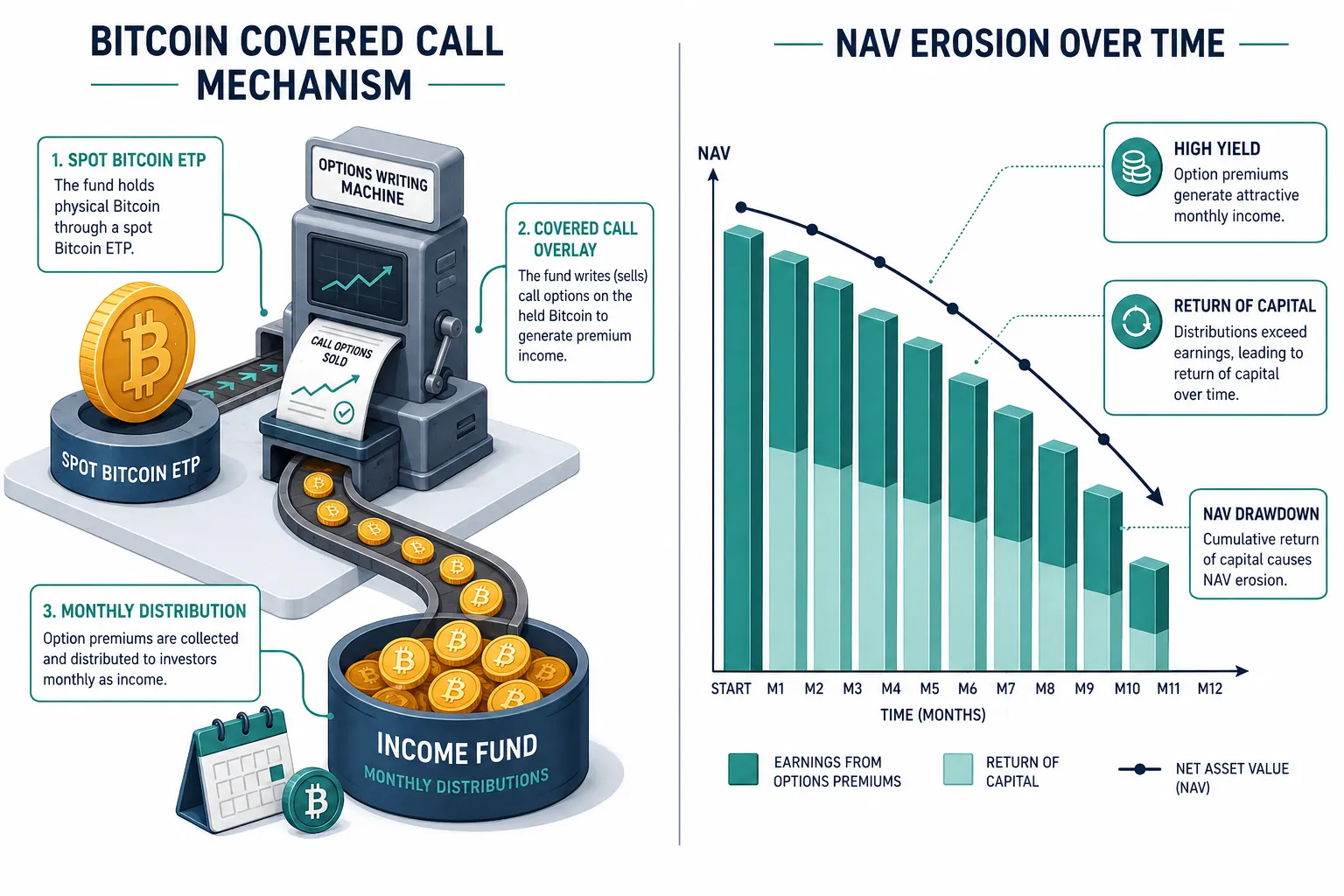
- BTCI does not hold Bitcoin directly; it holds spot Bitcoin ETPs and sells covered call options to generate monthly distributions. [3][4]
- The fund’s advertised distribution rate is approximately 27%, but its 30-day SEC yield was only 1.62% as of July 31, 2026. [3][4]
- An estimated 92% of BTCI’s July 2026 payout was classified as return of capital, meaning investors largely received their own principal back. [4][3]
- BTCI’s net asset value fell roughly 25.54% year-to-date and about 41-43% over the prior 12 months as of late July 2026. [3][4]
- Before this deal, Goldman already held around $715 million in Bitcoin ETFs, mainly through BlackRock’s IBIT. [7]
- Goldman has also executed Bitcoin-backed loans and non-deliverable options, showing a consistent pattern of using Bitcoin as collateral and structured yield underlying. [8][10]
- Covered call strategies cap upside during strong Bitcoin rallies, meaning the fund may underperform simple spot Bitcoin holdings in bull markets. [1][4]
- Regulators and analysts urge investors to focus on total return and NAV trends rather than headline distribution rates. [4][6]
What Is Bitcoin Yield Generation?
Bitcoin yield generation refers to strategies that produce regular income from Bitcoin holdings, rather than simply holding Bitcoin and waiting for price appreciation. Because Bitcoin itself pays no dividends or interest, institutions must use financial instruments layered on top of Bitcoin exposure to create income.
The most common methods include:
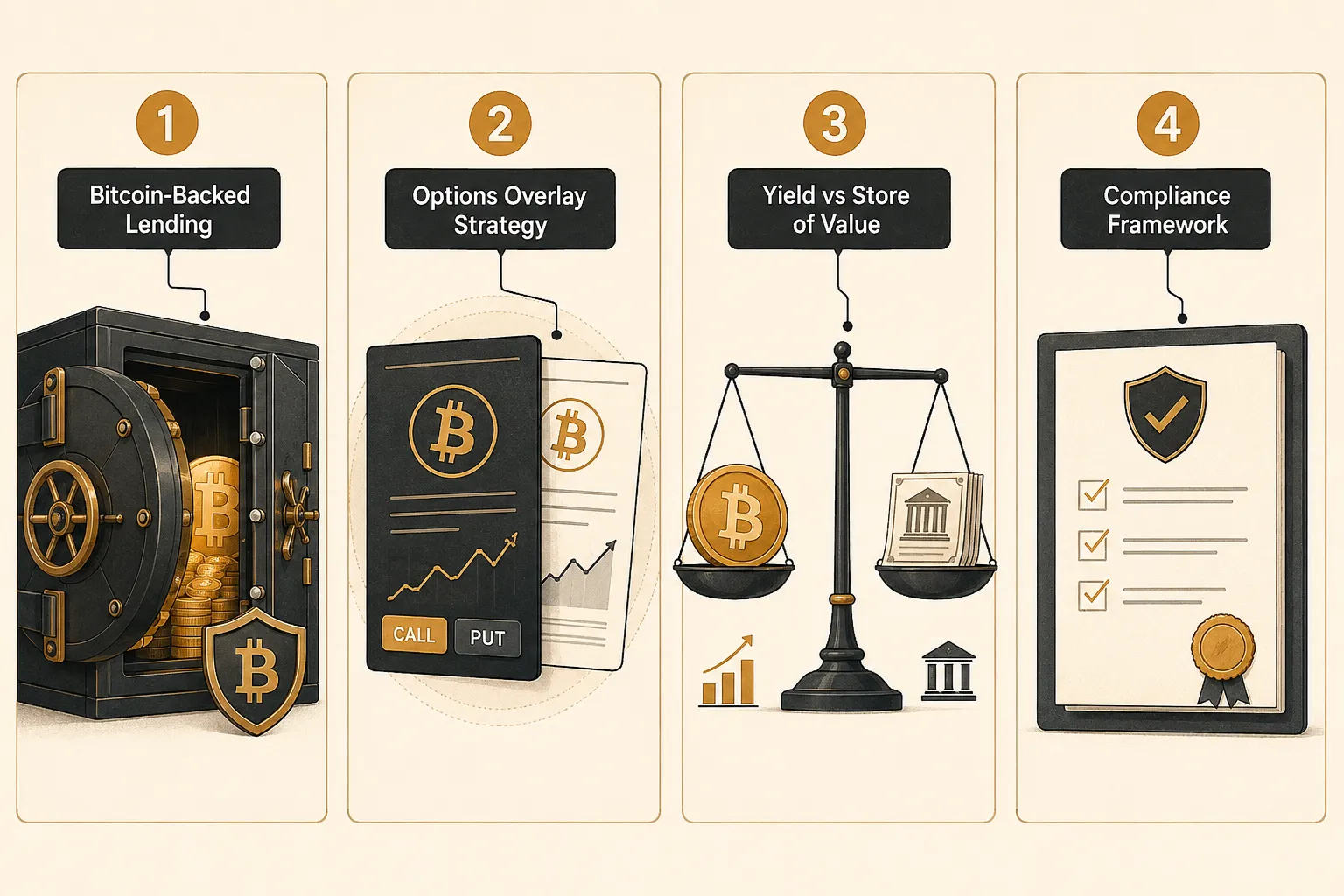
- Covered call writing: Holding Bitcoin or Bitcoin ETFs and selling call options against those positions. The option premium provides income, but the strategy caps potential gains if Bitcoin’s price rises sharply.
- Bitcoin lending: Lending Bitcoin to borrowers (often institutional counterparties) in exchange for interest payments.
- Collateralized loans: Using Bitcoin as collateral to borrow cash, which can then be deployed into yield-bearing instruments.
- Derivatives overlays: Structuring non-deliverable options or other derivative contracts on Bitcoin to generate fee income.
Goldman Sachs’s crypto desk has acknowledged that Bitcoin generates zero native yield, which is why institutions are drawn to derivative overlays and income-style products to monetize their holdings. [9][14] The NEOS/BTCI acquisition is a direct response to that gap.
How Goldman Sachs Eyes Bitcoin for Yield Generation in August 2026: The NEOS Deal Explained
Goldman Sachs’s August 2026 move is the clearest signal yet that Wall Street wants to transform Bitcoin from a speculative asset into an income-producing one. The bank agreed to pay $2.25 billion for NEOS Investments, a deal announced on August 12-13, 2026, with the BTCI Bitcoin income ETF as the primary target. [2][5]
How BTCI works:
- The fund buys spot Bitcoin exchange-traded products (ETPs), gaining Bitcoin price exposure without holding Bitcoin directly.
- It then systematically sells covered call options on those positions.
- The premiums collected from selling options are distributed to shareholders monthly.
- The result is a high headline distribution rate, but with two key trade-offs: capped upside in rallies and potential NAV erosion over time.
As of July 31, 2026, BTCI reported a 26.73% distribution rate alongside a 1.62% 30-day SEC yield. [3][4] The gap between these two numbers is significant. The SEC yield reflects actual income earned; the distribution rate includes return of capital, meaning the fund is partly paying investors back their own money and labeling it as yield.
Key fund metrics at a glance:
| Metric | Value (as of July 31, 2026) |
|---|---|
| Assets Under Management | ~$1.1 billion |
| Distribution Rate | ~26.73% |
| 30-Day SEC Yield | 1.62% |
| NAV Change (YTD) | -25.54% |
| NAV Change (12 months) | -41% to -43% |
| Management Fee | 0.99% |
| 52-Week Share Price Range | ~$28.40 to ~$65.87 |
Sources: [3][4][6]
Common mistake: Treating the 27% distribution rate as equivalent to a 27% return. Roughly 92% of BTCI’s July 2026 payout was estimated as return of capital. [4][3] Investors receiving those distributions are largely getting their own principal back, not income from profitable trades.
Goldman Sachs Crypto Investments History: How Did the Bank Get Here?
Goldman Sachs did not arrive at this point overnight. The bank’s crypto engagement has built steadily over several years, moving from cautious observation to active market participation.
Before the NEOS acquisition, Goldman held approximately $715 million in Bitcoin ETFs in early 2026, primarily through BlackRock’s IBIT (about $690 million) and Fidelity’s FBTC (about $25 million). [7] These were largely passive, directional positions.
Goldman also executed its first Bitcoin-collateralized loan and has traded non-deliverable options on Bitcoin with Galaxy Digital as a liquidity provider. [8][10] These moves show a consistent pattern: using Bitcoin not just as a price bet, but as collateral and as the underlying asset for structured products.
The NEOS deal represents a shift from passive Bitcoin exposure toward active yield-generation structures. [5][13] Analysts describe it as Goldman’s bid to dominate a premium income ETF segment tied to Bitcoin, potentially leapfrogging competitors like BlackRock in the Bitcoin yield niche. [3][4]
What Does Yield Mean in Crypto, and Can You Stake Bitcoin for Rewards?
In crypto, “yield” broadly means any return earned on holdings beyond simple price appreciation. For most proof-of-stake cryptocurrencies like Ethereum, yield comes from staking, where holders lock up coins to help validate the network and earn rewards in return.
Bitcoin is different. Bitcoin uses a proof-of-work consensus mechanism, which means there is no native staking mechanism. You cannot stake Bitcoin for rewards the way you can stake Ethereum. [9] This is a fundamental limitation that pushes institutions toward external yield strategies.
Options for generating yield on Bitcoin:
- Covered call ETFs (like BTCI): Sell options on Bitcoin exposure for monthly premiums.
- Bitcoin lending platforms: Lend Bitcoin to institutional borrowers for interest.
- Bitcoin-backed loans: Borrow against Bitcoin holdings and invest the proceeds.
- Structured notes and derivatives: Custom products that pay a coupon linked to Bitcoin performance.
Choose covered call ETFs if you want regulated, exchange-traded income exposure to Bitcoin without managing options yourself. Choose Bitcoin lending if you have direct Bitcoin holdings and want a simpler income stream, but be aware of counterparty risk.
Bitcoin Lending vs. Staking: Which Is Better for Yield?
For Bitcoin specifically, lending is the primary yield mechanism because staking does not apply. For the broader crypto market, the comparison is more nuanced.
Bitcoin lending involves lending your Bitcoin to a borrower (typically an institution or exchange) in exchange for interest. Rates vary widely based on market demand and counterparty creditworthiness. Goldman’s Bitcoin-backed loan program is an institutional version of this concept. [8][10]
Staking applies to proof-of-stake assets like Ethereum. It is generally considered lower risk than lending because you retain control of your assets and earn network-validated rewards, though smart contract risk still exists.
For institutions following Goldman Sachs’s model, covered call overlays on Bitcoin ETFs represent a third path: they generate income without requiring direct Bitcoin custody or lending counterparty relationships.
Key trade-off: Lending and staking preserve more upside potential. Covered call strategies cap gains during rallies, which can be costly in a strong bull market for Bitcoin. [1][4]
How Goldman Sachs Eyes Bitcoin for Yield Generation in August 2026: Risks Institutions Must Understand
The risks of institutional Bitcoin yield strategies are real and material. Goldman Sachs Eyes Bitcoin for Yield Generation in August 2026 through a product that has already shown significant capital erosion alongside its high distributions.
Primary risks:
- NAV erosion: BTCI’s share price fell from a 52-week high of about $65.87 to around $28.40, a drop of more than 40%. [6][3] High distributions have not protected investors from capital losses.
- Return of capital confusion: When roughly 92% of a monthly payout is return of capital, the fund is essentially liquidating itself slowly. [4][3] This is not sustainable yield.
- Upside cap: Selling covered calls limits gains during Bitcoin rallies. In a strong bull market, BTCI holders would underperform simple Bitcoin spot holders. [1][4]
- Volatility amplification: Bitcoin’s price volatility makes option premiums high but also makes NAV swings severe.
- Regulatory uncertainty: Regulatory changes affecting Bitcoin ETFs, options markets, or crypto broadly could disrupt the strategy’s mechanics.
- Fee drag: A 0.99% management fee compounds the pressure on total returns. [6]
Edge case: In a flat or mildly declining Bitcoin market, covered call strategies can outperform spot Bitcoin because the option premiums provide a buffer. The strategy is not universally bad; it depends heavily on market conditions.
How Bitcoin Compares to Traditional Yield Investments
Traditional yield investments like government bonds, dividend stocks, and real estate investment trusts (REITs) generate income from underlying economic activity: interest payments, corporate profits, or rental income. Bitcoin’s covered call yield is structurally different.
| Feature | Bitcoin Covered Call ETF | 10-Year Treasury Bond | Dividend Stock (S&P 500 avg.) |
|---|---|---|---|
| Source of yield | Options premiums + return of capital | Government interest payments | Corporate dividends |
| Capital stability | Low (high NAV volatility) | High (if held to maturity) | Moderate |
| Upside potential | Capped by call strikes | None beyond coupon | Moderate |
| Inflation hedge | Debated | Low | Moderate |
| Liquidity | High (ETF) | High | High |
Bitcoin yield products are best understood as high-risk income tools, not substitutes for bonds or dividend stocks. They may suit investors who already want Bitcoin exposure and want to monetize that position, but they are not appropriate as core income holdings for risk-averse investors.
Is Bitcoin a Good Investment for Institutions in 2026?
Bitcoin remains a viable institutional allocation in 2026, but with important caveats. Goldman Sachs’s own holdings and the NEOS acquisition confirm that major institutions view Bitcoin as a legitimate asset class. [2][7]
With Bitcoin prices hovering around the mid-$60,000s in late July and August 2026, the asset remains well below prior cycle peaks. [11][9] This backdrop has made yield-oriented strategies more appealing to institutions that want to make holding periods more palatable for clients.
Bitcoin suits institutional investors who:
- Have a multi-year investment horizon and can tolerate high volatility.
- Want portfolio diversification beyond traditional assets.
- Are looking for asymmetric upside potential with a defined position size.
- Can access sophisticated yield overlays to generate income during flat periods.
Bitcoin is less suitable for institutions that:
- Require stable, predictable income streams.
- Have strict capital preservation mandates.
- Cannot tolerate 40%+ drawdowns in a single year.
Is It Too Late to Invest in Bitcoin in 2026?
Whether it is too late to invest in Bitcoin in 2026 depends entirely on investment goals and time horizon. Goldman Sachs’s $2.25 billion commitment to Bitcoin yield products in August 2026 signals continued institutional confidence in Bitcoin’s long-term relevance. [2][5]
That said, Bitcoin’s price history shows cycles of dramatic gains followed by sharp corrections. Investors entering at cycle highs have historically faced multi-year recovery periods. The fact that BTCI’s NAV is down roughly 41-43% over the prior 12 months illustrates how costly poor entry timing can be. [3][4]
Practical guidance:
- Dollar-cost averaging (investing fixed amounts at regular intervals) reduces timing risk.
- Position sizing matters more than entry price for most long-term investors.
- Yield products like BTCI add complexity; understand the return of capital dynamics before investing.
What Regulatory Changes Affect Bitcoin Yields?
Regulatory clarity has improved significantly for Bitcoin ETFs in the United States following the approval of spot Bitcoin ETFs in early 2024. This regulatory shift is a key enabler of Goldman’s August 2026 strategy, as BTCI is built on regulated spot Bitcoin ETPs.
Key regulatory factors affecting Bitcoin yield strategies:
- ETF approval and oversight: SEC-regulated Bitcoin ETFs provide the legal foundation for covered call strategies like BTCI.
- Options market rules: The ability to list and trade options on Bitcoin ETFs is subject to exchange and SEC approval.
- Tax treatment of return of capital: Distributions classified as return of capital have different tax implications than ordinary income, which affects after-tax yield calculations.
- Banking regulations: Rules governing how banks like Goldman can hold, lend against, or structure products around Bitcoin continue to evolve.
- International frameworks: Institutions operating globally must navigate varying regulatory regimes across jurisdictions.
Investors should consult tax and legal advisors before investing in Bitcoin yield products, as the regulatory and tax landscape continues to develop.
How Much Return Can You Realistically Get From Bitcoin Yield Strategies?
The headline numbers are attractive but misleading. BTCI’s advertised ~27% distribution rate sounds compelling, but the 30-day SEC yield of 1.62% and the estimated 92% return-of-capital component in July 2026 payouts tell a more sobering story. [3][4]
Realistic return expectations:
- Option premium income: In volatile markets, covered call premiums on Bitcoin can be substantial, potentially 1-3% per month in high-volatility periods. However, this income is partially offset by capped upside.
- Total return: Investors must evaluate total return (price change plus distributions), not just distribution rate. BTCI’s total return has been negative over the past 12 months despite high distributions. [3][4][6]
- Sustainable yield estimate: The true economic yield from a covered call Bitcoin strategy is likely in the low single digits annually under normal conditions, with higher distributions funded by capital erosion.
Decision rule: If a Bitcoin yield product’s distribution rate far exceeds its SEC yield, investigate the return of capital percentage before investing. A high distribution rate funded primarily by return of capital is not sustainable income.
FAQ
What is Goldman Sachs doing with Bitcoin in August 2026? Goldman Sachs announced a $2.25 billion acquisition of NEOS Investments on August 12-13, 2026, primarily to gain control of the BTCI Bitcoin income ETF, which generates yield by selling covered call options on spot Bitcoin ETPs. [2][5]
Does BTCI hold actual Bitcoin? No. BTCI holds spot Bitcoin exchange-traded products (ETPs) and sells covered call options on those positions. It does not hold Bitcoin directly. [3][4]
What is the difference between BTCI’s distribution rate and its SEC yield? As of July 31, 2026, BTCI’s distribution rate was approximately 26.73%, while its 30-day SEC yield was only 1.62%. The gap exists because most distributions include return of capital, not income earned from the options strategy. [3][4]
Can you stake Bitcoin like Ethereum? No. Bitcoin uses proof-of-work, not proof-of-stake, so there is no native staking mechanism. Bitcoin yield must come from external strategies like lending, covered calls, or collateralized lending. [9]
Why is Goldman Sachs interested in Bitcoin yield products? Goldman recognizes that Bitcoin generates zero native yield, making income-oriented products attractive to institutional clients who want Bitcoin exposure with regular cash distributions. The NEOS deal gives Goldman a ready-made product in this niche. [1][2][9]
What are the main risks of BTCI? The main risks include severe NAV erosion (down 41-43% over 12 months), distributions that are largely return of capital (estimated 92% in July 2026), capped upside during Bitcoin rallies, and a 0.99% management fee. [3][4][6]
How does Goldman’s Bitcoin strategy compare to BlackRock’s? Before the NEOS deal, Goldman held about $715 million in Bitcoin ETFs primarily through BlackRock’s IBIT. The NEOS acquisition is described as Goldman’s move to leapfrog BlackRock in the Bitcoin yield niche by gaining a $1.1 billion income-focused Bitcoin ETF. [3][7]
Is the 27% distribution rate from BTCI real income? Not in the traditional sense. Approximately 92% of BTCI’s July 2026 distribution was classified as return of capital, meaning investors were largely receiving their own principal back rather than income generated from profitable trades. [4][3]
What is a covered call strategy in the context of Bitcoin? A covered call strategy involves holding Bitcoin or Bitcoin ETPs and selling call options on those positions. The option buyer pays a premium for the right to buy Bitcoin at a set price; the seller keeps that premium as income but gives up gains above the strike price. [2][4]
How does Bitcoin yield compare to bond yields? Bitcoin covered call yield is structurally different from bond yield. Bond interest comes from contractual government or corporate obligations; Bitcoin covered call distributions come from options premiums and often include return of capital. Bitcoin yield carries far higher capital risk than investment-grade bonds.
What should investors watch before buying a Bitcoin yield ETF? Investors should examine the 30-day SEC yield (not just the distribution rate), the percentage of distributions classified as return of capital, NAV performance over 12 months, the management fee, and how the strategy performs in both rising and falling Bitcoin markets. [4][6]
Did Goldman Sachs previously have any Bitcoin exposure before August 2026?
Yes. Goldman held approximately $715 million in Bitcoin ETFs in early 2026, primarily via BlackRock’s IBIT ($690 million) and Fidelity’s FBTC ($25 million), and had also executed Bitcoin-backed loans and derivatives trades. [7][8][10]
Conclusion
Goldman Sachs Eyes Bitcoin for Yield Generation in August 2026 through a bold $2.25 billion acquisition that signals a fundamental shift in how major financial institutions engage with cryptocurrency. Rather than simply holding Bitcoin as a directional bet, Goldman is building infrastructure to deliver regular income from Bitcoin exposure, using covered call options as the primary mechanism.
The strategy is innovative, but investors must approach it with clear eyes. The BTCI fund’s 27% headline distribution rate is not equivalent to a 27% return. NAV erosion, return-of-capital distributions, and capped upside during rallies are material risks that any investor must weigh carefully. [4][3][6]
Actionable next steps for investors and advisors:
- Distinguish distribution rate from total return. Always check a fund’s 30-day SEC yield and NAV performance alongside its distribution rate before investing.
- Understand return of capital. Ask what percentage of distributions are classified as return of capital. A high percentage signals the fund is paying you back your own money, not generating sustainable income.
- Size positions appropriately. Bitcoin yield products are high-risk instruments. They should represent a small, defined portion of a diversified portfolio, not a core income holding.
- Monitor regulatory developments. Tax treatment of return-of-capital distributions and evolving banking regulations around Bitcoin products can affect after-tax returns.
- Compare total return, not just yield. Evaluate how a Bitcoin yield ETF’s total return compares to simply holding a spot Bitcoin ETF over the same period before committing capital.
Goldman’s move into Bitcoin yield products will likely accelerate competition in this space, potentially bringing more options and lower fees over time. For now, the key lesson is that turning Bitcoin into a yield machine comes with real costs, and understanding those costs is the first step to making an informed decision.
References
[1] Goldman Sachs Wants Turn Bitcoin 162000621 – https://finance.yahoo.com/video/goldman-sachs-wants-turn-bitcoin-162000621.html
[2] Goldman Sachs Paying 2 25 143600528 – https://finance.yahoo.com/markets/crypto/articles/goldman-sachs-paying-2-25-143600528.html
[3] Goldman Sachs Drops 2 25 Billion To Hijack The Bitcoin Yield Market And Leapfrog Blackrock By 19x – https://www.cryptosurges.com/goldman-sachs-drops-2-25-billion-to-hijack-the-bitcoin-yield-market-and-leapfrog-blackrock-by-19x/
[4] Leap Frog Goldmans 225 Billion Bitcoin Shock Rattles Blackrock – https://www.forbes.com/sites/boazsobrado/2026/08/14/leap-frog-goldmans-225-billion-bitcoin-shock-rattles-blackrock/
[5] Goldman Sachs Leaps Into Bitcoin Income Etfs With Usd2 25 Billion Neos Buyout – https://www.coindesk.com/business/2026/08/12/goldman-sachs-leaps-into-bitcoin-income-etfs-with-usd2-25-billion-neos-buyout
[6] Goldman Sachs Buys Neos In 2 25 Billion Deal To Land 1 Billion Bitcoin Yield Etf – https://cryptozalt.com/goldman-sachs-buys-neos-in-2-25-billion-deal-to-land-1-billion-bitcoin-yield-etf/
[7] Goldman Sachs Crypto Holdings Bitcoin Ethereum Etf 2026 – https://www.coingabbar.com/en/crypto-currency-news/goldman-sachs-crypto-holdings-bitcoin-ethereum-etf-2026
[8] Goldman Sachs Rolls Out First Bitcoin-Backed Loan – https://www.forbesindia.com/article/crypto%252525E2%25252580%25252590made%252525E2%25252580%25252590easy/goldman%252525E2%25252580%25252590sachs%252525E2%25252580%25252590rolls%252525E2%25252580%25252590out%252525E2%25252580%25252590first%252525E2%25252580%25252590bitcoinbacked%252525E2%25252580%25252590loan/75833/1
[9] Goldman Sachs Crypto Desk Publishes Bitcoin Btc Allocation – https://www.openpr.com/news/4446942/goldman-sachs-crypto-desk-publishes-bitcoin-btc-allocation
[10] Goldman Sachs Partners With Coinbase For Banks First Bitcoin Backed Loan – https://bitcoinmagazine.com/business/goldman-sachs-partners-with-coinbase-for-banks-first-bitcoin-backed-loan