Last updated: July 10, 2026
Quick Answer: The Cryptocurrency Prices And News: Bitcoin Rises, Shift4 Adds Stablecoin Settlements story covers two major developments: Bitcoin surged close to $117,200 in late April 2026 before pulling back sharply, and payments processor Shift4 launched stablecoin settlement functionality for its merchant network. Together, these events reflect the ongoing convergence of traditional payments infrastructure and digital assets.
Key Takeaways
- Bitcoin reached approximately $117,200 in late April 2026, a roughly 3.5% single-day gain, before retreating to the $58,000-$62,000 range by early July 2026 [2][8]
- Shift4, a major U.S. payments processor, added stablecoin settlement options, letting merchants receive payments settled in stablecoins rather than only fiat currency [2]
- Stablecoin settlements can reduce foreign exchange fees and speed up cross-border payment finality compared to traditional bank transfers
- Bitcoin’s April spike and July correction illustrate the asset’s characteristic volatility, with support zones identified near $56,200-$58,200 and resistance near $62,500-$63,800 [5]
- Stablecoins are pegged to fiat currencies (usually the U.S. dollar), making them far less volatile than Bitcoin or Ethereum
- Shift4’s move signals that mainstream payment processors are treating crypto infrastructure as a competitive differentiator, not a novelty
- Beginners following crypto news should focus on verified price trackers and reputable financial news sources rather than social media speculation
- Bitcoin price movements tend to pull the broader crypto market in the same direction, though the magnitude varies by asset
Why Did Bitcoin Price Go Up in April 2026?
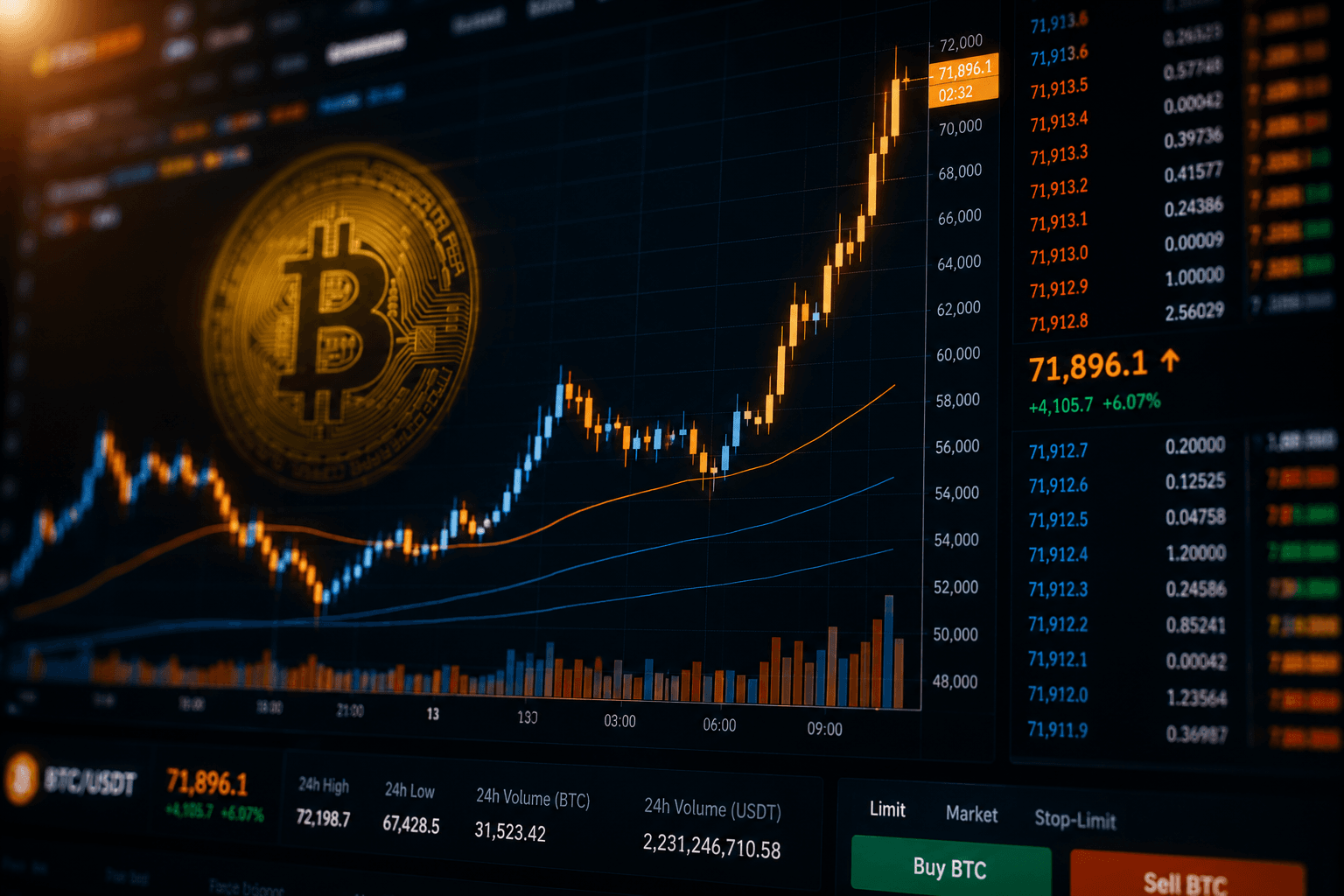
Bitcoin surged close to $117,200 on or around April 22, 2026, a gain of roughly 3.5% within 24 hours, according to CoinMarketCap data cited in the Cryptocurrency Prices And News: Bitcoin Rises, Shift4 Adds Stablecoin Settlements report [2]. That rally reflected a combination of renewed institutional buying interest, positive macro sentiment, and short-squeeze dynamics in futures markets.
Key factors that typically drive short-term Bitcoin price spikes include:
- Institutional inflows: Large purchases by ETF providers or corporate treasuries reduce available supply on exchanges
- Short liquidations: When prices rise quickly, traders who bet against Bitcoin are forced to buy back, accelerating the move
- Macro catalysts: Easing inflation data or Federal Reserve signals can push risk assets higher simultaneously
- News-driven momentum: Announcements like Shift4’s stablecoin integration signal mainstream adoption, which can attract speculative buying
However, the April spike did not hold. By July 1, 2026, Bitcoin had fallen to approximately $58,278-$58,620, representing a roughly 20% decline for June and a 21-month low [6][8]. This kind of retracement is common after sharp rallies and underscores the importance of not treating short-term price spikes as durable trends.
What Is Shift4 and Why Does It Matter for Crypto?
Shift4 is one of the largest U.S.-based payment processing companies, handling billions of dollars in transactions annually for merchants in hospitality, retail, and food service. Its decision to add stablecoin settlement functionality is significant because it brings crypto-native payment rails to a mainstream merchant base that previously had no practical reason to engage with digital assets [2].
When a company of Shift4’s scale integrates stablecoins, it validates the technology for thousands of smaller merchants who rely on its platform. This is not a crypto startup experiment; it is an established payments infrastructure provider making a deliberate product decision.
Why this matters for the broader crypto market:
- It increases real-world transaction volume for stablecoins, which strengthens the case for their utility beyond speculation
- It creates competitive pressure on other payment processors to offer similar features
- It signals regulatory comfort, since a company of Shift4’s size would not launch a stablecoin product without legal review
What Are Stablecoin Settlements and How Do They Work?
A stablecoin settlement means that when a customer pays a merchant, the final funds received by the merchant are denominated in a stablecoin (such as USDC or USDT) rather than traditional currency. The process works as follows:
- Customer pays in any accepted method (card, crypto, or fiat)
- The payment processor converts the funds into the designated stablecoin
- The stablecoin is transferred to the merchant’s digital wallet, typically within minutes
- The merchant can then hold, convert, or spend the stablecoin as needed
How stablecoin settlements reduce transaction costs: Traditional cross-border wire transfers can carry fees of 1-3% plus foreign exchange spreads and settlement delays of 1-3 business days. Stablecoin settlements on public blockchains can settle in seconds to minutes with fees that are often a fraction of a cent on networks like Solana or a few dollars on Ethereum, depending on network congestion.
Common mistake: Merchants sometimes assume stablecoins carry zero risk. They do not. Risks include smart contract vulnerabilities, issuer insolvency (relevant for centralized stablecoins), and regulatory changes that could freeze or restrict stablecoin transfers.
Which Stablecoins Does Shift4 Support?
As of the April 2026 announcement, Shift4’s stablecoin settlement feature was confirmed as part of its expanded crypto services, though the specific list of supported stablecoins was not exhaustively detailed in the initial report [2]. The most commonly integrated stablecoins by payment processors are:
| Stablecoin | Peg | Blockchain(s) | Issuer |
|---|---|---|---|
| USDC | 1:1 USD | Ethereum, Solana, others | Circle |
| USDT | 1:1 USD | Ethereum, Tron, others | Tether |
| PYUSD | 1:1 USD | Ethereum, Solana | PayPal |
Merchants considering Shift4’s stablecoin option should confirm directly with Shift4 which assets are supported before building any treasury or accounting workflows around a specific token.
What Is the Difference Between Stablecoins and Regular Crypto?
Stablecoins are designed to maintain a fixed value, usually pegged 1:1 to the U.S. dollar. Regular cryptocurrencies like Bitcoin and Ethereum have floating prices determined by market supply and demand, which means they can gain or lose 10-20% of their value in a single day.
Choose stablecoins if: The goal is predictable value transfer, payment settlement, or short-term holding without price exposure.
Choose Bitcoin or Ethereum if: The goal is speculative investment, store-of-value exposure, or participation in decentralized finance protocols that require native assets.
For merchants, this distinction is critical. Accepting Bitcoin directly means the value of a $500 sale could be worth $430 by the time it settles. Accepting a USD-pegged stablecoin eliminates that volatility entirely.

How Do Bitcoin Price Movements Affect the Broader Crypto Market?
Bitcoin’s price movements tend to set the tone for the entire cryptocurrency market. When Bitcoin rises sharply, altcoins (all other cryptocurrencies) typically follow, though often with a delay and at higher volatility. When Bitcoin falls, altcoins usually fall further in percentage terms.
This correlation exists because Bitcoin is the largest cryptocurrency by market capitalization and serves as the primary trading pair on most exchanges. Institutional investors also tend to treat Bitcoin as a proxy for overall crypto market sentiment.
The April 2026 spike to ~$117,200 [2] and the subsequent July correction to ~$58,000-$62,000 [8][6] both moved the broader market in the same direction, confirming this pattern held in 2026.
Is Now a Good Time to Buy Bitcoin in 2026?
No single answer fits all investors, but the technical picture as of early July 2026 shows Bitcoin testing significant support levels. Key reference points from 24/7 Wall St.’s July 2026 analysis include support zones near $56,200-$58,200, resistance near $62,500-$63,800, and a potential deeper downside into the low $50,000s if support breaks [5].
Decision framework:
- Dollar-cost averaging (DCA): Buying fixed amounts at regular intervals reduces the risk of buying at a single peak
- Risk tolerance check: Bitcoin dropped roughly 50% from its April high to early July lows; only invest what can be held through that kind of drawdown
- Time horizon: Short-term traders face significant technical uncertainty; long-term holders (3+ years) have historically recovered from similar corrections [1][3]
This is not financial advice. Consult a licensed financial advisor before making investment decisions.
What Are the Risks of Stablecoin Payments for Businesses?
Stablecoin payments carry real risks that businesses must evaluate before adoption. The main categories are:
- Regulatory risk: Stablecoin regulations are still evolving in the U.S. and EU. New rules could restrict how businesses hold or transfer stablecoins
- Counterparty risk: Centralized stablecoins like USDT depend on the issuer maintaining adequate reserves; a reserve shortfall could cause the peg to break
- Operational risk: Sending stablecoins to a wrong wallet address is typically irreversible
- Tax complexity: In many jurisdictions, receiving stablecoins may trigger taxable events, and accounting systems may not handle crypto natively
Edge case: A stablecoin that temporarily loses its peg (even briefly, as USDC did in March 2023 during the Silicon Valley Bank crisis) can create accounting discrepancies for businesses that settled transactions during that window.
What Should Beginners Know About Following Crypto News
Beginners should treat crypto news as a signal to research, not a signal to act. The Cryptocurrency Prices And News: Bitcoin Rises, Shift4 Adds Stablecoin Settlements headline is a good example: the Bitcoin price mentioned ($117,200) was a short-term spike, not a new baseline, and acting on that number without context would have led to buying near a local top [2].
Practical habits for following crypto news:
- Check prices on multiple verified trackers (CoinMarketCap, Bitbo, exchange apps) rather than relying on a single source [7]
- Separate price news from fundamental news; Shift4’s stablecoin integration is a fundamental development with long-term implications, while daily price moves are mostly noise
- Follow reputable financial outlets rather than anonymous social media accounts
- Check how often prices are updated; some aggregators lag by 15-30 minutes during volatile periods
How often to check: For long-term investors, checking weekly is sufficient. Active traders may monitor hourly, but more frequent checking often leads to emotional, poorly-timed decisions.
Is Shift4’s Stablecoin Move Bullish or Bearish for Crypto?
Shift4’s stablecoin integration is broadly bullish for the crypto ecosystem, particularly for stablecoins and the blockchains that support them. When a mainstream payments company adds crypto settlement infrastructure, it increases real-world utility and transaction volume, which are positive long-term signals.
However, the direct impact on Bitcoin’s price is indirect. Stablecoin settlements do not require Bitcoin; they use dollar-pegged tokens. The bullish signal is more relevant to stablecoin issuers (like Circle, which issues USDC) and the blockchains those stablecoins run on.
For the broader narrative tracked in Cryptocurrency Prices And News: Bitcoin Rises, Shift4 Adds Stablecoin Settlements, Shift4’s move reinforces that crypto infrastructure is becoming embedded in traditional finance, which tends to support long-term price floors across the asset class [2].
Conclusion
The Cryptocurrency Prices And News: Bitcoin Rises, Shift4 Adds Stablecoin Settlements story captures two distinct but related trends: Bitcoin’s continued price volatility (a spike to ~$117,200 in April followed by a retreat to the $58,000-$62,000 range by July [2][8][6]) and the steady integration of crypto payment rails into mainstream commerce through Shift4’s stablecoin settlement feature.
Actionable next steps:
- Merchants on the Shift4 platform should request details on which stablecoins are supported and review the tax and accounting implications before enabling the feature
- Investors monitoring Bitcoin should track the $56,200-$58,200 support zone and $62,500-$63,800 resistance levels identified for July 2026 [5]
- Beginners should build a habit of cross-referencing price data across at least two verified sources before drawing conclusions from any single headline
- Businesses considering stablecoin payments should consult both a legal advisor and an accountant familiar with digital asset regulations in their jurisdiction
- Long-term Bitcoin holders should review their risk tolerance against the asset’s demonstrated capacity for 40-50% drawdowns within a single quarter
Staying informed through credible sources and separating short-term price noise from structural developments like Shift4’s integration is the most practical approach for both investors and businesses engaging with crypto in 2026.
FAQ
What price did Bitcoin reach in April 2026? Bitcoin surged close to $117,200 around April 22, 2026, representing approximately a 3.5% gain in 24 hours, according to CoinMarketCap data cited by Investors.com [2].
What is Shift4’s stablecoin settlement feature? Shift4 added the ability for merchants on its platform to receive transaction settlements in stablecoins rather than only in traditional fiat currency, expanding its crypto-related payment services [2].
Where was Bitcoin trading in early July 2026? Bitcoin was trading in the $58,000-$62,000 range in early July 2026, down roughly 20% for June and near a 21-month low, according to Finbold and Fortune [8][6].
Are stablecoins safe for business payments? Stablecoins are more price-stable than Bitcoin, but they carry regulatory, counterparty, and operational risks. Businesses should review issuer reserve quality and local tax rules before adopting them.
Does Shift4’s stablecoin move affect Bitcoin’s price? Not directly. Stablecoin settlements use dollar-pegged tokens, not Bitcoin. The broader bullish signal is for stablecoin issuers and the blockchains they run on, with only an indirect positive effect on overall crypto sentiment.
What support levels should Bitcoin investors watch in July 2026? Key support is identified near $56,200-$58,200, with resistance near $62,500-$63,800, based on technical analysis from 24/7 Wall St. [5].
What is the difference between USDC and USDT? Both are USD-pegged stablecoins. USDC is issued by Circle and is generally considered more transparent about its reserves. USDT is issued by Tether and has the highest trading volume globally. Both carry issuer-specific risks.
How often should a beginner check Bitcoin prices? For long-term investors, weekly check-ins are sufficient. Checking more frequently often leads to emotional decisions without improving outcomes.
Why did Bitcoin fall after its April 2026 high? Post-rally corrections are common in Bitcoin’s history. After reaching ~$117,200, profit-taking, macro uncertainty, and weak June trading volume contributed to a decline toward the $58,000 range by July 2026 [8][6].
Can merchants convert stablecoins back to dollars easily? Yes. Most stablecoin issuers and crypto exchanges allow direct redemption of major stablecoins like USDC for U.S. dollars, typically within one business day.
References
[2] Cryptocurrency Prices News – https://www.investors.com/news/cryptocurrency-prices-news/ [5] Bitcoin Price Prediction For July 2026 – https://247wallst.com/investing/cryptocurrency/2026/07/02/bitcoin-price-prediction-for-july-2026/ [6] Price Of Bitcoin 07 01 2026 – https://fortune.com/article/price-of-bitcoin-07-01-2026/ [7] Price – https://charts.bitbo.io/price/ [8] Bitcoin Price Today July 2026 – https://finbold.com/bitcoin-price-today-july-2026/ [1] Bitcoin Price Prediction – https://changelly.com/blog/bitcoin-price-prediction/ [3] Price Prediction – https://coincodex.com/crypto/bitcoin/price-prediction/