
}
Last updated: July 14, 2026
Quick Answer: On July 10, 2026, Circle Internet Group received final approval from the U.S. Office of the Comptroller of the Currency (OCC) to establish a national trust bank called Circle National Trust. This makes Circle one of fewer than 10 fintech or digital asset companies to hold an OCC banking or trust charter, and it directly strengthens the regulatory foundation of USDC, the world’s largest regulated stablecoin, which has more than $73 billion in circulation. [1][4]
Key Takeaways
- Circle received OCC approval on July 10, 2026, to establish First National Digital Currency Bank, N.A., operating as Circle National Trust. [4]
- Circle National Trust is a federally chartered trust bank and qualified custodian, not a commercial bank, it does not take deposits or make loans. [3]
- The charter consolidates Circle’s digital asset custody and reserve operations under a single federal regulator, the OCC, replacing a patchwork of state-level oversight. [1][7]
- USDC has more than $73 billion in circulation, and the new charter is designed to support federally regulated custody and future reserve management for the stablecoin. [1][4]
- Circle’s stock surged approximately 12 to 14 percent following the OCC approval announcement. [1][6]
- Initial services will focus on fiduciary digital asset custody for Circle and its affiliates, with potential future expansion to a limited number of institutional customers. [4][5]
- Circle applied for the national trust bank charter in June 2025, making the approval process roughly 13 months. [10]
- This development positions USDC as trusted, federally regulated digital dollar infrastructure for payments, settlement, and capital markets. [2][4]
What Is Circle’s Federal Trust Bank Boost?
Circle’s Federal Trust Bank Boost refers to the OCC’s final approval for Circle Internet Group to establish a national trust bank, a regulatory milestone that significantly elevates the company’s standing in both the crypto and traditional finance sectors. The newly chartered entity, Circle National Trust, operates as a federally supervised custodian for digital assets. [4][5]
This is not a commercial banking license. Circle National Trust cannot accept customer deposits or issue loans. Its purpose is narrower and more specific: it acts as a fiduciary custodian, safeguarding digital assets under direct OCC supervision. For Circle, this means the infrastructure backing USDC moves from a mix of state-regulated arrangements to a single, federally chartered framework.
Why this matters: Federal charters carry more regulatory weight than state money transmitter licenses. They signal institutional-grade compliance, which is a key factor for large banks, asset managers, and payment processors evaluating whether to build on USDC rails.
What Happened With Circle and Federal Trust Bank: The Full Timeline
Circle applied for a national trust bank charter in June 2025, and the OCC granted final approval on July 10, 2026. [4][10] The approved entity is formally named First National Digital Currency Bank, N.A., and will operate under the brand name Circle National Trust. [4][5]
Key milestones:
- June 2025: Circle submits its application to the OCC for a national trust bank charter. [10]
- July 10, 2026: OCC grants final approval; Circle announces Circle National Trust publicly. [4]
- Same day: Circle’s stock (NYSE: CRCL) surges approximately 12 to 14 percent on investor optimism. [1][6]
This timeline places Circle among a very small group. Fewer than 10 fintech or digital asset companies have secured an OCC banking or trust charter to date. [7][9]
How Does Circle’s Federal Trust Bank Boost Work?
Circle National Trust functions as a federally chartered trust bank and qualified custodian. In practice, it creates a regulated fiduciary layer within the Circle ecosystem that holds digital assets on behalf of Circle and its affiliates under OCC supervision. [3][4]
Here is how the structure works:
- Custody layer: Circle National Trust holds digital assets in a fiduciary capacity, meaning it has a legal obligation to act in the best interest of the asset owners.
- Reserve management: The charter supports federally regulated custody of USDC reserves, with future reserve management capabilities built into the approved business plan. [4]
- Institutional expansion: Over time, and depending on demand, Circle National Trust may extend custody services to a limited number of institutional customers, specifically banks and regulated financial institutions such as derivatives organizations. [4][7]
- Single federal regulator: All these operations fall under OCC oversight, replacing the previous arrangement where Circle relied on a patchwork of state-level regulatory frameworks. [1][7]
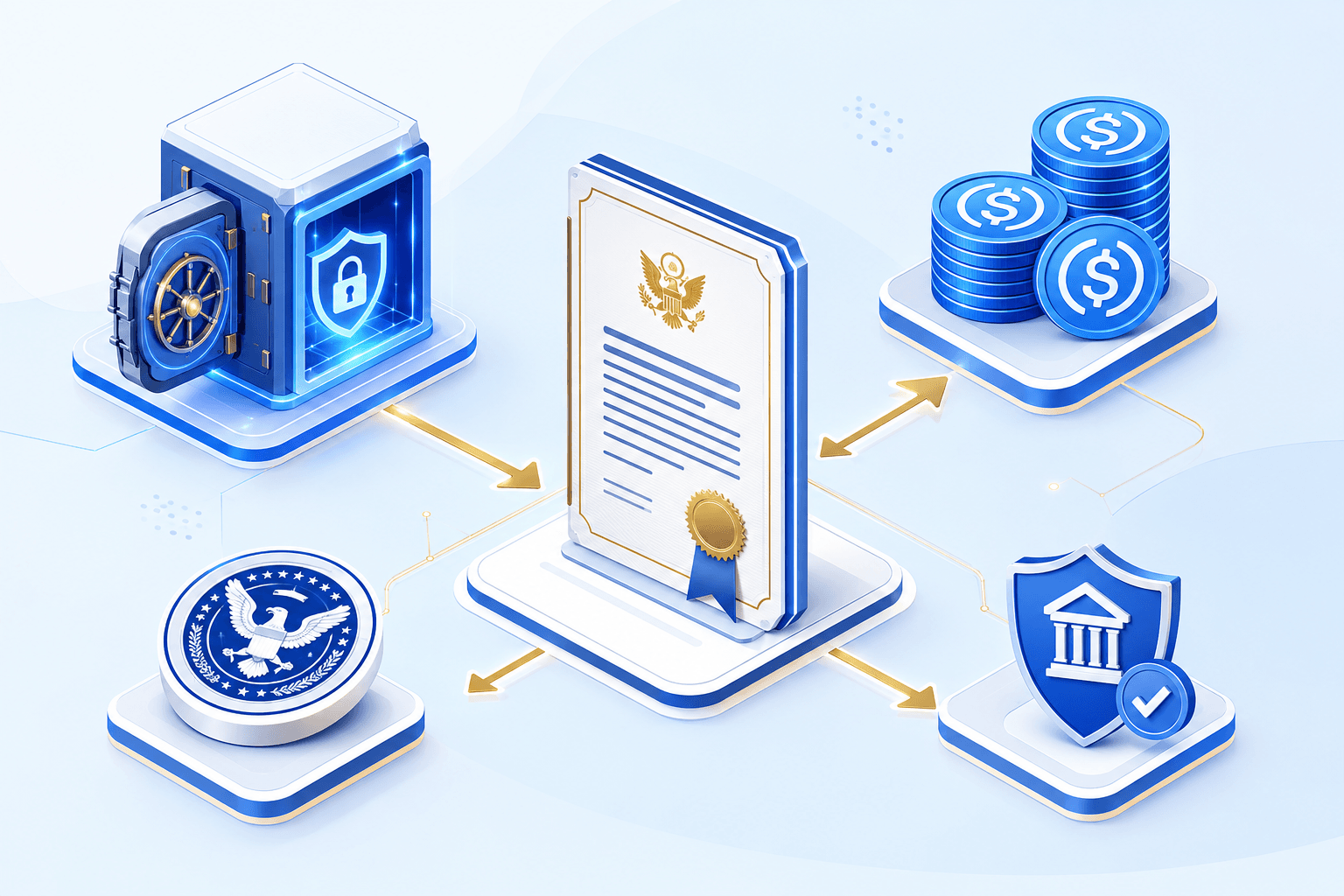
“Circle National Trust is a federally chartered trust bank and qualified custodian that safeguards digital assets under direct OCC supervision.”, Circle [3]
Why Did Circle Partner With Federal Trust Bank: The Strategic Rationale
Circle pursued a federal trust bank charter primarily to control its own reserve and custody infrastructure rather than depending on third-party banks and external custodians. Before this approval, Circle’s multibillion-dollar USDC reserves were managed through external financial institutions, creating counterparty risk and operational complexity. [1][4]
A federal charter solves several problems at once:
- Margin improvement: Bringing reserve management in-house reduces fees paid to external custodians, which analysts expect to improve Circle’s operating margins.
- Risk reduction: Direct OCC supervision eliminates the risk of a custodian partner failing or changing terms.
- Credibility signal: A federal charter is recognized by institutional counterparties globally as a mark of regulatory seriousness, which supports USDC adoption in capital markets and payments. [2][4]
- Regulatory clarity: Operating under one federal regulator simplifies compliance compared to managing dozens of state-level licenses. [7]
Circle vs. Other Stablecoin Providers: Bank Integrations Compared
Circle’s Federal Trust Bank Boost sets it apart from most stablecoin competitors in one clear way: direct federal oversight of custody and reserves. Most other stablecoin issuers still rely on third-party banking relationships or state-licensed trust companies.
| Feature | Circle (USDC) | Typical Competitor |
|---|---|---|
| Regulatory charter type | OCC national trust bank | State money transmitter or state trust |
| Reserve custody | In-house (Circle National Trust) | Third-party banks or custodians |
| Federal oversight | Yes, OCC | Varies by state |
| Deposit-taking | No | No (for most stablecoin issuers) |
| Institutional custody expansion | Planned (banks, derivatives orgs) | Limited or not applicable |
The practical difference for institutional users is significant. A federally chartered custodian meets the “qualified custodian” standard required by many regulated investment advisers and fund managers, which opens USDC to a broader set of institutional use cases. [3][7]
Is Circle’s Federal Trust Bank Boost Safe?
Circle National Trust is designed to be one of the most regulated digital asset custody structures in the United States. It operates under direct OCC supervision, which applies the same federal oversight framework used for national banks. [3][4]
Key safety features:
- Fiduciary duty: As a trust bank, Circle National Trust has a legal obligation to act in the interest of the assets it holds.
- Federal examination: The OCC conducts regular examinations of national trust banks, providing ongoing oversight rather than one-time licensing.
- No deposit risk: Because Circle National Trust does not take deposits, it is not exposed to the bank-run dynamics that affected some crypto-adjacent banks in recent years.
- Separation from commercial banking risk: The trust bank structure isolates custody operations from lending and credit risk. [3][7]
Important caveat: Circle National Trust is not FDIC-insured, because it is a trust bank, not a commercial bank. Users should understand that USDC itself is a stablecoin backed by reserves, not a bank deposit.
How Does Circle’s Bank Boost Affect USDC Transfers and the Stablecoin Market?
For everyday USDC users, Circle’s Federal Trust Bank Boost does not change how USDC transfers work at the transaction level. Transfers remain fast, on-chain, and settled in the same way as before. [3][4]
The structural impact is longer-term and more significant for institutional users:
- Reserve confidence: USDC reserves are now custodied under federal oversight, which reduces the risk of reserve mismanagement.
- Institutional adoption: The qualified custodian status makes USDC more accessible to regulated fund managers and financial institutions that have strict custodian requirements.
- Market signaling: The OCC approval reinforces USDC’s position as federally regulated digital dollar infrastructure, which could accelerate its use in payments, settlement, and capital markets. [2][4]
- Competitive pressure: Other stablecoin issuers may face pressure to seek similar regulatory upgrades, raising the bar for the entire sector.
What’s the Difference Between Circle National Trust and Regular Banking Relationships?
Before the OCC approval, Circle managed USDC reserves through external banks and custodians, a common arrangement for fintech and crypto firms. Circle National Trust changes this by bringing custody in-house under a federal charter. [1][4][7]
The key differences:
- Control: Circle now directly controls its reserve custody rather than relying on third-party institutions.
- Regulatory layer: External banking relationships are governed by the counterparty bank’s regulators. Circle National Trust is governed directly by the OCC.
- Cost structure: In-house custody eliminates custodian fees, improving margins over time.
- Counterparty risk: Removing external custodians reduces the risk that a partner bank’s problems could affect USDC operations.
Can Non-U.S. Users and Institutions Use Circle National Trust?
Circle National Trust’s initial services are focused on fiduciary digital asset custody for Circle and its affiliates, not direct public access. [4][5] For individual USDC users outside the United States, the trust bank does not change day-to-day access to USDC.
For international institutional customers, the picture is more nuanced:
- The OCC charter is a U.S. federal designation, so direct custody services from Circle National Trust will initially be limited to U.S.-regulated entities.
- Circle’s approved business plan indicates potential future expansion to a “limited number of institutional customers,” specifically banks and regulated financial institutions. [4][7]
- International institutions that want to use USDC can still do so through Circle’s existing products and partner networks, with the trust bank providing an added layer of reserve security in the background.
How Much Does Circle’s Bank Boost Cost and How Do I Access It?
Circle National Trust is not a consumer product with a sign-up fee. It is a regulated custody infrastructure entity within Circle’s corporate structure. [3][4]
- For individual users: There is no direct sign-up process or cost. USDC users benefit indirectly through improved reserve security and regulatory credibility.
- For institutional customers: Circle has indicated that custody services may eventually be extended to a limited number of banks and regulated financial institutions, but no public pricing or enrollment process has been announced as of July 2026. [4][7]
- For businesses building on USDC: Access to Circle’s broader ecosystem (Circle APIs, USDC on-chain) remains through Circle’s existing developer and business programs.

Common Problems and Misconceptions About Circle’s Federal Trust Bank Boost
Several misunderstandings have circulated since the July 10, 2026 announcement:
- Misconception: Circle is now a full commercial bank. False. Circle National Trust is a trust bank only. It cannot take deposits or make loans. [3][7]
- Misconception: USDC is now FDIC-insured. False. Trust banks are not FDIC-insured institutions. USDC remains a stablecoin backed by reserves, not a bank deposit.
- Misconception: Any crypto company can now get an OCC charter. The OCC process is rigorous. Fewer than 10 fintech or digital asset companies have achieved this. [7][9]
- Misconception: This changes USDC on-chain mechanics. The trust bank affects custody and reserve management infrastructure, not the on-chain transfer mechanics of USDC.
Conclusion
Circle’s Federal Trust Bank Boost marks a genuine structural shift in how a major stablecoin issuer operates within the U.S. regulatory system. The OCC approval for Circle National Trust consolidates federal oversight, brings reserve custody in-house, and positions USDC as a federally regulated digital dollar with institutional-grade credibility. [1][4][7]
Actionable next steps based on this development:
- Institutional investors and fund managers: Evaluate whether USDC’s new qualified custodian status meets your internal compliance requirements for digital asset exposure.
- Businesses building on stablecoin rails: Review Circle’s developer documentation and monitor announcements about institutional custody access as Circle National Trust expands its services.
- Stablecoin competitors and other crypto firms: The OCC approval raises the regulatory bar. Firms relying solely on state-level licenses should assess whether a federal charter application aligns with their long-term strategy.
- Regulators and policymakers: Circle’s model provides a working template for how digital asset companies can integrate into the federal banking framework without becoming full commercial banks.
The broader implication is clear: federally chartered digital asset custody is no longer theoretical. It is operational, and it will influence how the next generation of stablecoin infrastructure is built and regulated across the United States and beyond. [2][4]
FAQ
What is Circle National Trust? Circle National Trust is a federally chartered trust bank and qualified custodian approved by the OCC on July 10, 2026. It safeguards digital assets under direct federal supervision and is not a commercial bank. [3][4]
Does Circle National Trust take deposits? No. Circle National Trust is structured as a trust bank, which means it does not accept deposits or make loans. [3][7]
How does the OCC approval affect USDC? It strengthens USDC’s reserve and custody infrastructure by placing it under direct federal oversight, replacing a patchwork of state-level arrangements. USDC now has more than $73 billion in circulation. [1][4]
Why did Circle’s stock surge after the announcement? Investors reacted positively because the charter allows Circle to bring reserve management in-house, reducing costs and counterparty risk. Circle’s stock rose approximately 12 to 14 percent on the day of the announcement. [1][6]
When did Circle apply for the national trust bank charter? Circle submitted its application in June 2025, and the OCC granted final approval in July 2026, roughly 13 months later. [10]
Is Circle National Trust open to the public? Not directly. Initial services focus on custody for Circle and its affiliates. Future expansion to a limited number of institutional customers (banks, derivatives organizations) is planned but not yet publicly available. [4][7]
Is USDC now FDIC-insured because of this charter? No. Trust banks are not FDIC-insured. USDC remains a stablecoin backed by reserves, not a bank deposit.
How many crypto companies have an OCC charter? Fewer than 10 fintech or digital asset companies have secured an OCC banking or trust charter as of 2026. [7][9]
Does this affect how USDC transfers work on-chain? No. The trust bank affects custody and reserve infrastructure. On-chain USDC transfer mechanics remain unchanged. [3][4]
What is a qualified custodian and why does it matter? A qualified custodian is a regulated entity that can legally hold assets on behalf of investment advisers and fund managers. This status makes USDC more accessible to institutional investors who have strict custodian requirements. [3][7]
References
[1] Circle Gets An OCC Bank Charter As Stablecoin Competition Heats Up Shares Surge 14percent – https://www.cnbc.com/2026/07/10/circle-gets-an-occ-bank-charter-as-stablecoin-competition-heats-up-shares-surge-14percent.html
[2] Circle – https://cryptorank.io/news/tag/circle
[3] Circle National Trust – https://www.circle.com/circle-national-trust
[4] Circle Receives Final OCC Approval To Establish National Trust Bank – https://www.circle.com/pressroom/circle-receives-final-occ-approval-to-establish-national-trust-bank
[5] Circle Receives Final OCC Approval To Establish National Trust Bank – https://www.morningstar.com/news/business-wire/20260710400969/circle-receives-final-occ-approval-to-establish-national-trust-bank
[6] Circle Stock Pops After Stablecoin Issuer Wins Approval To Establish A Trust Bank – https://finance.yahoo.com/markets/stocks/article/circle-stock-pops-after-stablecoin-issuer-wins-approval-to-establish-a-trust-bank-124700862.html
[7] Circle Receives New Regulatory Approval For National Trust Bank Here’s What It Could Mean For CRCL Stock – https://www.theglobeandmail.com/investing/markets/stocks/CRCL-N/pressreleases/3232332/circle-receives-new-regulatory-approval-for-national-trust-bank-here-s-what-it-could-mean-for-crcl-stock/
[9] Fintech Circle Gets Green Light To Launch US Trust Bank – https://www.linkedin.com/news/story/fintech-circle-gets-green-light-to-launch-us-trust-bank-7420868/
[10] Circle Applies For National Trust Bank Charter – https://www.coindesk.com/business/2025/06/30/circle-applies-for-national-trust-bank-charter