Last updated: August 20, 2026
Quick Answer
Bitcoin crossed the $70,000 mark on August 20, 2026, driven primarily by a surprise U.S. Treasury announcement that it would double its bond buyback operations to suppress long-term yields. The resulting liquidity injection sent risk assets surging, triggered a massive short squeeze exceeding $400 million in liquidations, and pulled the broader crypto market sharply higher alongside Bitcoin.
Key Takeaways
- Bitcoin surpassed $70,000 on August 20, 2026, its highest level in over two months [7]
- The U.S. Treasury announced an expansion of its bond buyback program, targeting long-term debt to push yields lower [9]
- Over $400 million in short positions were liquidated as Bitcoin jumped, amplifying the price move [2]
- Ethereum and other major cryptocurrencies rallied in tandem, reflecting broad market risk appetite [1]
- The Treasury’s move injected fresh liquidity into financial markets, which historically flows into risk assets including crypto [5]
- Bitcoin climbed more than 11% in a single session, marking one of its sharpest single-day moves of 2026 [7]
- The SEC’s concurrent crypto-friendly regulatory signals added secondary momentum to the rally [1]
- Analysts warn the rally’s sustainability depends on whether Treasury buybacks continue and macro conditions hold [3]
What Is Bitcoin and How Does It Work
Bitcoin is a decentralized digital currency that operates on a peer-to-peer network without a central bank or single administrator. Transactions are verified by network nodes through cryptography and recorded on a public distributed ledger called a blockchain.
Unlike traditional currencies, Bitcoin has a fixed supply cap of 21 million coins, which gives it scarcity properties similar to gold. New Bitcoin enters circulation through a process called mining, where computers solve complex mathematical problems to validate transactions. This fixed supply is one reason Bitcoin is sensitive to macro liquidity conditions: when more money enters the financial system, some portion tends to flow into scarce assets like Bitcoin.
Key mechanics at a glance:
- Blockchain: A chain of transaction records, publicly visible and tamper-resistant
- Mining: Computational process that creates new Bitcoin and secures the network
- Wallets: Software that stores private keys allowing users to send and receive Bitcoin
- Halving: Every four years, the mining reward is cut in half, reducing new supply
Why Did Bitcoin Surge Past $70K in August 2026
Bitcoin surges past $70K: Treasury buybacks fuel crypto rally this August because the U.S. Treasury’s decision to double its bond buyback operations sent a powerful liquidity signal to markets. When the Treasury buys back its own bonds, it pushes cash back into the financial system, lowering long-term yields and making risk assets more attractive by comparison.
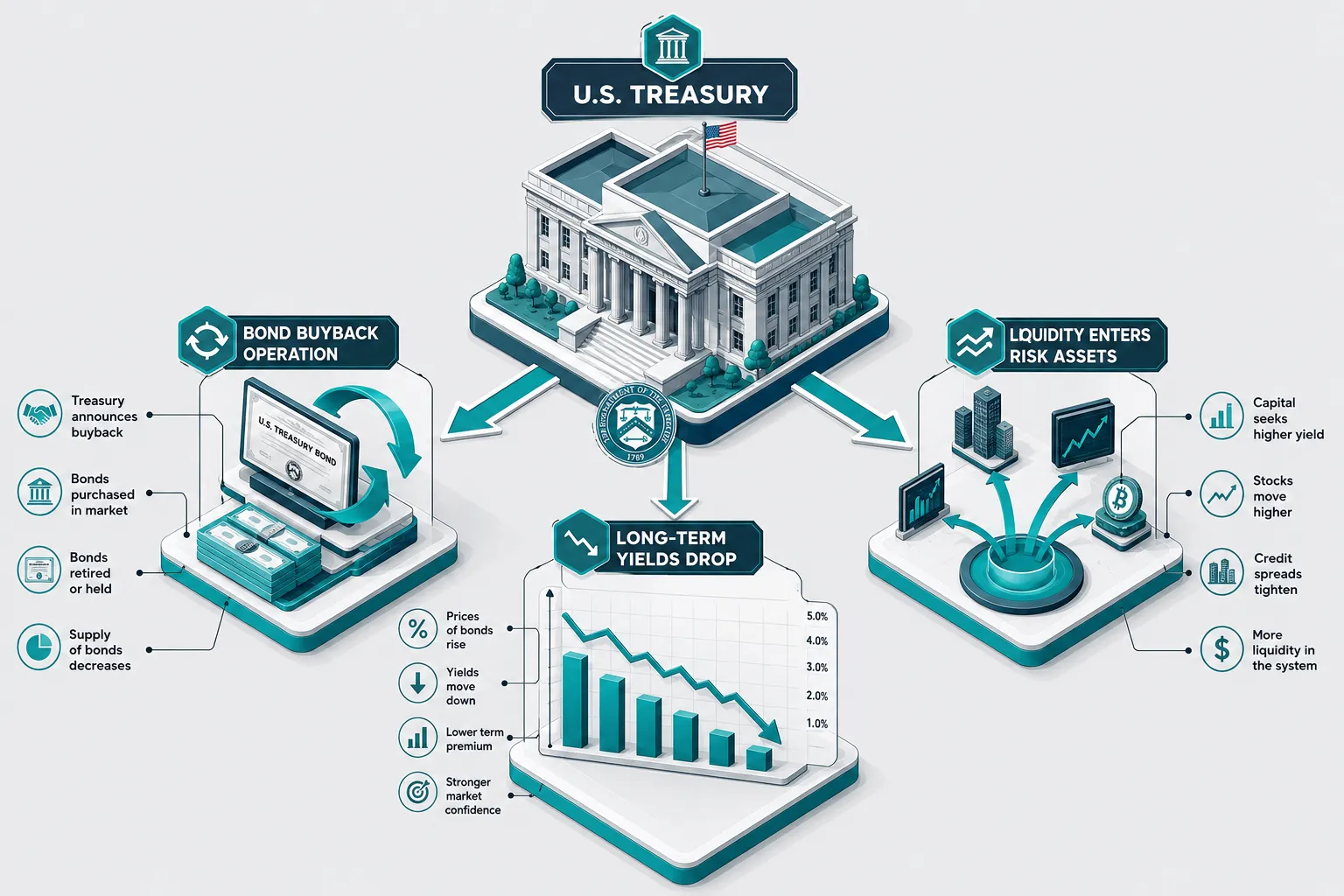
Bitcoin climbed more than 11% in a single trading session on August 20, 2026, briefly topping $70,000 for the first time in over two months [7]. The move began after the Treasury’s announcement sent bond yields sharply lower, and traders quickly rotated into crypto as a high-beta risk asset [9].
Bitcoin had been trading near $63,000 just days before the announcement. The speed of the move from roughly $65,000 to above $70,000 was partly mechanical: a large pool of traders had bet against Bitcoin (short positions), and as prices rose, those positions were automatically closed out at a loss, forcing additional buy orders that pushed prices even higher [6].
What Are Treasury Buybacks and How Do They Affect Crypto
Treasury buybacks occur when the U.S. government repurchases its own previously issued bonds from the open market before they mature. The primary goal is to manage the yield curve by reducing the supply of long-term bonds, which pushes their prices up and their yields down [9].
How this connects to crypto:
- Lower long-term yields reduce the appeal of holding safe government bonds
- Investors seeking higher returns rotate toward risk assets: equities, commodities, and crypto
- The cash injected into the system by the buyback increases overall market liquidity
- Higher liquidity environments have historically correlated with Bitcoin price appreciation [5]
The Treasury’s August 2026 announcement specifically targeted longer-term debt and represented a doubling of the scale of prior buyback operations [2]. This was not a routine adjustment. The scale signaled an active effort to suppress long-term borrowing costs, which markets read as a meaningful easing of financial conditions.
“Treasury buybacks compress yields and push liquidity into the system, and that liquidity has to go somewhere. In 2026, a meaningful portion went straight into Bitcoin.” — paraphrased from analyst commentary cited by crypto.news [5]
How Fed Policy Impacts Bitcoin Price
Federal Reserve policy and Treasury operations together shape the interest rate environment that Bitcoin trades within. When yields fall, Bitcoin tends to benefit because the opportunity cost of holding a non-yielding asset like Bitcoin decreases.
The August 2026 Treasury buyback expansion effectively acted as a form of yield curve control without formal Fed involvement. By driving long-term yields lower, the Treasury created conditions similar to monetary easing [9]. Bitcoin’s sensitivity to these macro shifts has grown as institutional investors now hold significant positions and actively adjust them based on rate expectations.
Key relationship:
- Rising yields: typically negative for Bitcoin (higher opportunity cost)
- Falling yields: typically positive for Bitcoin (lower opportunity cost, more liquidity)
- Quantitative easing or buyback programs: historically bullish for crypto
What Was the Short Squeeze and How Did It Amplify the Rally
A short squeeze happens when a rising asset price forces traders who had bet on a price decline to buy back the asset to limit their losses, which in turn pushes the price even higher. On August 19-20, 2026, this dynamic played out at scale in Bitcoin markets.
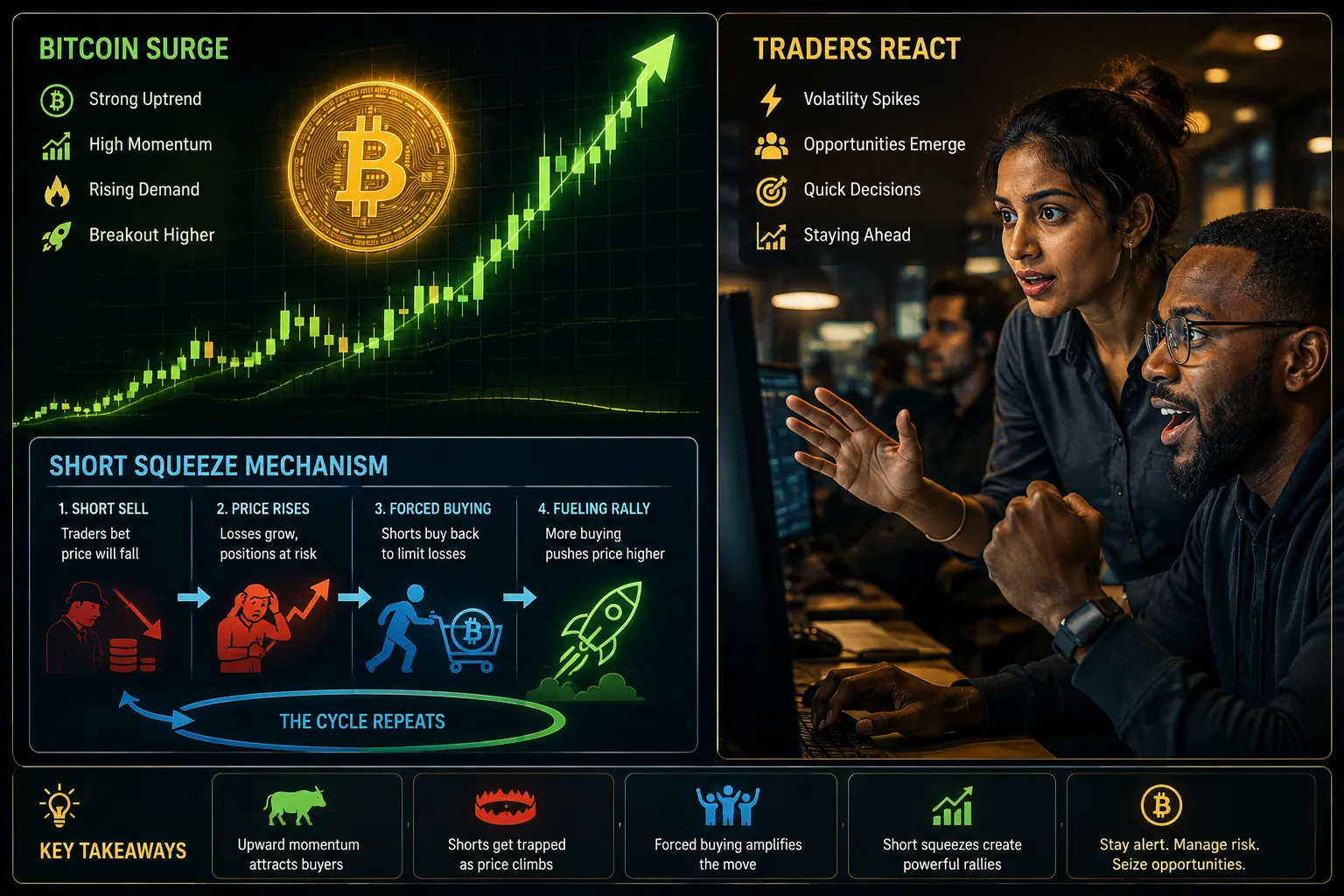
More than $400 million in short positions were liquidated across crypto markets as Bitcoin climbed from around $65,000 toward $70,000 [2]. Each wave of forced buying added fuel to the move, creating a self-reinforcing cycle. Ethereum and other major tokens were swept up in the same dynamic, with Ether posting significant gains alongside Bitcoin [1] [8].
Short squeeze mechanics simplified:
- Trader borrows Bitcoin and sells it, hoping to buy it back cheaper later
- Price rises instead of falling
- Broker issues a margin call, forcing the trader to buy Bitcoin at a higher price
- Mass forced buying across thousands of positions accelerates the upward move
This is why Bitcoin’s move from $69,000 to above $70,000 happened so quickly. The short squeeze compressed what might have been a multi-day move into a matter of hours [6].
Is This Bitcoin Rally Sustainable or Temporary
The sustainability of Bitcoin surges past $70K depends on whether the macro conditions that triggered the move persist. If Treasury buybacks continue at the expanded scale and long-term yields remain suppressed, risk assets including Bitcoin have a supportive backdrop [3].
However, several risks could reverse the rally:
- Buyback program reversal: If the Treasury scales back operations, yields could rebound
- Inflation data: A surprise inflation reading could pressure the Fed to tighten, offsetting the Treasury’s easing
- Profit-taking: After an 11% single-session move, short-term traders often lock in gains
- Regulatory shifts: Any negative policy signal could dampen sentiment quickly
Analysts cited by Forbes noted that Bitcoin approaching $70,000 after the Treasury announcement reflected genuine macro repricing, not purely speculative momentum [3]. That said, forward-looking statements about price targets carry inherent uncertainty and should not be treated as financial advice.
Can Bitcoin Crash After Hitting $70K
Yes, Bitcoin can and has experienced sharp corrections after hitting major price milestones. History shows that round-number levels like $70,000 often act as resistance zones where profit-taking concentrates.
After the short squeeze cleared out bearish positioning, the market’s next move depends on new buyers stepping in at elevated prices. If demand does not sustain the level, a pullback toward prior support around $63,000-$65,000 is a plausible scenario, particularly if macro conditions shift. Investors should treat any single-day surge, however dramatic, as one data point rather than a directional guarantee.
Is Bitcoin a Good Investment Right Now
Whether Bitcoin is appropriate depends entirely on individual risk tolerance, investment horizon, and portfolio context. Bitcoin is a high-volatility asset that can gain or lose 20-30% in a matter of weeks.
Choose Bitcoin if:
- You have a long investment horizon (3-5+ years)
- You can tolerate significant short-term drawdowns
- You want exposure to a macro liquidity-sensitive asset
- You are allocating a small, defined portion of a diversified portfolio
Avoid or limit Bitcoin if:
- You need the capital within 12 months
- You cannot absorb a 50%+ drawdown without financial stress
- You are new to investing and lack a broader portfolio foundation
The August 2026 rally is a reminder of Bitcoin’s upside potential, but also of how quickly macro conditions can change. No single price event defines a long-term investment thesis.
Should I Invest in Bitcoin or Ethereum Instead
Bitcoin and Ethereum serve different purposes and carry different risk profiles. Bitcoin is primarily a store of value and macro liquidity play. Ethereum is a programmable blockchain platform whose value is tied to activity across decentralized applications, stablecoins, and smart contracts.
| Factor | Bitcoin | Ethereum |
|---|---|---|
| Primary use case | Store of value, macro hedge | Smart contracts, DeFi, NFTs |
| Supply | Fixed at 21 million | No hard cap, but deflationary pressure |
| Macro sensitivity | High | Moderate to high |
| Volatility | High | Higher |
| Institutional adoption | Broader | Growing |
Both rallied in August 2026, but Bitcoin led the move given its direct sensitivity to the macro liquidity signal from the Treasury [1] [8]. Many investors hold both as complementary positions rather than choosing one exclusively.
How to Buy Bitcoin Safely for Beginners
Buying Bitcoin safely requires choosing a reputable exchange, securing your holdings properly, and understanding the tax implications before you start.
Step-by-step for first-time buyers:
- Choose a regulated exchange: Use platforms registered with financial regulators in your jurisdiction. Major options include Coinbase, Kraken, and Gemini in the U.S.
- Complete identity verification: Regulated exchanges require KYC (Know Your Customer) verification. This is a legal requirement, not optional.
- Fund your account: Link a bank account or debit card. Avoid using credit cards due to cash advance fees and interest risk.
- Buy a defined amount: Start with an amount you are comfortable losing entirely. Many advisors suggest no more than 1-5% of a portfolio for high-risk assets.
- Secure your Bitcoin: For amounts above a few hundred dollars, consider moving Bitcoin off the exchange into a hardware wallet (cold storage).
- Record every transaction: You will need this for tax reporting.
Common mistake: Buying during a sharp rally out of fear of missing out (FOMO), then selling during the inevitable correction. Define your entry strategy before you buy, not after.
Where Can I Trade Bitcoin With Low Fees
Fee structures vary significantly across exchanges and trading methods. Spot trading fees on major exchanges typically range from 0.1% to 0.5% per transaction, while maker-taker models reward traders who add liquidity with lower rates.
Lower-fee options to research:
- Binance: Competitive maker-taker fees with volume discounts
- Kraken: Transparent fee schedule, lower fees for higher volume
- Coinbase Advanced Trade: Lower fees than the standard Coinbase interface
- Peer-to-peer platforms: Can reduce exchange fees but introduce counterparty risk
Always check the full cost including withdrawal fees, which can exceed trading fees on some platforms. For large purchases, wire transfers typically cost less than card payments.
What Taxes Do I Pay on Bitcoin Gains
In the United States, Bitcoin is treated as property by the IRS, meaning capital gains tax applies when you sell, trade, or spend it. The rate depends on how long you held the asset.
- Short-term gains (held less than 1 year): Taxed as ordinary income, up to 37% depending on your bracket
- Long-term gains (held more than 1 year): Taxed at 0%, 15%, or 20% depending on income
Important: The August 2026 rally means many holders who bought Bitcoin below $70,000 are sitting on unrealized gains. No tax is owed until a taxable event occurs (selling, trading, or using Bitcoin to buy goods or services). Consult a qualified tax professional for advice specific to your situation, as crypto tax rules vary by country and can change.
What Happens to Bitcoin If the Economy Crashes
Bitcoin’s behavior during economic downturns has been inconsistent. In the 2020 COVID crash, Bitcoin initially fell sharply alongside equities before recovering strongly as stimulus measures flooded the market with liquidity. In 2022, Bitcoin fell over 70% from its peak during a period of aggressive rate hikes.
The key variable is not the recession itself but the policy response. If a downturn triggers aggressive monetary or fiscal easing (as in 2020), Bitcoin tends to benefit from the liquidity surge. If the response involves tightening or austerity, Bitcoin faces headwinds alongside other risk assets.
The August 2026 Treasury buyback story reinforces this pattern: it was the policy signal, not economic growth, that drove the rally [5] [9].
Conclusion
Bitcoin surges past $70K: Treasury buybacks fuel crypto rally this August in a move that illustrates how deeply Bitcoin has become intertwined with macro policy signals. The U.S. Treasury’s decision to double its bond buyback operations compressed long-term yields, injected liquidity into markets, and set off a chain reaction that included a $400 million short squeeze and broad crypto market gains [2] [6].
Actionable next steps:
- For existing holders: Review your position size against your risk tolerance. A sharp rally is a good time to rebalance if Bitcoin now represents more of your portfolio than intended.
- For prospective buyers: Avoid chasing the move. Define an entry plan based on your investment horizon, not on recent price action.
- For all investors: Track Treasury yield curve developments and Fed communications closely. These macro signals are now among the most reliable leading indicators for Bitcoin’s short-term direction.
- For tax planning: Log all transactions now. Waiting until year-end makes accurate reporting significantly harder.
The August 2026 rally is a reminder that Bitcoin does not move in isolation. Understanding the macro forces behind the price is as important as understanding the asset itself.
FAQ
What caused Bitcoin to hit $70,000 in August 2026? The U.S. Treasury announced an expansion of its bond buyback program targeting long-term debt, which pushed yields lower and sent liquidity into risk assets including Bitcoin. A simultaneous short squeeze amplified the move. [2] [9]
What is a short squeeze in crypto? A short squeeze occurs when rising prices force traders who bet on a price decline to buy back the asset to limit losses. In August 2026, over $400 million in short positions were liquidated, adding forced buying that accelerated Bitcoin’s rally. [6]
How much did Bitcoin gain on August 20, 2026? Bitcoin surged more than 11% in a single session, crossing $70,000 for the first time in over two months. [7]
Did Ethereum also rally? Yes. Ethereum and other major cryptocurrencies rallied alongside Bitcoin as the macro liquidity signal and short squeeze affected the broader crypto market. [1] [8]
Are Treasury buybacks the same as quantitative easing? Not exactly. Quantitative easing is a Federal Reserve tool involving bond purchases to expand the money supply. Treasury buybacks are conducted by the U.S. Treasury to manage the yield curve and debt maturity profile. Both can have similar effects on market liquidity. [9]
Is $70,000 a resistance level for Bitcoin? Round-number price levels like $70,000 often attract profit-taking, making them short-term resistance zones. Whether Bitcoin holds above this level depends on continued macro support and new buyer demand. [3]
Should I buy Bitcoin after a major rally? Buying after a sharp rally carries higher short-term risk because much of the momentum may already be priced in. A disciplined approach involves setting a target allocation and entering gradually rather than chasing a single move.
How do I report Bitcoin gains on my taxes? In the U.S., report Bitcoin gains on Schedule D of your federal tax return. Short-term gains (under one year) are taxed as ordinary income; long-term gains qualify for reduced capital gains rates. Keep records of every buy, sell, and trade.
What is the safest way to store Bitcoin? For significant holdings, a hardware wallet (cold storage device) kept offline is the most secure option. Exchange accounts are convenient but expose holdings to platform risk.
Can the Treasury buyback program reverse? Yes. The program can be scaled back or halted depending on fiscal conditions, inflation data, or policy priorities. A reversal could remove the macro tailwind that drove the August 2026 rally. [3] [5]
References
[1] 2026 08 19 Bitcoin 69000 Ether Jumps Treasury Buybacks Sec Crypto Proposal Fuel Market Rally – https://www.theblock.co/news/markets/2026-08-19-bitcoin-69000-ether-jumps-treasury-buybacks-sec-crypto-proposal-fuel-market-rally-412248
[2] Bitcoin Price Hits 69500 As Over 400m Of Shorts Liquidated Because US Doubles Treasury Debt Buybacks To Crush Long Term Yields – https://cryptorank.io/news/feed/0beab-bitcoin-price-hits-69500-as-over-400m-of-shorts-liquidated-because-us-doubles-treasury-debt-buybacks-to-crush-long-term-yields
[3] Bitcoin Approaches 70000 After Treasury Announces Buyback Expansion – https://www.forbes.com/sites/digital-assets/2026/08/19/bitcoin-approaches-70000-after-treasury-announces-buyback-expansion/
[4] Bitcoin Rose Nearly 6% After US Treasury Bond Buyback Announcement – https://ua.news/en/finansi/bitkoyin-zris-maizhe-na-6-pislia-zaiavi-minfinu-ssha-pro-vikup-obligatsii
[5] Treasury Buyback Bitcoin Yield Curve Rally – https://crypto.news/treasury-buyback-bitcoin-yield-curve-rally/
[6] Bitcoin 70000 Treasury Buybacks Short Squeeze – https://coin360.com/news/bitcoin-70000-treasury-buybacks-short-squeeze
[7] Bitcoin Surges Over 11%, Tops $70,000 For First Time In More Than 2 Months – https://www.aa.com.tr/en/economy/bitcoin-surges-over-11-tops-70-000-for-1st-time-in-more-than-2-months/4032572
[8] Bitcoin Ethereum Rally US Treasury Move – https://www.fxtrustscore.com/bitcoin-ethereum-rally-us-treasury-move/
[9] Treasury Announces Upscaled Buyback Operation For Longer Term Debt Sending Yields Lower – https://www.cnbc.com/2026/08/19/treasury-announces-upscaled-buyback-operation-for-longer-term-debt-sending-yields-lower.html
[10] Bitcoin Jumps 8% To $69,700 As Bond News Triggers Short Squeeze – https://www.whalesbook.com/news/English/crypto/Bitcoin-Jumps-8percent-To-dollar69700-As-Bond-News-Triggers-Short-Squeeze/6a865ee684d2dd5c12dc971b