Last updated: August 14, 2026
Quick Answer: Starting October 1, 2026, Hawaii will prohibit cryptocurrency ATM operators from accepting cash from customers in exchange for digital assets, making it one of the first U.S. states to enact such a broad consumer-protection ban. The law, signed by Governor Josh Green on July 9, 2026, does not ban crypto ownership or online trading, but it does shut down the cash-deposit function on the roughly 57 crypto kiosks operating across the state. [1][2]
Key Takeaways
- Hawaii’s House Bill 1642 (Act 224) bans cash-to-crypto transactions at kiosks from October 1, 2026, but still allows crypto-to-cash withdrawals at the same machines. [2][11]
- Governor Josh Green signed the bill into law on July 9, 2026. [2]
- The FBI recorded 92 complaints and $3.85 million in adjusted losses tied to crypto kiosk scams among Hawaii residents in 2025 alone. [2]
- Each prohibited transaction is treated as a separate offense under Hawaii’s unfair or deceptive practices law, creating significant liability for operators. [2]
- Minnesota, Tennessee, and Indiana have already enacted similar restrictions, making Hawaii the fourth state in this category. [5][6]
- At least 20 U.S. states have adopted new laws restricting crypto kiosk activity, with more proposals pending. [10]
- Federal legislation, the Crypto ATM Fraud Prevention Act (S.710), is under consideration in Congress. [7]
- Residents can still buy, sell, and hold crypto through online exchanges after the ban takes effect. [1][3]
What Is Hawaii’s Crypto ATM Ban About?
Hawaii’s Act 224 prohibits the ownership, operation, or management of any “digital financial asset transaction kiosk” that accepts U.S. currency from a customer in exchange for a digital financial asset. The ban is specifically targeted at the cash-deposit function, not at crypto kiosks as a whole. [2][11]
The law draws a clear line: inserting cash into a machine to buy Bitcoin or another digital asset will be illegal in Hawaii from October 1, 2026. However, using a kiosk to convert existing cryptocurrency into cash remains permitted. Online platforms for buying and selling crypto are entirely unaffected. [1][3]
This distinction matters because Hawaii’s legislators concluded that the cash-to-crypto channel at physical kiosks was the primary vector for fraud, not digital asset ownership itself.
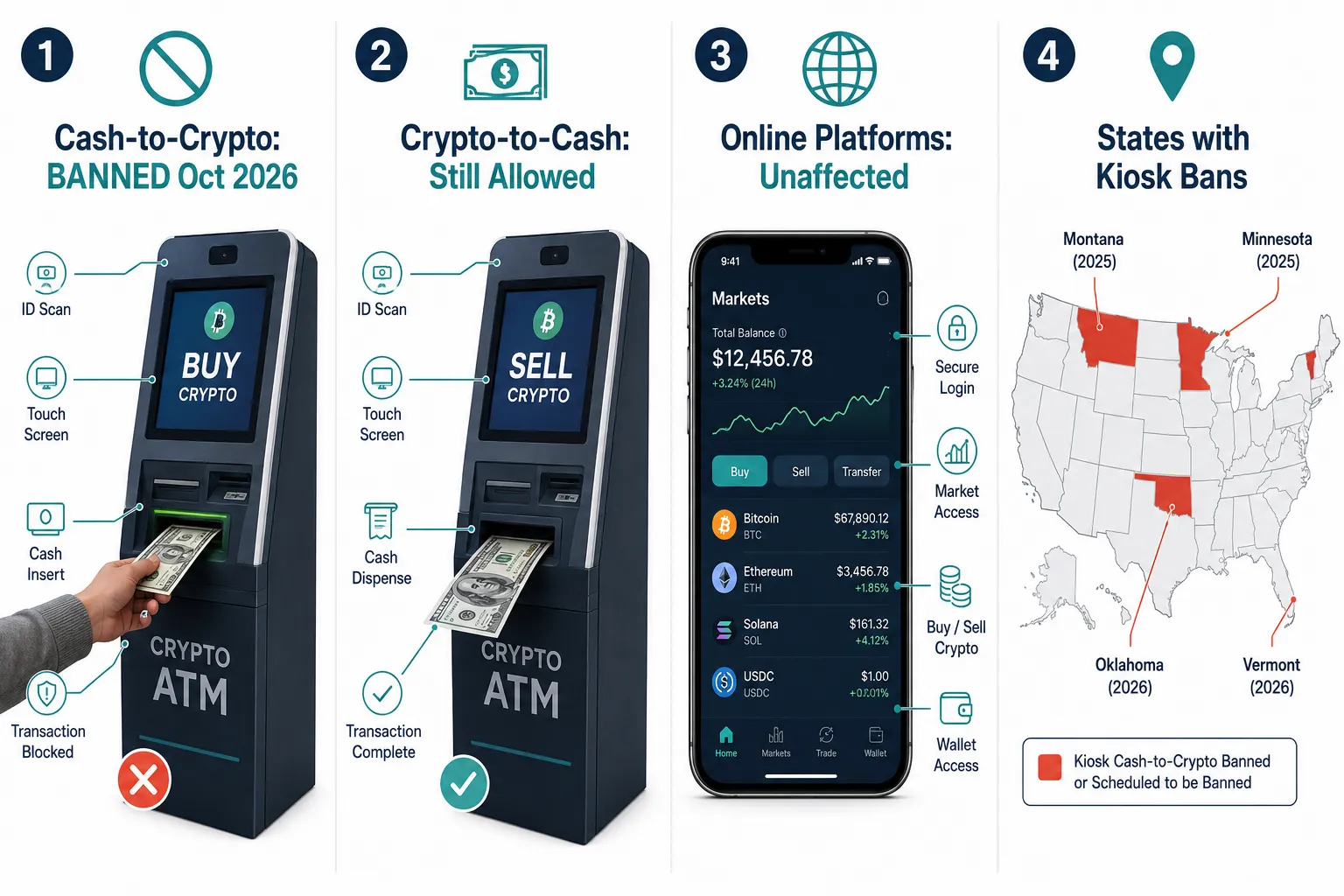
Key elements of the law:
- Covered machines: Any physical kiosk accepting U.S. currency for digital assets.
- Banned activity: Cash-in transactions at kiosks (buying crypto with cash).
- Still permitted: Crypto-to-cash withdrawals; crypto-to-crypto swaps at kiosks; all online exchange activity.
- Enforcement structure: Each prohibited transaction is a separate offense under Hawaii’s unfair or deceptive practices statute, which substantially increases operator liability. [2][11]
When Does Hawaii’s Crypto ATM Ban Start?
The ban takes effect October 1, 2026. Governor Josh Green signed House Bill 1642 into law as Act 224 on July 9, 2026, giving operators roughly three months to comply. [2][5]
Hawaii media confirmed the October 1 date as the hard enforcement deadline. Operators who continue accepting cash for digital assets after that date face per-transaction penalties under state consumer protection law. [1][2]
Why Is Hawaii Banning Crypto ATMs?
The core justification is consumer protection, specifically the rapid growth of kiosk-related fraud targeting Hawaii residents. The FBI recorded 92 complaints and $3.85 million in adjusted losses linked to crypto kiosks in Hawaii in 2025. [2] Local reporting noted that losses via crypto ATM scams increased several-fold in a single year. [1][13]
Earlier legislative drafts explored transaction caps, such as a $2,000-per-day limit and a $10,000-per-30-day cap, along with restrictions on new customers and shared wallet addresses. Lawmakers ultimately concluded that incremental limits were insufficient given the speed and scale of scam growth, and moved to an outright ban on cash deposits at kiosks. [14][2]
Why cash-to-crypto kiosks are high-risk:
- Transactions are fast, largely irreversible, and anonymous compared to bank transfers.
- Scammers frequently direct victims to deposit cash at a nearby kiosk, making recovery nearly impossible.
- Older consumers are disproportionately targeted, a pattern that organizations like AARP have documented nationally. [10][8]
What’s the Difference Between Crypto ATMs and Regular ATMs?
A regular bank ATM connects to a customer’s bank account to dispense or accept government-issued currency. A crypto ATM (also called a digital financial asset transaction kiosk) converts cash into cryptocurrency, or cryptocurrency into cash, without any bank account required. [6]
This structural difference creates the fraud risk Hawaii is targeting. Bank ATMs have account-level identity verification and reversible transactions. Crypto kiosks typically require only a phone number or basic ID scan, and once crypto is sent to a scammer’s wallet, it cannot be recalled. The speed and finality of crypto transactions make kiosks a preferred tool in romance scams, government impersonation fraud, and tech-support scams. [8][10]
What Happens to Existing Crypto ATMs in Hawaii After the Ban?
The 57 cryptocurrency ATMs operating across Hawaii’s four main islands must disable their cash-to-crypto functionality by October 1, 2026. [4][5] Operators have two practical options: reconfigure machines to offer only crypto-to-cash or crypto-to-crypto services (both of which remain legal), or remove the machines entirely.
Because each cash-to-crypto transaction after October 1 constitutes a separate offense under the state’s unfair or deceptive practices law, the financial risk of non-compliance is high. Most industry analysts expect operators to either reconfigure or exit the Hawaii market rather than test enforcement. [2][5]
How Does Hawaii’s Ban Compare to Other States?
Hawaii is the fourth U.S. state to enact a law that effectively bans or severely restricts cash-based cryptocurrency kiosk transactions. Indiana’s prohibition took effect in March 2026, Tennessee’s in July 2026, and Minnesota’s in August 2026, all framed as responses to kiosk-related scams. [6][10]
Beyond outright bans, at least 20 states have adopted new laws restricting crypto kiosk activity through transaction caps, enhanced disclosure requirements, or licensing rules. States including Arizona, Arkansas, and Vermont have also introduced tightening measures. [8][10]
| State | Approach | Effective Date |
|---|---|---|
| Indiana | Prohibition on cash-to-crypto kiosk transactions | March 2026 |
| Tennessee | Prohibition on cash-to-crypto kiosk transactions | July 2026 |
| Minnesota | Prohibition on cash-to-crypto kiosk transactions | August 2026 |
| Hawaii | Ban on cash deposits at kiosks (Act 224) | October 1, 2026 |
| 20+ other states | Transaction caps, disclosures, licensing | Varies |
Sources: [5][6][10]
Minnesota’s approach is particularly comparable to Hawaii’s because both states moved from proposed transaction limits to outright prohibitions after fraud data showed that caps were insufficient deterrents. [6][10]
Will Other US States Follow Hawaii’s Lead?
The trend strongly suggests yes. With four states now enacting outright bans and at least 20 others tightening rules, the regulatory momentum is clearly in one direction. [10] Industry analysts and mainstream business media have noted that “the crypto ATM’s days in America may be numbered,” citing tightening regulations and growing pressure from law enforcement and consumer advocates. [8]
Several factors are accelerating state-level action:
- Fraud losses are rising. Nationally documented losses from crypto kiosk scams have grown sharply, drawing attention from state attorneys general and consumer protection agencies.
- AARP advocacy. The organization has actively supported tighter kiosk rules due to the disproportionate impact on older Americans. [10][8]
- Federal pressure. Congress is considering the Crypto ATM Fraud Prevention Act (S.710, 119th Congress), which would address fraudulent kiosk transactions at the federal level. A related Senate amendment (S.Amdt.2246) would require kiosk operators to submit updated location lists to the Treasury Department. [7][12]
The absence of a unified federal framework means states are filling the gap. If federal legislation stalls, more states are likely to adopt Hawaii-style bans rather than wait. [6][10]
How Does This Affect Crypto ATM Operators?

Operators face a shrinking market and rising compliance costs. In Hawaii specifically, the per-transaction penalty structure under Act 224 makes continued cash-to-crypto operation after October 1 financially untenable. [2][11] Across the U.S., operators must now navigate a patchwork of state rules, including outright bans, transaction caps, disclosure mandates, and licensing requirements, alongside existing federal Bank Secrecy Act obligations. [6][10]
Likely operator responses:
- Reconfigure machines to crypto-to-cash only in states with cash-deposit bans.
- Exit markets where compliance costs exceed revenue.
- Pivot to higher-value, lower-risk services such as crypto-to-cash ATMs or institutional custody.
- Invest in enhanced fraud-detection and identity-verification systems to meet tightening state standards elsewhere. [5][8]
Can You Still Buy Crypto in Hawaii After the Ban?
Yes. Hawaii residents retain full access to digital assets through online exchanges and trading platforms. The ban applies only to the specific act of inserting cash into a physical kiosk to purchase cryptocurrency. [1][3]
Buying crypto via a bank transfer, debit card, or credit card on platforms such as Coinbase, Kraken, or similar exchanges is entirely unaffected by Act 224. The law targets a specific high-risk channel, not digital asset ownership or trading in general. [2][3]
Is This Part of a Larger US Crypto Regulation Trend?
Yes, and the question of whether Hawaii to ban crypto ATMs from October 2026 represents a US regulatory trend is no longer speculative. Four states have enacted outright prohibitions, 20-plus have adopted restrictions, and federal legislation is advancing in Congress. [6][7][10]
The current regulatory environment for crypto kiosks is a patchwork of federal anti-money laundering rules under the Bank Secrecy Act, state money-transmitter laws, and new consumer-protection statutes. Commentators argue that Hawaii’s ban and the wave of similar state actions are increasing pressure on federal regulators to create harmonized national rules. [6][8] Whether that results in a federal ban, a national licensing framework, or continued state-by-state variation remains to be seen, but the direction of travel is clearly toward tighter oversight.
FAQ
Q: What is Hawaii’s Act 224? Act 224 is the codified version of House Bill 1642, signed by Governor Josh Green on July 9, 2026. It prohibits any person from owning, operating, or managing a digital financial asset transaction kiosk that accepts U.S. currency in exchange for a digital asset, effective October 1, 2026. [2][11]
Q: Can crypto ATM operators still run machines in Hawaii after October 1, 2026? Yes, but only in a limited way. Kiosks that dispense cash in exchange for cryptocurrency, or swap one digital asset for another, remain legal. Only the cash-to-crypto deposit function is banned. [1][3]
Q: What are the penalties for violating Hawaii’s crypto ATM ban? Each prohibited transaction is treated as a separate offense under Hawaii’s unfair or deceptive practices law. This structure can multiply penalties rapidly for any operator that continues cash-to-crypto operations after October 1, 2026. [2][11]
Q: How many crypto ATMs are in Hawaii? Approximately 57 cryptocurrency ATMs were operating across Hawaii’s four main islands at the time the law was enacted. [4][5]
Q: Does the ban affect online crypto purchases in Hawaii? No. Buying, selling, or holding digital assets through online exchanges is entirely unaffected by Act 224. The law targets only physical kiosks accepting cash. [1][2]
Q: What states have already banned crypto ATMs? Indiana (March 2026), Tennessee (July 2026), and Minnesota (August 2026) enacted prohibitions before Hawaii’s October 2026 effective date. [6][10]
Q: Is there a federal crypto ATM law? Not yet. The Crypto ATM Fraud Prevention Act (S.710) is under consideration in the 119th Congress, and a Senate amendment would require operators to report kiosk locations to the Treasury Department, but no federal statute specifically governing crypto kiosks has been enacted as of August 2026. [7]
Q: Why do scammers prefer crypto ATMs? Crypto transactions are fast, largely irreversible, and require minimal identity verification at kiosks. Once a victim deposits cash and the crypto is transferred to a scammer’s wallet, recovery is extremely difficult, making kiosks a preferred tool in fraud schemes. [8][10]
Conclusion
Hawaii’s Act 224 is a clear signal that state-level tolerance for unregulated cash-to-crypto kiosk activity is running out. The October 1, 2026 effective date gives operators a firm deadline, and the per-transaction penalty structure leaves little room for non-compliance. With Indiana, Tennessee, and Minnesota already ahead of Hawaii on similar measures, and at least 20 other states tightening rules, the question is no longer whether crypto ATM regulation will intensify but how far it will go. [5][6][10]
Actionable steps for those affected:
- Crypto users in Hawaii: Transition to a reputable online exchange before October 1, 2026, to ensure uninterrupted access to digital assets.
- Crypto ATM operators: Audit Hawaii machines immediately, disable cash-deposit functionality before the deadline, and consult legal counsel on per-transaction liability exposure under Act 224.
- Operators in other states: Monitor state legislative calendars closely. At least 20 states have active or pending kiosk restrictions; proactive compliance is cheaper than reactive legal defense. [10]
- Investors and industry observers: Track the Crypto ATM Fraud Prevention Act (S.710) in Congress for signals about whether a federal framework will preempt or reinforce state bans. [7]
The broader regulatory trend is unmistakable. States are moving faster than federal agencies, and Hawaii’s ban is less an outlier than a leading indicator of where U.S. crypto kiosk policy is heading.
References
[1] New Hawaii Law Banning Cryptocurrency Atm Deposits Take Effect Oct 1 – https://www.hawaiinewsnow.com/2026/08/12/new-hawaii-law-banning-cryptocurrency-atm-deposits-take-effect-oct-1/
[2] Hawaii Crypto Atm Cash Deposits Banned From Oct 1 – https://crypto.news/hawaii-crypto-atm-cash-deposits-banned-from-oct-1/
[3] Kokua Line Why Are Crypto Kiosks Still Around – https://www.staradvertiser.com/2026/08/02/hawaii-news/kokua-line/kokua-line-why-are-crypto-kiosks-still-around/
[4] Hawaii Enacts Crypto Atm Ban Effective Oct 1 After 80m Losses 23408626 – https://www.gate.com/news/detail/hawaii-enacts-crypto-atm-ban-effective-oct-1-after-80m-losses-23408626
[5] Hawaii Crypto Atm Ban October Enforcement – https://regional-front.cointelegraph.com/news/hawaii-crypto-atm-ban-october-enforcement
[6] Kiosks – https://crypto.news/us/kiosks/
[7] All Info – https://www.congress.gov/bill/119th-congress/senate-bill/710/all-info
[8] Bitcoin Crypto Atm Scam Fraud Regulation – https://www.cnbc.com/2026/01/10/bitcoin-crypto-atm-scam-fraud-regulation.html
[10] States Tighten Reins On Crypto Atms – https://bankingjournal.aba.com/2026/04/states-tighten-reins-on-crypto-atms/