Last updated: June 11, 2026
Quick Answer
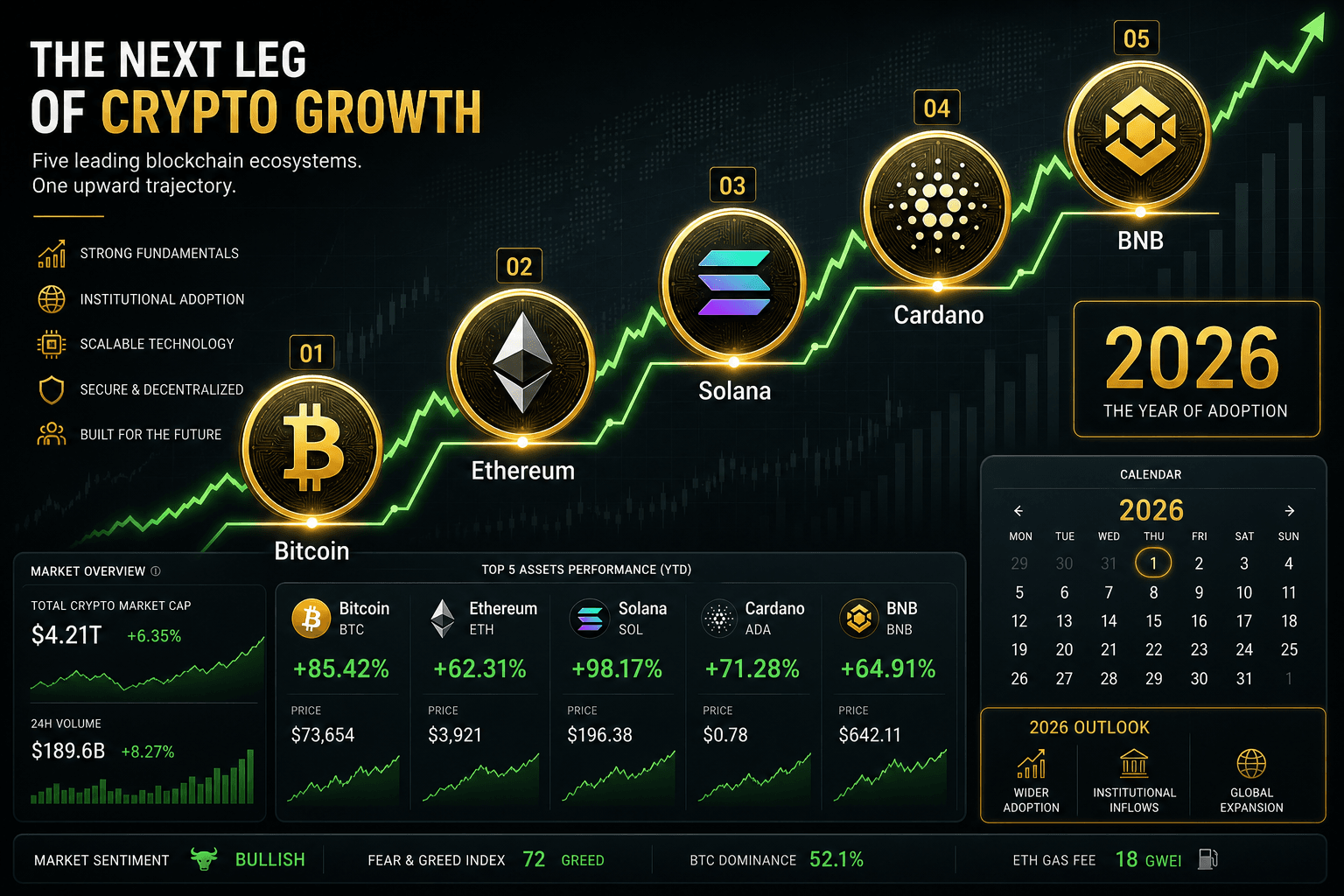
The 5 next cryptocurrencies poised to explode in 2026 are Bitcoin (BTC), Ethereum (ETH), Solana (SOL), Cardano (ADA), and Binance Coin (BNB). Each project combines real-world utility, growing institutional interest, and favorable regulatory trends that analysts believe could drive significant price appreciation before year-end. Investors should assess risk tolerance and conduct thorough research before committing capital to any of these assets.
Key Takeaways
- Bitcoin price forecasts for 2026 range from $60,000 to $250,000 depending on macroeconomic conditions and institutional demand [1]
- Ethereum’s staking-enabled ETFs, introduced in early 2026, have added a yield-bearing dimension that may attract new institutional capital [3]
- Solana is positioned for record-breaking performance if U.S. regulatory clarity improves, with Visa’s USDC integration signaling institutional confidence [4]
- Cardano’s trajectory depends heavily on real-world adoption and developer activity rather than speculation alone [5]
- Binance Coin benefits from deep ecosystem utility and growing Binance Smart Chain adoption for decentralized applications [5]
- Smaller crypto projects carry higher volatility and regulatory risk than established large-cap coins
- Investors can start with as little as $10 to $50 on most major exchanges through fractional purchases
- Tax authorities in most jurisdictions treat crypto gains as taxable events, including trades between coins
- Researching a project’s whitepaper, team credentials, and on-chain activity is essential before investing
- Diversifying across multiple assets and limiting crypto to a defined percentage of a portfolio reduces downside exposure
What Makes a Cryptocurrency Likely to Grow in Value
A cryptocurrency is likely to grow in value when it combines genuine utility, expanding adoption, and improving market conditions. Projects that solve real problems, attract institutional capital, and benefit from favorable regulation tend to outperform speculative tokens with no underlying use case.
Key growth drivers to look for include:
- Real-world utility: Does the network process payments, power smart contracts, or support decentralized applications at scale?
- Institutional adoption: Are major financial firms, payment processors, or governments integrating the asset?
- Tokenomics: Is supply limited or deflationary? Does staking or burning reduce circulating supply over time?
- Developer activity: A high volume of active developers signals ongoing innovation and long-term viability.
- Regulatory clarity: Projects operating in jurisdictions with clear crypto rules face fewer sudden legal risks.
- Macroeconomic conditions: Interest rates, money supply, and broader risk appetite all influence crypto valuations [5].
Decision rule: Choose projects with at least three of these six factors working in their favor. A coin with only hype and no utility is a speculation, not an investment.
The 5 Next Cryptocurrencies Poised to Explode in 2026
These five assets represent the strongest combination of growth catalysts, institutional interest, and analyst confidence heading into the second half of 2026.
Bitcoin (BTC)
Bitcoin remains the benchmark for the entire crypto market. Analyst price targets for 2026 range widely, from $60,000 to $250,000, reflecting disagreement about how quickly institutional demand will absorb available supply [1]. Early Bitcoin investor Michael Terpin forecasts a potential cycle low near $60,000 in Q4 2026, which he views as a buying opportunity ahead of stronger accumulation phases in 2028 and 2029 [2].
Bitcoin suits investors who want the highest liquidity, the longest track record, and the clearest regulatory treatment of any digital asset.
Ethereum (ETH)
Ethereum powers the largest ecosystem of decentralized applications and smart contracts in crypto. Price predictions for 2026 range from $3,175 to $7,500, with the introduction of staking-enabled ETFs in early 2026 adding a new income dimension to holding ETH [3]. These ETFs allow traditional investors to earn staking yield without managing wallets or private keys, potentially drawing significant institutional capital.
Ethereum suits investors who want exposure to the infrastructure layer of decentralized finance and Web3 applications.
Solana (SOL)
Solana processes thousands of transactions per second at low cost, making it a preferred chain for payment applications and consumer-facing crypto products. Analysts anticipate Solana could break price records in 2026, particularly if U.S. regulatory developments become more favorable [4]. Visa’s decision to make USDC available on the Solana blockchain is a concrete signal of institutional confidence in the network’s reliability [4].
Solana suits investors comfortable with higher volatility in exchange for exposure to a fast-growing developer ecosystem.
Cardano (ADA)
Cardano takes a research-first approach to blockchain development, with a peer-reviewed protocol and a focus on financial inclusion in emerging markets. Its 2026 performance is expected to vary significantly based on actual adoption metrics and real-world usage rather than speculation [5]. Cardano’s outcomes will also be shaped by macroeconomic factors including interest rates and global money flows [5].
Cardano suits patient investors who believe methodical development produces more durable long-term growth.
Binance Coin (BNB)
BNB derives its value primarily from utility within the Binance ecosystem, including trading fee discounts, token launches, and transaction fees on Binance Smart Chain. Growth in 2026 is expected to be driven by expanded use of Binance Smart Chain for decentralized applications and increasing institutional interest as regulatory environments stabilize [5]. BNB’s close ties to the world’s largest crypto exchange by volume give it a structural demand floor that purely speculative tokens lack.
BNB suits investors who already use the Binance platform and want an asset with built-in, recurring utility.
Top Crypto Projects With Real-World Utility in 2026
The most promising cryptocurrencies for long-term growth are those embedded in functioning economic systems, not just trading markets. Real-world utility means the network is being used to transfer value, execute contracts, or power applications that people actually need.
| Cryptocurrency | Primary Utility | Notable 2026 Development |
|---|---|---|
| Bitcoin (BTC) | Store of value, payments | Continued ETF inflows, sovereign interest |
| Ethereum (ETH) | Smart contracts, DeFi, NFTs | Staking-enabled ETFs launched [3] |
| Solana (SOL) | High-speed payments, DApps | Visa USDC integration [4] |
| Cardano (ADA) | Financial inclusion, governance | Adoption-dependent growth [5] |
| Binance Coin (BNB) | Exchange utility, DeFi | Smart Chain DApp expansion [5] |
Projects without a clear utility layer, regardless of marketing claims, carry substantially higher risk of permanent capital loss.

How Do I Actually Invest in Up-and-Coming Crypto
Investing in emerging cryptocurrencies requires a brokerage or exchange account, a funded wallet, and a clear plan for position sizing. The process is straightforward for most retail investors.
Step-by-step process:
- Choose a regulated exchange (Coinbase, Kraken, Binance, or a local equivalent).
- Complete identity verification (KYC) as required by the platform.
- Deposit funds via bank transfer, debit card, or wire.
- Search for the asset by name or ticker symbol.
- Enter the dollar amount you want to invest (fractional purchases are available on most platforms).
- Set a limit order at your target price or use a market order for immediate execution.
- Transfer assets to a personal hardware wallet for long-term storage if holding significant amounts.
Common mistake: Buying on a single exchange without comparing fees. Trading fees of 0.5% to 1.5% per transaction compound quickly for active traders.
How Much Money Do I Need to Start Investing in Emerging Cryptocurrencies
Most major exchanges allow purchases starting at $10 to $25, making crypto one of the most accessible asset classes for new investors. There is no minimum portfolio size required to get started, but position sizing matters more than the starting amount.
A practical framework for beginners:
- Limit total crypto exposure to 5% to 10% of investable assets if you are new to the space
- Spread that allocation across two to four assets rather than concentrating in one coin
- Keep at least three to six months of living expenses in cash before investing in any volatile asset class
- Dollar-cost averaging (investing a fixed amount weekly or monthly) reduces the impact of buying at a peak
Risks of Investing in Smaller Crypto Projects
Smaller and emerging crypto projects carry risks that established large-cap coins do not. The primary risks include:
- Liquidity risk: Low trading volume makes it hard to exit a position without moving the price against yourself.
- Smart contract bugs: Unaudited code can be exploited, resulting in total loss of funds locked in a protocol.
- Regulatory risk: A single enforcement action can wipe out a project’s value overnight.
- Team abandonment: Anonymous or pseudonymous teams can exit a project without warning.
- Market manipulation: Thin order books make smaller coins vulnerable to pump-and-dump schemes.
Even among the 5 next cryptocurrencies poised to explode in 2026, Cardano and BNB carry more regulatory and adoption uncertainty than Bitcoin, which has the longest track record and deepest liquidity.
Are These Cryptocurrencies Regulated or Safe
Bitcoin and Ethereum have the clearest regulatory status in most major jurisdictions, including the United States, European Union, and United Kingdom. Solana, Cardano, and BNB operate in a more ambiguous legal environment, where classification as a security versus a commodity remains unsettled in some countries.
“Safe” is relative in crypto. No digital asset is insured by a government deposit scheme the way bank accounts are. Investors can reduce custodial risk by:
- Using regulated, insured exchanges for active trading
- Storing long-term holdings in hardware wallets (cold storage)
- Never sharing private keys or seed phrases with anyone
Comparison of Potential Returns: Bitcoin, Ethereum, and Smaller Coins
Bitcoin and Ethereum offer lower potential upside than smaller coins but also lower downside risk relative to micro-cap projects. The trade-off is straightforward.
| Asset | 2026 Analyst Price Range | Risk Level | Liquidity |
|---|---|---|---|
| Bitcoin (BTC) | $60,000 to $250,000 [1] | Lower | Highest |
| Ethereum (ETH) | $3,175 to $7,500 [3] | Medium | High |
| Solana (SOL) | Record highs possible [4] | Medium-High | High |
| Cardano (ADA) | Adoption-dependent [5] | High | Medium |
| BNB | Ecosystem-driven growth [5] | Medium-High | High |
Smaller altcoins outside this list can produce 10x to 100x returns in bull markets but also lose 90% or more in bear cycles. Allocate accordingly.
Mistakes Beginners Make When Picking Crypto Investments
The most costly beginner mistake is buying based on social media hype rather than on-chain fundamentals. Other frequent errors include:
- Ignoring fees and slippage on low-liquidity tokens
- Over-concentrating in one asset, especially a new or unproven project
- Panic selling during normal 20% to 40% corrections, which are common even in bull markets
- Skipping security basics such as two-factor authentication and hardware wallets
- Failing to account for taxes on every trade, not just withdrawals to a bank account
How to Research a Cryptocurrency Before Investing
Thorough research takes 30 to 60 minutes per project and can prevent costly mistakes. A reliable research checklist includes:
- Read the official whitepaper for the project’s stated purpose and technical approach
- Check the team’s LinkedIn profiles and past project history for credibility
- Review on-chain data (active addresses, transaction volume, developer commits) on platforms like Messari or CoinGecko
- Look for independent security audits of any smart contract code
- Check whether the project has disclosed its tokenomics, including total supply, vesting schedules, and insider allocations
- Search for regulatory actions or enforcement history involving the project or its founders
Edge case: A project can have a strong whitepaper and still fail if the team lacks execution experience. Always cross-reference stated credentials with verifiable work history.
Tax Implications of Crypto Investments in 2026
In most major jurisdictions, every crypto transaction is a taxable event in 2026, including trading one cryptocurrency for another. Selling BTC for ETH, for example, triggers a capital gains calculation on the BTC position in the United States, United Kingdom, Australia, and most of the EU.
Key tax considerations for crypto investors in 2026:
- Short-term gains (assets held under one year) are typically taxed at ordinary income rates
- Long-term gains (assets held over one year) qualify for lower capital gains rates in the U.S. and similar preferential treatment in other jurisdictions
- Staking rewards are generally treated as ordinary income at the time of receipt in the U.S.
- Record-keeping is the investor’s responsibility; most exchanges provide annual transaction reports but these may not capture cross-platform activity
Consult a tax professional familiar with digital assets before filing, particularly if you have traded across multiple exchanges or held assets in DeFi protocols.
Which Cryptocurrencies Are Recommended by Financial Experts
Financial analysts most frequently cite Bitcoin and Ethereum as core holdings due to their liquidity, regulatory clarity, and institutional infrastructure. Solana draws increasing attention for its technical performance and real-world payment integrations [4]. Cardano and BNB receive more cautious endorsements, with analysts emphasizing that their value is contingent on continued adoption and regulatory outcomes [5].
No credible financial expert recommends allocating a majority of a portfolio to any single cryptocurrency, including Bitcoin. The standard institutional guidance is to treat crypto as a high-risk, high-potential-return satellite allocation within a diversified portfolio.
FAQ
What are the 5 next cryptocurrencies poised to explode in 2026? Bitcoin, Ethereum, Solana, Cardano, and Binance Coin are the five assets analysts most frequently identify as having strong growth potential for the remainder of 2026, based on utility, institutional interest, and market positioning.
Is 2026 a good time to buy cryptocurrency? Market conditions in 2026 include staking-enabled ETFs, growing institutional adoption, and improving regulatory clarity in several major markets, all of which are generally positive for crypto prices. However, timing the market is unreliable; dollar-cost averaging reduces entry-point risk.
How much can Bitcoin realistically reach in 2026? Analyst forecasts range from $60,000 to $250,000 for Bitcoin in 2026, a wide range that reflects genuine uncertainty about institutional demand and macroeconomic conditions [1].
Can I lose all my money investing in crypto? Yes. Smaller projects can go to zero, and even large-cap coins have declined 70% to 90% in previous bear markets. Never invest more than you can afford to lose entirely.
What is the safest way to hold cryptocurrency? A hardware wallet (cold storage) from a reputable manufacturer is the safest way to store crypto long-term. It keeps private keys offline and out of reach of exchange hacks or platform failures.
Do I have to pay taxes on crypto gains? In most countries, including the U.S., U.K., Australia, and EU member states, yes. Capital gains taxes apply to profits from selling or trading crypto. Staking rewards are typically taxed as income. Consult a local tax professional for jurisdiction-specific guidance.
What is the minimum investment to buy Ethereum or Solana? Most major exchanges allow purchases starting at $10 to $25 for any supported cryptocurrency, including Ethereum and Solana, through fractional buying.
Is Solana better than Ethereum for new investors? Solana offers faster transactions and lower fees, while Ethereum has a larger ecosystem and more regulatory clarity. New investors prioritizing stability may prefer Ethereum; those seeking higher growth potential may consider Solana as a smaller allocation.
Conclusion
The 5 next cryptocurrencies poised to explode in 2026, namely Bitcoin, Ethereum, Solana, Cardano, and Binance Coin, each carry a distinct risk-reward profile backed by real utility and analyst attention. Bitcoin and Ethereum offer the most institutional infrastructure and regulatory clarity. Solana brings speed and payment-network momentum. Cardano and BNB offer growth potential tied to adoption milestones and ecosystem expansion.
Actionable next steps:
- Open an account on a regulated exchange and complete identity verification before you need it.
- Allocate only what you can afford to lose, and spread it across at least two of the five assets above.
- Set up a hardware wallet for any holding you plan to keep longer than six months.
- Track every transaction for tax purposes from day one, using dedicated crypto tax software.
- Revisit your thesis every quarter; if a project’s fundamentals change, your allocation should too.
The opportunity in 2026 is real, but so is the risk. Informed, patient investors who do their research before buying are far better positioned than those chasing the latest social media trend.
References
[1] Bitcoin Price Predictions Expert Forecasts – https://www.coingecko.com/learn/bitcoin-price-predictions-expert-forecasts?utm_source=openai
[2] Bitcoin Q4 2026 Bottom 60k Despite Payment Growth Michael Terpin – https://coinmarketcap.com/academy/article/bitcoin-q4-2026-bottom-60k-despite-payment-growth-michael-terpin?utm_source=openai
[3] Ethereum Eth Price Predictions Expert Forecasts – https://www.coingecko.com/learn/ethereum-eth-price-predictions-expert-forecasts?locale=en&utm_source=openai
[4] 6 Crypto Predictions 2026 According 100000171 – https://finance.yahoo.com/markets/crypto/articles/6-crypto-predictions-2026-according-100000171.html?utm_source=openai
[5] 15 Cryptocurrency Forecasts For 2026 – https://investinghaven.com/crypto-blockchain/coins/bitcoin/15-cryptocurrency-forecasts-for-2026/?utm_source=openai