Last updated: June 20, 2026
Quick Answer: Two timing trends are shaping crypto investing strategy this week: macro-event sensitivity (particularly FOMC rate decisions) and weekly price cycle patterns tied to institutional trading activity. Investors who align entry and exit points with these patterns can reduce exposure during high-volatility windows and potentially improve risk-adjusted returns without committing to active day trading.
Key Takeaways
- The Federal Reserve’s June 17, 2026 decision to hold rates at 3.50%–3.75% triggered a 2–4% Bitcoin drop and sharper altcoin declines, confirming that FOMC windows are high-risk timing events [1]
- Bitcoin is currently priced at approximately $63,586 as of June 20, 2026, reflecting post-FOMC pressure
- Weekly crypto price cycles show consistent patterns: lower liquidity on weekends, higher volatility around Monday opens and Friday closes
- Transaction fees and slippage tend to be lowest during off-peak hours, typically late night UTC on weekdays
- Long-term holding (dollar-cost averaging) outperforms market timing for most retail investors, but timing awareness can improve entry quality
- Tools such as CoinGlass, Glassnode, and TradingView offer time-based volume and fee data for pattern analysis
- Timing strategies in crypto differ from stocks because crypto markets run 24/7 and react faster to macro signals
- Bear markets reduce the reliability of timing patterns, but macro-event avoidance still adds value
- Beginners should use timing data to avoid the worst entry points rather than trying to pick perfect ones
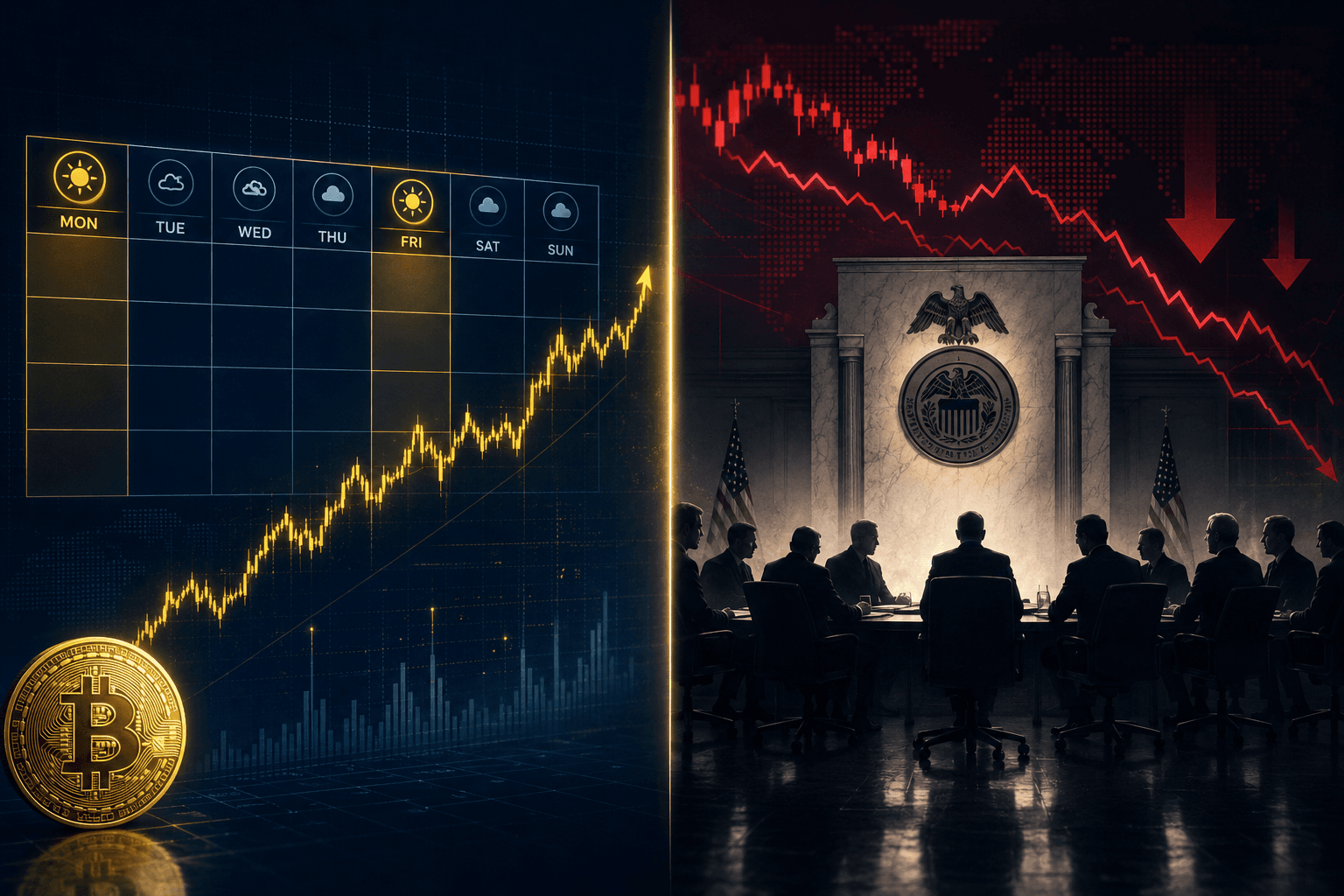
What Are the 2 Timing Trends to Optimize Your Crypto Investing Strategy This Week
The two most actionable timing trends right now are macro-event sensitivity and weekly cycle patterns. Both are grounded in observable market behavior and can be applied without requiring active day trading.
Trend 1: Macro-Event Sensitivity Central bank decisions, particularly FOMC meetings, consistently move crypto prices. On June 17, 2026, the Federal Open Market Committee held the federal funds rate at 3.50%–3.75%. Bitcoin fell to approximately $63,850–$64,400 in the hours that followed, a 2–4% drop. Ethereum declined 2.5–3.5%, and altcoins fell even further due to their higher speculative exposure [1]. This pattern is not new. Each FOMC meeting creates a volatility window that typically spans 24–48 hours before and after the announcement.
Trend 2: Weekly Cycle Patterns Crypto markets show measurable differences in volume and price behavior across days of the week. Institutional desks are most active during traditional business hours (Monday through Friday, U.S. and European sessions). Weekend trading volumes drop, which can amplify price swings in either direction on thin order books.
How Do Timing Trends Affect Cryptocurrency Prices
Timing trends affect crypto prices through two primary mechanisms: liquidity shifts and sentiment catalysts. When liquidity is low (weekends, late-night UTC), even moderate buy or sell orders move prices more than they would during peak hours. When a sentiment catalyst like an FOMC decision hits, the reaction is amplified because algorithmic trading systems respond within milliseconds.
The divergence between price and adoption is worth noting here. Despite macro-driven price pressure in June 2026, institutional adoption of digital assets is accelerating, with traditional financial firms expected to broadly offer Bitcoin and Ethereum to clients [2]. This means price dips driven by timing events do not always reflect underlying demand destruction.
Is There a Best Day of the Week to Invest in Bitcoin
Research and historical data suggest Monday and Tuesday tend to offer slightly lower average entry prices for Bitcoin, while Friday afternoons often see elevated volatility as institutional traders close or rebalance positions before the weekend. This is a probabilistic tendency, not a guarantee.
Weekend prices can appear attractive but carry higher slippage risk because order book depth is thinner. For investors placing larger orders, executing during peak weekday hours reduces the cost of entry.
“Timing awareness is not about predicting the market. It is about avoiding the windows where the odds are most stacked against you.”
What Time of Day Has the Lowest Crypto Transaction Fees
On-chain transaction fees (gas fees for Ethereum, network fees for Bitcoin) are lowest during periods of low network congestion, typically between midnight and 6:00 AM UTC on weekdays. Weekend mornings UTC also see reduced fee pressure.
For exchange-based trades, fees are fixed by the platform, but slippage (the difference between expected and executed price) is lowest during high-liquidity windows: 8:00 AM to 12:00 PM UTC (London open overlap with Asia close) and 1:00 PM to 5:00 PM UTC (New York open overlap with London).
How to Use Timing Strategies for Crypto Without Day Trading
Timing strategies do not require constant monitoring. The most practical approach for non-day traders is a macro-aware dollar-cost averaging (DCA) method:
- Set a regular investment schedule (weekly or bi-weekly)
- Identify upcoming FOMC dates and major macro announcements on the economic calendar
- Shift your scheduled purchase by 48–72 hours if it falls within an FOMC window
- Execute during peak liquidity hours (8:00 AM to 5:00 PM UTC on weekdays) to minimize slippage
- Avoid placing large orders on Friday afternoons or Sunday evenings
This approach keeps the discipline of DCA intact while reducing exposure to the most predictable volatility windows.
Crypto Market Timing vs. Long-Term Holding: Which Is Better
For most retail investors, long-term holding with periodic DCA beats active market timing. The evidence consistently shows that missing even a handful of the best days in any given year significantly reduces total returns. Crypto markets move faster than equities, making mistimed exits costly.
That said, timing awareness adds value at the margins. An investor who avoids buying in the 24 hours before a known FOMC decision is not timing the market aggressively. They are simply avoiding a known risk window. A study published in February 2026 on algorithmic trend-following in crypto markets found that adaptive strategies combining trend signals with portfolio construction achieved a Sharpe ratio of 2.41 over a 36-month backtest, though these results reflect institutional-grade systems rather than retail approaches [8].
Choose timing awareness if: You are making a lump-sum purchase and want to reduce entry risk. Stick to pure DCA if: You are investing small, fixed amounts on a regular schedule and cannot monitor the market.
Common Mistakes When Trying to Time the Crypto Market
- Waiting for the “perfect” entry: Markets rarely return to the exact price an investor is waiting for. Hesitation often costs more than a slightly suboptimal entry.
- Ignoring macro calendars: Buying hours before an FOMC announcement without awareness of the event is an avoidable risk.
- Treating weekend dips as signals: Low-volume weekend drops frequently reverse by Monday without ever confirming a trend.
- Over-weighting short-term patterns: Altcoins like those flagged in June 2026 (Zcash, Ondo Finance, Chainlink) can break from typical weekly patterns due to project-specific news [4].
- Panic-selling during FOMC drops: The post-FOMC dip on June 17, 2026 was sharp but followed a pattern seen in prior rate-hold decisions [1]. Selling into that drop locked in losses for investors who later saw partial recovery.
Do Crypto Timing Patterns Work During Bear Markets
Timing patterns are less reliable in bear markets but not useless. During sustained downtrends, the FOMC sensitivity pattern still holds: rate decisions that disappoint markets (holds when cuts were expected, or hikes) accelerate selling. The weekly cycle pattern weakens because institutional buyers reduce activity, making the Monday recovery effect less consistent.
The most durable bear-market timing rule is avoidance rather than entry timing: stay out of the 48-hour FOMC window, avoid adding to positions on high-volume down days, and wait for at least one confirmed weekly close above a key support level before scaling in.
What Tools Can Track Crypto Price Patterns by Time and Day
Several platforms provide time-based analytics for crypto markets:
| Tool | What It Tracks | Best For |
|---|---|---|
| CoinGlass | Liquidation heatmaps, open interest by hour | Identifying high-risk volatility windows |
| Glassnode | On-chain volume, active addresses by day | Macro cycle and adoption trends |
| TradingView | Candlestick charts with custom time filters | Weekly and daily price pattern analysis |
| Crypto Fear and Greed Index | Daily sentiment score | Gauging entry risk by market mood |
| Etherscan Gas Tracker | Real-time Ethereum gas fees | Timing on-chain transactions for lowest cost |
Why Does Crypto Volume Change at Different Times of the Week
Crypto volume follows human behavior and institutional schedules. The largest trading desks operate during U.S. and European business hours, Monday through Friday. Asian markets add volume during their morning sessions. When these overlap (8:00–11:00 AM UTC), volume peaks. On weekends, retail traders dominate, and volume drops by an estimated 20–40% compared to peak weekday sessions (based on historical exchange data patterns, not a single sourced study).
Institutional activity is growing. As traditional financial firms accelerate their crypto offerings [2], weekday institutional volume is expected to increase further, which may strengthen existing weekly cycle patterns over time.
Can You Really Predict Crypto Price Movements With Timing Data
Timing data improves probability, not certainty. No tool or pattern predicts crypto prices reliably enough to trade on alone. What timing data does is narrow the range of likely outcomes for a given window. For example, knowing that an FOMC decision is 18 hours away does not tell you where Bitcoin will be in a week, but it does tell you that the next 48 hours carry above-average volatility risk [1].
The practical value is in risk reduction, not return maximization. Investors who use timing data to avoid the worst entry windows will not always outperform, but they are less likely to suffer the largest drawdowns.
Is Crypto Market Timing Worth It for Beginners
For beginners, timing the market is generally not worth the effort or the emotional cost. The priority should be establishing a consistent investment habit, understanding the assets being purchased, and building a position over time through DCA.
However, two timing rules are worth learning from day one:
- Check the FOMC calendar before making any lump-sum purchase
- Execute trades during peak liquidity hours to reduce slippage
These two habits take less than five minutes to apply and reduce the most common beginner timing errors without requiring active monitoring.
Timing Strategies for Crypto vs. Stocks: Are They Different
Yes, crypto timing strategies differ from stock timing in three important ways:
- 24/7 markets: Crypto never closes, so there is no opening gap risk, but there is also no forced reset. Sentiment can compound overnight without a circuit breaker.
- Macro sensitivity is faster: Crypto reacted to the June 17, 2026 FOMC decision within hours [1]. Equity markets often take longer to fully price in rate decisions.
- No earnings calendar: Stock timing often revolves around quarterly earnings. Crypto has no equivalent, so macro events and on-chain data carry more weight.
The FOMC sensitivity trend applies to both asset classes, but the speed and magnitude of crypto’s reaction makes calendar awareness more urgent for crypto investors than for most stock investors.
Conclusion
The 2 timing trends to optimize your crypto investing strategy this week are clear and actionable: watch macro-event windows (especially FOMC decisions) and align purchases with weekly liquidity cycles. Bitcoin’s drop to approximately $63,586 following the June 17, 2026 rate hold [1] is a direct, recent example of how predictable these windows can be.
Actionable next steps:
- Add the next FOMC meeting date to your calendar and avoid lump-sum purchases within 48 hours of the announcement
- Schedule regular DCA purchases for Tuesday or Wednesday mornings during peak UTC liquidity hours
- Use CoinGlass or TradingView to review the past four weeks of volume patterns for any asset you plan to buy
- Treat timing data as a risk filter, not a prediction engine
Timing awareness does not replace a sound long-term strategy. But applied consistently, these two trends can meaningfully reduce the chance of buying at the worst possible moment.
FAQ
What are the 2 timing trends to optimize your crypto investing strategy this week? The two trends are macro-event sensitivity (particularly FOMC rate decisions) and weekly price cycle patterns driven by institutional trading activity. Both can be used to identify lower-risk entry windows.
When is the best time of day to buy crypto? Peak liquidity windows (8:00 AM to 5:00 PM UTC on weekdays) offer the lowest slippage. For on-chain transactions, midnight to 6:00 AM UTC typically has the lowest network fees.
Does the FOMC meeting always cause a Bitcoin price drop? Not always, but rate holds or hikes that disappoint market expectations consistently trigger short-term selling. The June 17, 2026 hold caused a 2–4% Bitcoin decline [1].
Is dollar-cost averaging better than timing the market for crypto? For most retail investors, yes. DCA removes the emotional burden of timing and captures average prices over time. Timing awareness is most useful when making lump-sum purchases.
What is the best day of the week to buy Bitcoin? Historical patterns suggest Monday and Tuesday tend to offer slightly lower average prices, but this is a tendency rather than a rule. Avoid Friday afternoons and Sunday evenings due to lower liquidity.
Do timing strategies work for altcoins as well as Bitcoin? Altcoins follow similar macro-event patterns but with greater volatility. Project-specific news can override weekly cycle patterns entirely, making timing less predictable for smaller-cap tokens [4].
How do I find upcoming FOMC meeting dates? The Federal Reserve publishes its full meeting calendar at federalreserve.gov. Most financial calendar apps and platforms like TradingView also list these dates.
Can beginners use timing strategies effectively? Yes, but only the simplest rules: check the FOMC calendar before large purchases and trade during peak liquidity hours. More complex timing strategies require experience and tools that most beginners do not yet have.
Why do crypto prices drop more than stocks after Fed decisions? Crypto markets are more speculative and react faster. Algorithmic trading amplifies moves within hours. The absence of market close also means selling pressure can compound without interruption.
Is the weekend a bad time to buy crypto? Weekend purchases carry higher slippage risk due to lower order book depth. Prices can appear attractive but may reverse quickly once institutional volume returns Monday morning.
References
[1] Bitcoin Dips Altcoins Plunge Full Impact Of June 2026 Fomc Meeting On Crypto – https://www.cryptotimes.io/2026/06/18/bitcoin-dips-altcoins-plunge-full-impact-of-june-2026-fomc-meeting-on-crypto/?utm_source=openai
[2] Exclusive Wall Street Embraces Crypto Banks Bitcoin – https://www.axios.com/2026/06/09/exclusive-wall-street-embraces-crypto-banks-bitcoin?utm_source=openai
[3] Crypto Markets Hold Steady On June Amid Institutional Shifts – https://www.pickaxe.io/resources/news/crypto-markets-hold-steady-on-june-amid-institutional-shifts?utm_source=openai
[4] Best Altcoins June 2026 – https://crypto.com/us/market-updates/best-altcoins-june-2026?utm_source=openai
[5] Top Trending Cryptocurrencies – https://mudrex.com/learn/top-trending-cryptocurrencies/?utm_source=openai
[6] 3 Altcoins To Watch As June Begins With Weak Risk Appetite – https://www.investing.com/analysis/3-altcoins-to-watch-as-june-begins-with-weak-risk-appetite-200681366?utm_source=openai
[7] Crypto In June 2026 Prices Down Adoption Up – https://aminagroup.com/research/crypto-in-june-2026-prices-down-adoption-up/?utm_source=openai
[8] AdaptiveTrend: Systematic Trend-Following in Crypto Markets (arxiv, 2026) – https://arxiv.org/abs/2602.11708?utm_source=openai