Last updated: July 27, 2026
Quick Answer
A crypto bear market is a sustained period where digital asset prices fall 20% or more from recent highs, driven by a combination of macroeconomic pressure, regulatory tightening, and shifting investor sentiment. Understanding crypto bear markets in 2026 and the key reasons for recent declines requires looking at both persistent inflation data and a broader loss of risk appetite across global financial markets. As of July 2026, Bitcoin and the total crypto market cap remain in bear-market territory, with no clear consensus on when a full recovery will begin.
Key Takeaways
- A crypto bear market is defined by a sustained price decline of 20% or more from peak levels, often lasting 12 to 18 months historically.
- The 2026 downturn has been driven by elevated U.S. inflation, aggressive monetary policy, regulatory crackdowns, and weakening retail demand.
- U.S. inflation reached a three-year high in mid-2026, reducing investor appetite for speculative assets like cryptocurrencies [3].
- Bitcoin and Ethereum are the most visible casualties, but smaller altcoins typically suffer steeper percentage losses during bear cycles.
- A bear market differs from a short-term correction: corrections last weeks, bear markets last months to years.
- Historical bear markets (2018, 2022) eventually ended, but recovery timelines varied widely based on macro conditions.
- Buying during a bear market carries risk but has historically rewarded patient, long-term investors.
- Common mistakes include panic selling, over-leveraging, and abandoning diversification strategies.
- Regulation has become a more significant driver of crypto price action in 2026 than in previous cycles.
- Watching on-chain metrics, institutional flows, and macro signals together offers the clearest picture of a potential market bottom.
What Is a Crypto Bear Market and How Long Do They Usually Last
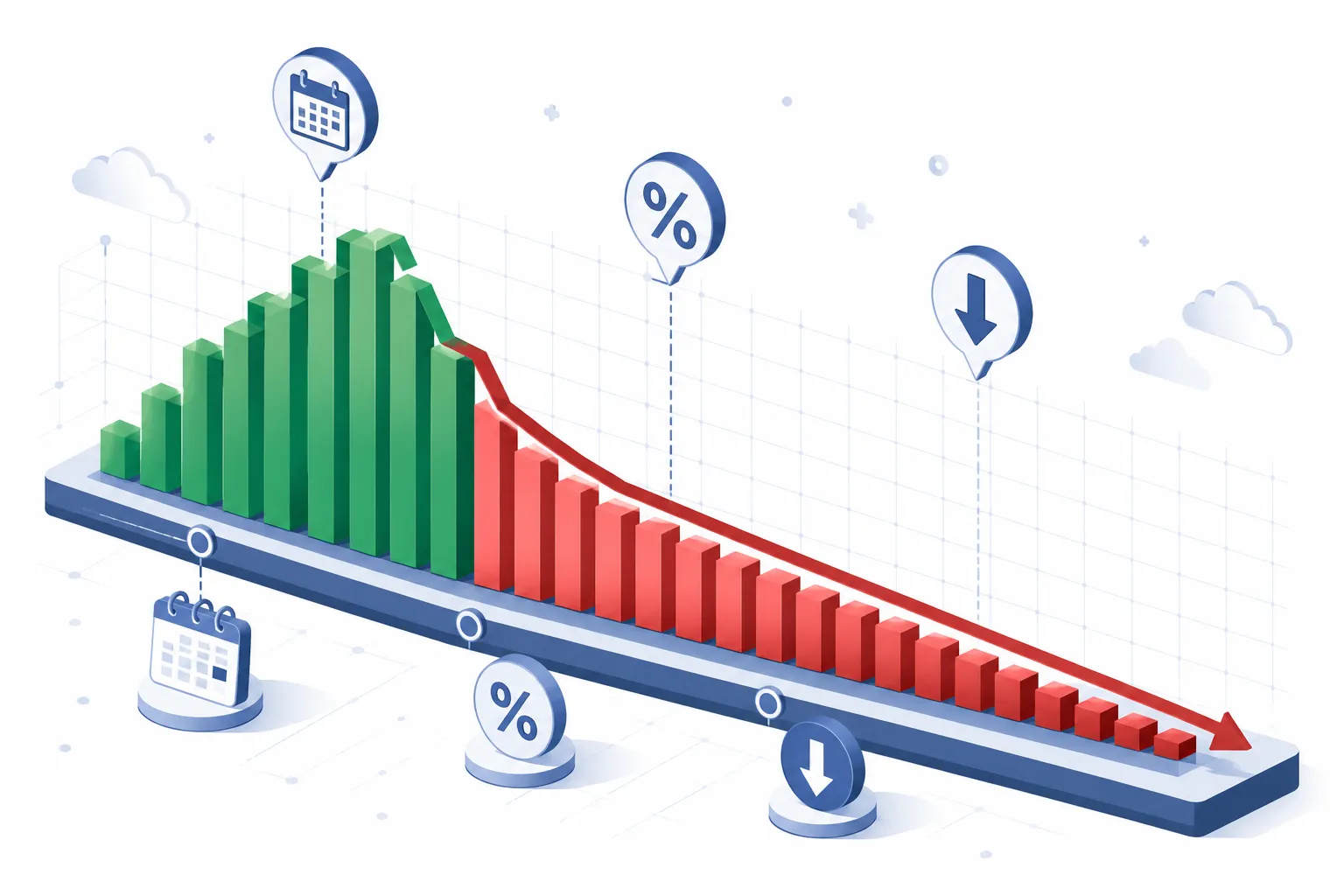
A crypto bear market is a prolonged decline of at least 20% from a recent market peak, accompanied by negative sentiment and reduced trading volume. Unlike stock markets, crypto bear markets tend to be sharper and faster-moving, but also capable of deeper losses.
Typical duration: Historically, crypto bear markets have lasted anywhere from 12 to 24 months. The 2018 bear market ran approximately 13 months before Bitcoin found a sustainable floor. The 2022 cycle stretched closer to 18 months before meaningful recovery began.
Key characteristics of a crypto bear market include:
- Sustained price declines across Bitcoin, Ethereum, and most altcoins
- Declining trading volumes and shrinking market capitalization
- Negative media coverage and reduced retail participation
- Increased regulatory scrutiny as governments respond to market stress
Why Did Crypto Crash in 2026
The 2026 crypto decline stems from a convergence of macroeconomic and market-specific pressures that began building in early 2026. Understanding crypto bear markets in 2026 means recognizing that this is not a single-cause event.
The primary drivers include:
- Persistent inflation: U.S. inflation hit a three-year high in mid-2026 [3], with the Consumer Price Index rising sharply due to energy price surges [3]. Higher inflation keeps the Federal Reserve in a restrictive monetary stance, making risk assets less attractive.
- Interest rate environment: With rates remaining elevated, investors have shifted capital toward bonds and money market instruments, pulling liquidity away from crypto [8].
- Regulatory pressure: Multiple jurisdictions introduced or enforced stricter crypto regulations in 2026, creating uncertainty for exchanges and institutional participants.
- Macro forecasts: Global forecasting groups projected U.S. inflation at approximately 4.2% for 2026, well above Federal Reserve targets [8], signaling that rate cuts remain distant.
- Sentiment collapse: Retail investor confidence dropped sharply after several high-profile exchange issues and project failures in early 2026.
What Causes Bitcoin and Ethereum to Drop in Value
Bitcoin and Ethereum prices fall when selling pressure exceeds buying demand, which can be triggered by macroeconomic shifts, regulatory news, or internal market dynamics.
For Bitcoin specifically:
- It trades as a macro asset, closely correlated with risk-on/risk-off sentiment in traditional markets.
- Rising real interest rates make Bitcoin’s opportunity cost higher compared to yield-bearing assets.
- Miner selling pressure increases during downturns as revenue shrinks.
For Ethereum specifically:
- Network activity and gas fees decline during bear markets, reducing the economic case for holding ETH.
- DeFi and NFT market collapses reduce demand for ETH as a transactional asset.
Both assets are sensitive to large institutional outflows, which tend to accelerate declines once key support levels break.
How Is a Bear Market Different from a Correction
A correction is a short-term price decline of 10% to 20% from a recent high, typically resolving within weeks. A bear market is a deeper, longer decline exceeding 20%, often lasting many months and reflecting a fundamental shift in sentiment or economic conditions.
Quick comparison:
| Feature | Correction | Bear Market |
|---|---|---|
| Price decline | 10% to 20% | 20% or more |
| Duration | Days to weeks | Months to years |
| Cause | Profit-taking, news events | Macro shifts, structural issues |
| Recovery speed | Often rapid | Gradual, uneven |
Is the 2026 Bear Market Worse Than 2022
The 2022 bear market was severe, marked by the collapse of the Terra/LUNA ecosystem, the FTX bankruptcy, and a global rate-hiking cycle. The 2026 downturn shares some structural similarities but differs in key ways.
Similarities to 2022:
- Both were triggered partly by tightening monetary policy and inflation concerns.
- Both saw significant altcoin collapses alongside Bitcoin and Ethereum declines.
Key differences in 2026:
- Regulatory frameworks are more developed, meaning enforcement actions carry more weight.
- Institutional participation is larger, so institutional exits create bigger sell-side pressure.
- Inflation in 2026 has proven more persistent than many analysts expected, with forecasts revised upward multiple times [8][9].
Whether 2026 is “worse” depends on the metric. In percentage terms, the 2022 bear market saw Bitcoin fall roughly 75% from its all-time high. The 2026 cycle’s full depth is still being determined as of July 2026.
Which Cryptocurrencies Are Most Affected by Bear Markets
Bitcoin and Ethereum are the most visible casualties, but smaller-cap altcoins typically suffer the steepest percentage losses. This pattern holds across every major bear cycle.
General vulnerability ranking:
- Micro-cap altcoins (highest risk): Often lose 90% or more, many go to zero.
- Mid-cap altcoins: Typically lose 70% to 85% from peak.
- Ethereum: Usually loses 60% to 80% from peak.
- Bitcoin: Generally the most resilient, losing 50% to 75% from peak.
Stablecoins are designed to hold their peg and are not directly affected by bear market price action, though they carry their own counterparty and regulatory risks.
How Does Regulation Impact Crypto Bear Markets
Regulatory actions are a significant amplifier of crypto bear markets, not just a background factor. In 2026, tighter enforcement in the U.S. and Europe has added a persistent headwind to price recovery.

Key regulatory impacts in 2026 include:
- Exchange compliance costs rising, reducing profitability and investor confidence.
- Uncertainty over asset classification (security vs. commodity) delaying institutional product launches.
- International regulatory divergence creating arbitrage risks and market fragmentation.
Regulatory clarity, when it eventually arrives, has historically been a catalyst for recovery. The absence of that clarity in 2026 is one reason sentiment remains cautious.
What Should I Do with My Crypto During a Bear Market
The right approach depends on individual risk tolerance, investment horizon, and portfolio size. There is no universal answer, but several principles apply broadly.
Practical steps for bear market management:
- Audit your portfolio: Remove positions in projects with weak fundamentals or unclear use cases.
- Avoid leverage: Margin trading during a bear market dramatically increases liquidation risk.
- Dollar-cost average (DCA) cautiously: Spreading purchases over time reduces the risk of buying at a temporary bottom that continues falling.
- Hold stablecoins as dry powder: Having liquid, stable capital allows you to act when conditions improve.
- Stay informed on macro signals: Inflation data [1][2] and Federal Reserve policy decisions directly affect crypto market direction in 2026.
Common mistake: Panic selling at the lowest point locks in losses and removes the possibility of participating in the eventual recovery.
Should I Buy Crypto During a Bear Market or Wait
Historically, buying during bear markets has produced strong long-term returns for investors who held through the recovery. However, timing the exact bottom is nearly impossible.
Choose to buy if:
- You have a multi-year investment horizon (3 years or more).
- You are using capital you can afford to keep illiquid.
- You are spreading purchases over time rather than deploying all at once.
Wait if:
- You need the capital within 12 months.
- You are already over-allocated to crypto relative to your overall portfolio.
- Macro conditions (inflation, rate policy) show no signs of easing.
How Do I Know When a Bear Market Is Ending
No single signal confirms a bear market bottom, but several indicators together suggest conditions are improving.
Signals to watch:
- Bitcoin dominance stabilizes and begins to decline (capital rotating into altcoins).
- On-chain metrics show long-term holders accumulating rather than distributing.
- Inflation data trends downward, signaling potential rate relief [4][5].
- Trading volumes increase on up days rather than down days.
- Institutional inflows into Bitcoin ETFs or similar products resume.
A confirmed recovery typically requires multiple weeks of higher highs and higher lows, not just a single sharp rally.
What Are Common Mistakes People Make During Crypto Downturns
Bear markets are where most long-term crypto wealth is either protected or destroyed. The mistakes below are consistent across every cycle.
- Panic selling: Selling at or near the bottom after holding through most of the decline.
- Catching falling knives: Buying aggressively early in a downturn before the bottom is established.
- Ignoring macro context: Treating crypto as isolated from interest rates and inflation data [6][7].
- Over-concentrating in one asset: Lack of diversification amplifies losses.
- Abandoning research: Continuing to hold projects with deteriorating fundamentals out of attachment rather than analysis.
Can You Make Money During a Bear Market in Crypto
Yes, but the strategies that work in bear markets are different from bull market approaches and carry their own risks.
Approaches used by experienced participants:
- Short selling: Profiting from price declines via futures or options, though this requires sophisticated risk management.
- Stablecoin yield: Earning yield on stablecoins through lending platforms, though platform risk must be assessed carefully.
- Accumulation for the next cycle: Building positions in high-conviction assets at lower prices, with the goal of selling into the next bull market.
Bear markets reward patience and preparation more than active trading for most retail investors.
What Historical Events Triggered Past Crypto Bear Markets
Every major crypto bear market has had a distinct catalyst, though macroeconomic conditions usually set the stage.
- 2018: The ICO bubble burst, regulatory crackdowns in Asia, and the end of speculative excess following Bitcoin’s 2017 peak.
- 2020 (brief): The COVID-19 pandemic triggered a sharp but short decline in March 2020, followed by rapid recovery.
- 2022: The collapse of Terra/LUNA wiped out tens of billions in market cap, followed by the FTX bankruptcy and a global rate-hiking cycle.
- 2026: Persistent inflation [3], elevated interest rates [8], and regulatory enforcement actions combined to suppress risk appetite.
Each cycle has ended, but recovery timelines ranged from under a year (2020) to nearly two years (2022).
Conclusion
Understanding crypto bear markets in 2026 and the key reasons for recent declines comes down to a clear picture: elevated inflation [3], restrictive monetary policy [8], regulatory pressure, and weakened retail sentiment have combined to create a sustained downturn. This is not unprecedented. Every previous crypto bear market ended, and each recovery rewarded investors who stayed informed and avoided panic-driven decisions.
Actionable next steps for investors in July 2026:
- Review your portfolio and exit positions in projects with weak fundamentals.
- Track monthly inflation reports and Federal Reserve guidance [1][5] as leading indicators for potential recovery.
- If buying, use a dollar-cost averaging strategy rather than lump-sum entries.
- Keep a portion of your portfolio in stablecoins to preserve flexibility.
- Set clear criteria for what would signal a trend reversal before making significant new commitments.
Bear markets are uncomfortable, but they are also where the foundation for the next cycle is built. Staying disciplined, informed, and patient remains the most reliable strategy.
FAQ
What is the definition of a crypto bear market? A crypto bear market is a sustained decline of 20% or more from a recent price peak, typically lasting months and accompanied by negative sentiment and reduced market activity.
How long do crypto bear markets typically last before recovery? Historically, crypto bear markets have lasted between 12 and 24 months. The 2018 cycle lasted roughly 13 months; the 2022 cycle lasted closer to 18 months before meaningful recovery.
Why is crypto falling in 2026? The primary causes are persistent U.S. inflation at a three-year high [3], elevated interest rates reducing risk appetite [8], tighter regulatory enforcement, and weakened retail investor confidence.
Is it safe to buy Bitcoin during a bear market? Buying Bitcoin during a bear market has historically produced strong long-term returns, but only for investors with a multi-year horizon and capital they do not need in the short term.
What is the difference between a crypto correction and a bear market? A correction is a decline of 10% to 20% lasting days to weeks. A bear market is a decline exceeding 20% lasting months to years, driven by structural rather than temporary factors.
Which crypto assets hold up best during a bear market? Bitcoin is generally the most resilient major asset, followed by Ethereum. Smaller altcoins typically suffer the steepest losses, often exceeding 80% to 90% from peak.
How does inflation affect crypto prices? High inflation keeps central banks in a rate-hiking or rate-holding stance, which reduces liquidity and pushes investors toward lower-risk, yield-bearing assets, away from speculative assets like crypto [1][6].
Can regulation end a crypto bear market? Regulatory clarity can act as a recovery catalyst by reducing uncertainty and encouraging institutional participation. Ongoing regulatory ambiguity, as seen in 2026, tends to prolong downturns.
What signals suggest a crypto bear market is ending? Key signals include stabilizing on-chain accumulation by long-term holders, increasing volume on up days, declining inflation readings [4][5], and institutional inflows resuming into Bitcoin-related products.
Should I sell all my crypto during a bear market? Selling everything locks in losses and eliminates upside exposure to recovery. A more measured approach, such as reducing high-risk positions while maintaining core holdings, is generally more effective for long-term investors.
References
[1] CPI Inflation Report May 2026 – https://www.cnbc.com/2026/06/10/cpi-inflation-report-may-2026.html
[2] Inflation CPI – https://tradingeconomics.com/united-states/inflation-cpi
[3] US Inflation Hits New Three Year High Amid Energy Price Surge – https://www.aljazeera.com/economy/2026/6/10/us-inflation-hits-new-three-year-high-amid-energy-price-surge
[4] PNC Economics Research Consumer Price Inflation 13 February 2026 – https://www.pnc.com/content/dam/pnc-com/pdf/aboutpnc/EconomicReports/EconomicUpdates/2026/PNC_Economics_Research_Consumer_Price_Inflation_13_February_2026.pdf
[5] PNC Economics Research CPI 10 June 2026 – https://www.pnc.com/content/dam/pnc-com/pdf/aboutpnc/EconomicReports/EconomicUpdates/2026/PNC_Economics_Research_CPI_10_June_2026.pdf
[6] Inflation June 2026 Why Are Prices Still High – https://www.chase.com/personal/investments/learning-and-insights/article/inflation-june-2026-why-are-prices-still-high
[7] Here’s The Inflation Breakdown For January 2026 In One Chart – https://www.cnbc.com/2026/02/13/heres-the-inflation-breakdown-for-january-2026-in-one-chart.html
[8] Global Forecasting Group Sees US Inflation At 4.2% This Year Much Higher Than Fed Estimate – https://www.cnbc.com/2026/03/26/global-forecasting-group-sees-us-inflation-at-4point2percent-this-year-much-higher-than-fed-estimate
[9] Goldman Just Released Its Inflation Playbook For The Rest Of 2026 – https://www.thestreet.com/economy/goldman-just-released-its-inflation-playbook-for-the-rest-of-2026