Last updated: August 24, 2026
Quick Answer: On August 22, 2026, the crypto market suffered its worst flash crash since October 2025, wiping out approximately $1.71 billion in leveraged positions within 24 hours and affecting nearly 282,000 traders. Bitcoin, Ethereum, and XRP led the losses as cascading margin calls tore through derivatives markets in minutes.
Key Takeaways
- The crypto market crash on August 22, 2026 liquidated approximately $1.71 billion in positions across major exchanges within 24 hours, per CoinGlass data [1]
- About 281,846 traders were affected by forced closures during the event [1]
- Total crypto market cap dropped from roughly $2.68 trillion to $2.55 trillion in approximately six minutes [1]
- XRP suffered the sharpest single-asset drop, falling about 37% to roughly $0.60, triggering around $500 million in long liquidations [4]
- More than $476 million in leveraged long positions were wiped out in a single 60-minute window, even though Bitcoin’s spot price fell only about 2.5% [5]
- August 2026 was an unusually volatile month overall, with multiple liquidation events including a $360 million cascade on August 1 [10]
- The primary driver was extreme derivatives leverage combined with crowded directional bets, where small price moves triggered automatic, cascading margin calls [1][5]
- Binance concentrated the bulk of forced closures during the crash [4]
- Traders using high leverage are most at risk; spot holders were not subject to forced liquidation
- Protecting capital means reducing leverage, setting stop-losses, and monitoring margin ratios before volatility spikes
What Caused the Crypto Market Crash in August 2026
The August 22, 2026 crash was driven by a combination of extreme leverage in derivatives markets, crowded long positions, and a rapid price trigger that set off automatic margin calls across major exchanges. When Bitcoin’s spot price fell just 2.5%, the amplified effect on highly leveraged positions caused hundreds of millions of dollars in forced closures within minutes [5].
Several structural conditions made the crash worse:
- Elevated open interest: In mid-August 2026, crypto futures open interest had already dropped by roughly $3 billion, accompanied by about $308 million in forced liquidations, signaling a fragile market [6]
- Long-side crowding: As early as August 1, roughly 65% of liquidations were long positions, showing that traders were heavily betting on price increases [10]
- Cascading margin calls: Once the first wave of liquidations began, the forced selling pushed prices lower, triggering additional liquidations in a self-reinforcing cycle [1]
- Macroeconomic sensitivity: Crypto markets in 2026 have remained highly reactive to broader risk sentiment, with any sudden shift capable of sparking rapid deleveraging
The weekend timing of the August 22 event likely reduced liquidity, amplifying the price impact of each sell order.
What Does Liquidation Mean in Crypto
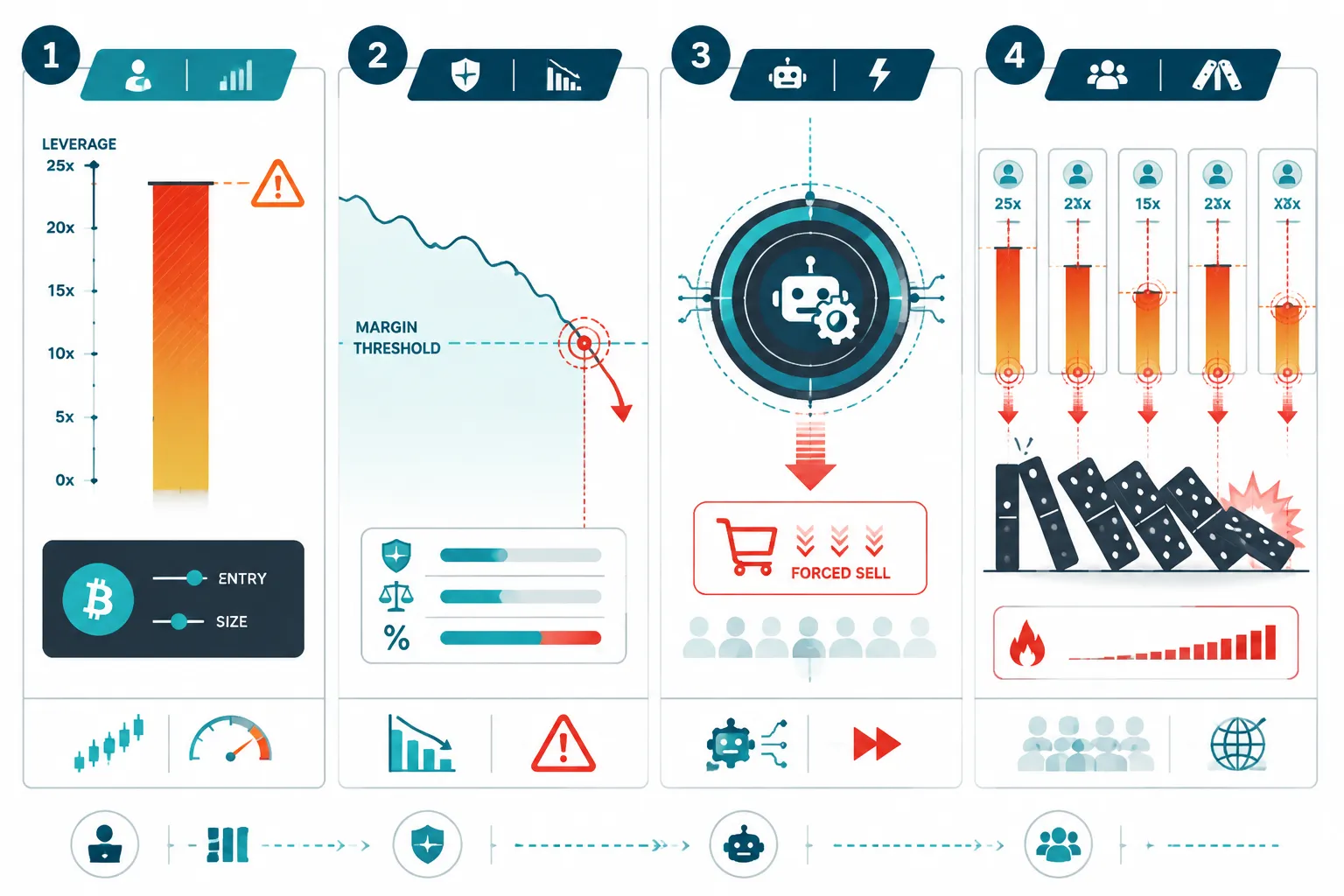
In crypto trading, liquidation occurs when an exchange automatically closes a trader’s leveraged position because their account balance can no longer cover potential losses. It is not the same as simply losing money on a trade; it is a forced closure triggered by the exchange when a margin threshold is breached.
How it works in practice:
- A trader opens a leveraged position, for example, 10x long on Bitcoin
- The exchange requires a minimum margin balance to keep the position open
- If the asset price moves against the position and the margin falls below the required level, the exchange closes the position automatically
- The trader loses their deposited margin, and in some cases owes additional fees
The August 22 crash illustrates how quickly this can scale: more than $476 million in long positions were liquidated in just 60 minutes, even though Bitcoin’s price only dropped about 2.5% [5]. At 10x leverage, a 2.5% price drop translates to a 25% loss on margin, enough to trigger liquidation for many positions.
Why Did $1.7 Billion Get Liquidated in the August 2026 Crash
The Crypto Market Sees $1.7 Billion Liquidated in August 2026 Crash primarily because an unusually large number of traders held highly leveraged long positions simultaneously. When prices dropped, the cascade effect meant each wave of forced selling pushed prices further down, triggering the next wave.
Key factors behind the $1.71 billion total [1]:
- High leverage ratios across Bitcoin, Ethereum, and altcoin futures
- Concentrated long bets that left the market one-sided and vulnerable
- Thin weekend liquidity that magnified price moves
- XRP’s 37% flash crash, which alone generated about $500 million in long liquidations within minutes [4]
- Automated exchange systems that execute margin calls instantly, with no human delay
The August 22 event was preceded by warning signs. On August 1, a $360 million cascade wiped out more than 90,000 traders, with about $100 million in Bitcoin longs among the casualties [10]. The market did not fully deleverage before the larger crash arrived.
Which Cryptocurrencies Were Hit Hardest in August 2026
Bitcoin, Ethereum, and XRP bore the largest absolute losses during the August 22 crash, though XRP experienced the most severe percentage decline [1][4].
| Asset | Key Impact | Notable Stat |
|---|---|---|
| Bitcoin (BTC) | Spot price fell ~2.5%; leveraged longs wiped out | $476M+ liquidated in 60 minutes [5] |
| Ethereum (ETH) | Significant long liquidations across futures | Major contributor to $1.71B total [1] |
| XRP | Flash crash of ~37%, falling to ~$0.60 | ~$500M in long liquidations [4] |
| Altcoins | Broad sell-off across smaller cap assets | Contributed to $108B market cap erasure [1] |
XRP’s 37% drop stands out as the most dramatic single-asset move. Its high retail leverage exposure and thinner liquidity compared to Bitcoin made it especially vulnerable to rapid cascading sells [4].
What Happened to Bitcoin in August 2026
August 2026 was a tale of two extremes for Bitcoin. In the days just before the August 22 crash, Bitcoin had actually surged sharply. Around August 19, Bitcoin rallied toward the high-$60,000s, driven partly by a massive short squeeze that erased roughly $2.74 billion in short positions over 24 hours and was described as the eighth-largest liquidation event in crypto history [7][8].
Then the reversal came. By August 22, leveraged long positions had piled up, and when selling pressure hit, Bitcoin’s spot price dropped about 2.5%, which was enough to trigger more than $476 million in long liquidations within a single hour [5]. The total market cap fell from approximately $2.68 trillion to $2.55 trillion in roughly six minutes [1].
The August 2026 pattern demonstrates Bitcoin’s dual role: it can be the engine of both short squeezes and long liquidation cascades, depending on which side of the market is over-leveraged at any given moment.
Is This the Worst Crypto Crash Ever
No. While the Crypto Market Sees $1.7 Billion Liquidated in August 2026 Crash was severe, it was not the largest liquidation event on record. For context, the August 19, 2026 short squeeze itself generated approximately $2.99 billion in forced closures in 24 hours, making it the eighth-largest liquidation event in crypto history according to CoinGlass-based data [7][9].
The August 22 event was notable as the biggest flash crash since October 2025, but the crypto market has seen larger absolute liquidation totals during the 2021 bull market peak and subsequent crashes. What made August 22 distinctive was the speed: roughly $108 billion in market cap erased in about six minutes [1].
What Is the Difference Between a Crash and a Correction
A correction is typically defined as a price decline of 10% to 20% from a recent peak. A crash involves a faster, more severe drop, often 20% or more, and is usually accompanied by panic selling, high liquidation volumes, and a breakdown in normal market structure.
The August 22 event qualifies more as a flash crash than a structural correction. Bitcoin’s spot price fell only about 2.5%, but the leveraged derivatives market amplified that into a $1.71 billion liquidation event [1][5]. The broader market cap drop of roughly $108 billion in six minutes reflects crash-level speed, even if the percentage decline was moderate by historical standards.
Choose the right label based on:
- Duration: corrections unfold over days or weeks; crashes happen in hours or minutes
- Leverage involvement: crashes typically involve mass liquidations; corrections may not
- Recovery speed: flash crashes often see partial recovery within hours; structural corrections take longer
Should I Sell My Crypto During a Market Crash
Selling during a crash locks in losses and often means selling near the bottom. For spot holders, the better question is whether the original investment thesis has changed, not whether the price has dropped.
That said, the answer depends on the individual’s situation:
- If holding spot (no leverage): Selling during a flash crash is rarely optimal. Prices often recover partially within hours to days after liquidation-driven drops
- If holding leveraged positions: Monitor margin ratios closely. Do not wait for the exchange to liquidate; reduce position size proactively if volatility spikes
- If near a margin call: Add margin or reduce exposure before the threshold is breached, not after
The August 22 crash is a clear example of why leverage amplifies urgency. Spot Bitcoin holders saw a 2.5% dip; leveraged long holders lost their entire margin in some cases [5].
How Long Do Crypto Crashes Usually Last
Flash crashes driven by liquidation cascades, like the August 22, 2026 event, often see partial price recovery within hours. The underlying mechanism is self-limiting: once leveraged positions are closed, the forced selling stops and prices stabilize.
Broader structural bear markets last much longer, typically six to eighteen months based on historical cycles. The August 22 event was a liquidity-driven flash crash, not a fundamental shift in market structure, which suggests a shorter recovery window than a full bear market.
How to Protect Your Crypto From Liquidation

Protecting against liquidation requires active risk management before volatility hits, not during it. The August 2026 crash affected nearly 282,000 traders who were caught unprepared [1].
Practical steps to reduce liquidation risk:
- Use lower leverage. At 2x to 3x, a price move of 30% to 50% is needed to trigger liquidation. At 10x, a 5% to 10% move can wipe out margin
- Set stop-loss orders. Manually close positions before the exchange does it automatically, preserving some capital
- Monitor margin ratios daily. Most exchanges display a margin ratio or health score; keep it well above the liquidation threshold
- Avoid holding large leveraged positions overnight or over weekends, when liquidity is lower and price gaps are more likely
- Diversify across assets. XRP’s 37% drop [4] would have been catastrophic for a trader concentrated in XRP futures; spreading exposure reduces single-asset risk
- Use isolated margin instead of cross margin. Isolated margin limits losses to the amount allocated to a single trade; cross margin can drain the entire account
Common mistake: Adding more margin to a losing position rather than cutting it. This delays liquidation but increases total capital at risk.
How Do Crypto Exchanges Handle Liquidations
When a trader’s margin falls below the required maintenance level, the exchange’s automated liquidation engine takes over. The process is fast and does not require human approval.
Typical exchange liquidation process:
- The system continuously monitors all open leveraged positions
- When margin equity drops to the maintenance margin level, a liquidation order is triggered
- The exchange closes the position at market price, using the trader’s remaining margin to cover the loss
- If the market moves so fast that the position closes at a worse price than the margin covers, the exchange absorbs the shortfall through an insurance fund
- If the insurance fund is depleted, some exchanges use “auto-deleveraging,” which closes profitable positions on the opposite side to cover the gap
Binance handled the bulk of forced closures during the August 22 crash [4], and its insurance fund mechanisms were active throughout the event. Traders can review exchange-specific liquidation rules in their platform’s documentation before opening leveraged positions.
How to Avoid Getting Liquidated on Leverage Trading
Avoiding liquidation is about position sizing and preparation. The traders most affected by the August 2026 crash were those holding maximum leverage with no stop-loss orders during a period of already-elevated market instability [5][6].
Decision rules:
- Use leverage above 5x only if actively monitoring the position in real time
- If holding overnight, reduce leverage to 2x or lower
- Never allocate more than 5% to 10% of total portfolio to a single leveraged position
- Check open interest data on CoinGlass before entering large positions; rising open interest with one-sided bets signals elevated liquidation risk
Where Can I See Real-Time Liquidation Data
CoinGlass is the primary source for real-time and historical crypto liquidation data. It tracks forced closures across major exchanges including Binance, OKX, Bybit, and others, broken down by asset and direction (long vs. short).
Other useful resources:
- Coinglass.com: Liquidation heatmaps, open interest charts, funding rates
- Exchange dashboards: Binance, Bybit, and OKX each publish liquidation data within their trading interfaces
- CryptoBriefing and CryptoRank: Publish analysis of major liquidation events with sourced data [1][5][6]
Monitoring funding rates alongside liquidation data gives early warning of crowded trades. Extremely positive funding rates mean longs are paying shorts, which signals long-side crowding and elevated crash risk.
What Are Common Mistakes People Make During Crypto Crashes
The August 2026 events reveal several repeating errors:
- Holding maximum leverage into a volatile period. The August 1 warning event [10] gave traders three weeks of advance notice that the market was fragile; many ignored it
- Panic selling spot holdings at the bottom of a flash crash, then missing the recovery
- Adding to losing leveraged positions instead of cutting them
- Ignoring funding rates and open interest data that signal crowded trades
- Trading illiquid altcoins with high leverage. XRP’s 37% flash crash [4] was partly a liquidity problem; thinner order books mean larger price gaps when selling pressure hits
- No stop-loss orders. Automated stops execute faster than any manual response during a fast-moving crash
Frequently Asked Questions
What exactly happened on August 22, 2026 in the crypto market? On August 22, 2026, crypto markets suffered a flash crash that erased roughly $108 billion in market cap in about six minutes, with $1.71 billion in leveraged positions liquidated within 24 hours and nearly 282,000 traders affected, per CoinGlass data [1].
How much did Bitcoin fall on August 22, 2026? Bitcoin’s spot price fell approximately 2.5% during the flash crash, but the leveraged derivatives market amplified that into more than $476 million in long liquidations within a single hour [5].
Why was XRP hit so hard in August 2026? XRP experienced a flash crash of about 37%, falling to roughly $0.60, which triggered approximately $500 million in long-position liquidations in minutes. Thinner liquidity and high retail leverage exposure made XRP especially vulnerable [4].
Is $1.7 billion in liquidations a record? No. The August 19, 2026 short squeeze generated approximately $2.99 billion in liquidations in 24 hours, which ranks as the eighth-largest liquidation event in crypto history [7][9]. The August 22 event was the largest flash crash since October 2025 [1].
What exchange had the most liquidations during the August 2026 crash? Binance concentrated the bulk of forced closures during the August 2026 crash events [4].
Can spot crypto holders get liquidated? No. Liquidation only applies to leveraged positions opened through margin or futures trading. Spot holders can lose value if prices fall, but their positions are not forcibly closed by an exchange.
What is a liquidation cascade? A liquidation cascade occurs when forced closures push prices lower, which triggers additional liquidations, which push prices lower again. The August 22 crash is a textbook example: a 2.5% Bitcoin price drop cascaded into $1.71 billion in total liquidations [1][5].
How quickly did the market recover after August 22, 2026? Partial recovery began within hours, consistent with the self-limiting nature of liquidation-driven flash crashes. However, forced deleveraging continued the following day, with about $995 million in positions liquidated on August 23, including roughly $721 million in longs.
What warning signs preceded the August 2026 crash? Key warning signs included a $360 million liquidation cascade on August 1 [10], a $3 billion drop in futures open interest in mid-August [6], and extremely crowded long positioning across Bitcoin, Ethereum, and XRP.
Should I use leverage in crypto markets? Leverage amplifies both gains and losses. The August 2026 events show that even a 2.5% price move can wipe out a highly leveraged position entirely [5]. Traders who use leverage should keep ratios low, set stop-losses, and never risk more than they can afford to lose.
Conclusion
The Crypto Market Sees $1.7 Billion Liquidated in August 2026 Crash stands as a sharp reminder of how quickly leveraged positions can unravel when market conditions shift. Nearly 282,000 traders were affected in 24 hours, not because crypto fundamentals collapsed, but because excessive leverage and crowded directional bets created a structure where even a modest price move triggered a billion-dollar cascade [1][5].
Actionable next steps for traders and investors:
- Audit your current leverage. If any position is above 3x, evaluate whether the risk is justified given current market volatility
- Set stop-loss orders on all leveraged trades before the next volatility event, not during it
- Check CoinGlass regularly for open interest and funding rate data; these metrics provide early warning of crowded trades
- Keep the majority of crypto holdings in spot, where liquidation is not a risk
- Study the August 2026 timeline as a case study in cascade risk, particularly the sequence from August 1 through August 23
The August 2026 crash was severe but not unprecedented. Understanding its mechanics, from margin thresholds to cascade dynamics, is the most practical defense any crypto market participant can build.
References
[1] Bitcoin Ethereum And Xrp Crash As 1 7b Got Liquidated In 24 Hours – https://cryptorank.io/news/feed/0a7b2-bitcoin-ethereum-and-xrp-crash-as-1-7b-got-liquidated-in-24-hours
[2] Short Squeeze Sends Bitcoin To 72000 And Erases 1 6 Billion – https://www.thestreet.com/crypto/markets/short-squeeze-sends-bitcoin-to-72000-and-erases-1-6-billion
[3] 3 Billion Short Squeeze Anatomy Crypto Biggest Liquidation 2021 2 – https://crypto.news/3-billion-short-squeeze-anatomy-crypto-biggest-liquidation-2021-2/
[4] Xrp Flash Crash 500 Million Liquidated – https://cryptorank.io/news/feed/67db4-xrp-flash-crash-500-million-liquidated
[5] 476m Crypto Long Liquidations One Hour – https://cryptobriefing.com/476m-crypto-long-liquidations-one-hour/
[6] Crypto Open Interest Drops 3b Liquidations – https://cryptobriefing.com/crypto-open-interest-drops-3b-liquidations/
[7] Binance Square Post – https://www.binance.com/en-IN/square/post/357667597087345
[8] Bitcoin Surges Most Since March Ahead Of White House Meeting – https://www.bloomberg.com/news/articles/2026-08-19/bitcoin-surges-most-since-march-ahead-of-white-house-meeting
[9] Cryptos Biggest Liquidation Event Inside Flush – https://coindoo.com/cryptos-biggest-liquidation-event-inside-flush/
[10] Crypto News Review 2026 08 01 – https://coinvado.com/en/news-reviews/crypto-news-review-2026-08-01